Mercedes-AMG A45 W176: The Ultimate Tuning Guide to the Radical Hot Hatch
- The most cost-effective Mercedes A45 AMG tuning is aesthetic and bolt-on: roof spoiler, trunk spoiler, mirror caps, paddle shifters, shift knob.
- Two generations not to be confused: W176 (2013-2018, M133 engine, 360 then 381 hp) and W177 (2019-2025, M139 engine, 387 then 421 hp). The parts are not interchangeable.
- Realistic budget: 400 to 800 EUR for a visual pack, 1,500 to 3,000 EUR for a complete project with wheels and interior.
- In France, a reversible and drill-free aesthetic modification does not pose a problem at the technical inspection. Exhaust and lighting modifications do.
- The manufacturer's warranty does not generally drop: the part in question may be excluded, and the manufacturer must provide proof.
- The golden rule: start with the roof spoiler + mirror caps duo, it's what transforms the silhouette the most for the least money.
The Mercedes-AMG A45 W176 is 360 horsepower in 2013 then 381 horsepower after the 2015 facelift, in a 4.36-meter bodywork. It is also the most extreme sports compact ever released from the factory in 2013. Yet, many owners want to go further: refine the visual signature, gain aerodynamics, and personalize the interior. This guide explains how to intelligently tune your A45 AMG W176, without touching the engine, with approved and 100% bolt-on accessories. We also cover the W177 generation (2019+), the carbon traps, the exhaust issue, the homologation in France and the real budget by project level.
Table of Contents
- Why tune your Mercedes A45 AMG?
- W176 or W177: identify your generation before buying
- The roof spoiler: immediate AMG signature
- The trunk spoiler: aero and style
- Diagram: how the spoiler improves aerodynamics
- Paddle shifters: take control
- Mirror caps: the carbon touch
- The A45 AMG shift knob: premium detail
- Body kit, blades and diffuser
- Carbon on an A45: where to put it, or avoid it
- Exhaust and sound: what is legal in France
- Interior: steering wheel, seats, sills, ambiance
- Wheels and tires: dimensions, offset, mounting
- Manufacturer's warranty and modifications
- Homologation and technical inspection
- Maintaining a modified A45
- Total budget: how much to plan?
- Three project levels, three budgets
- The 8 mistakes not to make
- FAQ: 12 questions about A45 AMG tuning
- 4Matic and 7G-DCT gearbox: what really turns
- Is the A45 engine a Renault engine?
- Reliability: what to check before spending
- Real consumption and effect of accessories
- Stage 1, Stage 2: what French law says
- Twelve questions about A45 mechanics
- To go further
Why tune your Mercedes A45 AMG W176?
The first generation A45 AMG (2013-2018) arrived with already affirmed visual codes: 18-inch wheels as standard and 19-inch as an option, red AMG calipers, quad exhaust outlets. But Mercedes deliberately kept a discreet silhouette to appeal to a wider clientele than just the track. Result: at 30,000 km, many owners want to regain a more radical visual presence, without distorting the car.
The 3 main motivations that come back:
- Visual affirmation: an A45 without a roof spoiler almost goes unnoticed next to a standard A-Class. A few well-chosen accessories are enough to clearly reposition it as an AMG.
- Functional aerodynamics: beyond 130 km/h, a well-designed roof spoiler reduces rear lift and really stabilizes the car.
- Resale: an A45 whose visible wear parts have been refurbished (paddles, mirror caps, shift knob) looks better in the listing. We do not publish a percentage of added value: the rating depends on the mileage, the maintenance history and the current market, not the accessories.
There is a fourth reason, less confessed but just as legitimate: wear of time. A 2014 A45 is now over ten years old. The glossy black plastics get micro-scratched, the mirror caps yellow from UV rays, the leather of the shift knob gets shiny, the plastic paddles get loose. Replacing these parts with higher quality versions is not just tuning: it's an aesthetic refurbishment. Many owners approach the subject through this lens, and discover along the way that they can take advantage of it to upgrade rather than simply replace with the same.
Finally, it must be said a word on what aesthetic tuning is not. It does not make the car faster. It does not change the chassis behavior. It does not compensate for neglected maintenance. An A45 whose 7G-DCT gearbox clutch starts to slip will not be saved by a carbon spoiler. The hierarchy of priorities, on a 380-horsepower compact, remains: healthy mechanics first, quality tires next, aesthetics finally. This guide starts from the premise that the first two points are already settled.
W176 or W177: identify your generation before buying
It's the number one mistake of A45 parts buyers: ordering a spoiler or a mirror cap without checking the chassis code. The two generations look similar from afar, but no bodywork part is interchangeable between them. Here is how to decide in ten seconds.
| Criterion | A45 W176 (2013-2018) | A45 / A45 S W177 (2019-2025) |
|---|---|---|
| Engine | M133 2.0 turbo | M139 2.0 turbo |
| Power | 360 hp then 381 hp (2015 facelift) | 387 hp (A45) / 421 hp (A45 S) |
| Gearbox | 7G-DCT dual clutch | AMG Speedshift 8G-DCT |
| Rear lights | Single L-shaped block, horizontal | Thinner block, two-line signature |
| Grille | Single slat (Diamond as an option) | Panamericana with vertical slats |
| Hatch | Short integrated spoiler | More pronounced integrated spoiler, double level |
| Parts compatibility | Shared with A180/A200/A250 W176 | Shared with A180/A200/A250 W177 |
The infallible method remains the chassis number (VIN), visible at the bottom of the windshield on the driver's side or on the registration card in box E. Positions 4 to 8 encode the series: 176 for the first generation, 177 for the second. It's more reliable than the year of registration, because the transition model years (end of 2018, beginning of 2019) mix the two. An A45 registered in January 2019 can perfectly be a W176 produced in October 2018.
Another subtlety: within the W176 itself, there is a break at the mid-2015 facelift. The front and rear bumpers, the lights and certain trim parts differ between a pre-facelift (2013-2015) and a post-facelift (2015-2018). The roof spoilers and trunk spoilers, however, generally remain common to the entire W176 since they rely on the hatch, which has not changed. But everything touching the bumpers — bumper blades, diffuser, fog light surrounds — requires specifying the exact period.
The roof spoiler: the immediate AMG signature

It's the most visible and easiest tuning to install on an A45 W176. The spoiler comes above the rear hatch and extends the roof line. On an A45, it makes the car go from a "sports compact" to a "radical hot-hatch" in 30 minutes.

Mercedes-Benz Class A W176 W177 Spoiler
Glossy black ABS or carbon, compatible with W176 (2013-2018) and W177 (2018+). Installation by high-resistance 3M VHB adhesive, without drilling. From 279 EUR (surveyed on August 12, 2026; the carbon finishes of the same reference go higher, the price displayed on the product sheet is authoritative)
See the spoilerSucceeding the spoiler installation: the 6-step method
Adhesive installation is nothing magical, but it is definitive in practice: a correctly installed VHB adhesive does not come off without effort or risk to the paint. Better do it well the first time.
- Choose the time. Temperature between 18 and 25 degrees, sheltered from wind and direct sun. Below 15 degrees, the acrylic adhesive does not develop its grip. It's the first cause of peeling after a few weeks.
- Present dry. Without removing the protective film, position the spoiler and check the gaps on each side. Mark the ends with masking tape. This step takes five minutes and saves crooked installations.
- Degrease seriously. Isopropyl alcohol on a microfiber cloth, two passes, changing the face of the cloth. No glass products, no household wipes: silicone residues prevent adhesion.
- Heat slightly. A hair dryer on the gluing area and on the adhesive tape, a few seconds, significantly improves the initial grip. No heat gun: the risk of burning the varnish is real.
- Install in one motion. Remove the film, position with the markers, then press firmly for thirty seconds along the entire length. There is no repositioning possible.
- Let set. No high-pressure washing or highway for 48 hours. The adhesive reaches its nominal resistance after 72 hours.
Glossy black, matte or carbon: what choice for what shade
Glossy black is the default choice, and for a good reason: it takes the visual code of the original Mercedes Night pack, present on a large part of the A45. It matches all bodywork and forgives small alignment defects, because the eye reads the part as a continuation of the tinted rear window.
Matte black has a rawer rendering, very successful on light shades, but it requires specific maintenance: no polish, no wax, no abrasive washing, under penalty of creating unrecoverable glossy areas. It's the choice of meticulous owners.
Carbon, finally, only makes sense if it is coherent with the rest of the car. A carbon spoiler alone on a completely glossy black car makes the accessory stand out. On the other hand, a carbon spoiler accompanied by carbon mirror caps and a carbon front blade creates a credible overall reading. Carbon is thought by family, never individually.
The rear trunk spoiler: aero and style
The trunk spoiler (not to be confused with the roof spoiler) is fixed directly on the upper edge of the hatch. On an A45, it perfectly complements the roof spoiler to create a very visible "double aero" effect. Compatible with Class A W176 (A180, A200, A250 AMG, and A45) on the period 2013-2018.

Rear trunk spoiler Mercedes W176 (2013-2018)
Compatible A180, A200, A250 AMG and A45. Quality ABS, smooth glossy black finish. Adhesive installation in less than 20 minutes. 119 EUR
See the spoilerDo you really need both? The honest answer is: it depends on the desired silhouette. The roof spoiler alone gives an elongated profile, close to what Mercedes does on its most sporty versions. The trunk spoiler alone creates a sharper break on the hatch, in a more "street" spirit. The two together produce the most radical effect, but they require an irreproachable alignment, otherwise the eye immediately perceives the lack of parallelism between the two parts. If you are not comfortable with adhesive installation, start with one of the two.
Diagram: how a spoiler really improves aerodynamics
To understand why a spoiler is not just aesthetic on an A45 AMG, you have to visualize the airflow at the rear of the vehicle. Here is a simplified representation:
Concretely, on an A45 AMG launched at 200 km/h, the gain in rear stability is perceptible as soon as you release the accelerator coming out of a fast curve. It's not an "F1" effect — the car weighs 1480 kg — but owners describe it consistently. We do not quantify this gain: no public and reproducible measurement establishes it on this car, and a percentage pulled from a forum thread is not one.
A word of caution, however, so as not to sell a dream. An aftermarket roof spoiler is not designed in a wind tunnel and has not been subject to CFD validation. Its real effect depends on its profile, its angle of attack and its position relative to the trailing edge of the roof. On a hatchback, the main contribution is not a quantifiable downforce, but a stabilization of the boundary layer separation at the rear of the roof: the air detaches in a cleaner and more predictable way, which reduces micro-corrections of trajectory at high speed. It's a gain in comfort and serenity much more than a gain in chrono.
Conversely, an oversized spoiler poorly positioned can degrade the drag coefficient and make consumption rise without bringing anything. It's the reason why spoilers that take the original geometry of the sporty Mercedes versions are, in the vast majority of cases, the best compromise: they were designed for this precise bodywork.
Paddle shifters: take real control

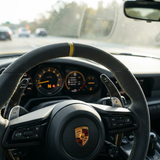
On the A45 AMG's 7G-DCT dual-clutch gearbox, the original plastic paddles are... a bit disappointing to the touch. An aluminum or carbon paddle shifter extension radically changes the feel. They snap over the existing paddles, without disassembly.

Mercedes A45 paddle shifter extension
Tool-free clip-on installation. Available in brushed aluminum. Adds 38 mm in length for perfect accessibility, keeping your palms on the steering wheel. 79 EUR
View extensionsThe benefit is more functional than it seems. On the A45, the small-diameter steering wheel places the original paddles quite close to the hub. During rapid shifting, you have to partially release the rim to reach the next gear. Extensions measuring thirty to forty millimeters bring the paddle back into the natural extension of your fingers, allowing you to keep both hands at the 9:15 position at all times. It's the kind of detail you don't notice at the dealership, but which becomes obvious after two weeks of use.
Pay attention to two points when choosing. First, the attachment: clip-on models with side locking screws hold up much better than those relying solely on double-sided adhesive. Next, the material: anodized aluminum feels pleasant to the touch all year round, while bare aluminum becomes unpleasantly cold in winter and burning hot behind a windshield in the summer sun. Carbon, on the other hand, does not conduct temperature and remains neutral to the touch.
Mirror caps: the carbon touch
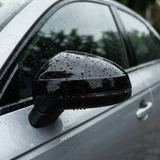
The original black chrome mirrors on the A45 age poorly (UV yellowing, micro-scratches). Replacement caps in genuine carbon fiber or glossy black ABS are a major visual upgrade for a reasonable price.


Carbon or glossy black: how to choose?
If your A45 is white, matte gray, or Cavansite blue, carbon gives it a very chic racing touch. If it's black (Obsidian, Cosmos), glossy black creates a more elegant visual continuity. On red A45s (Jupiter), both options work.
Disassembly, step by step
Replacing a mirror cap on a Class A requires no special tools, but it does require a gentle touch. The outer cap is held in place by a series of peripheral clips. The method consists of tilting the mirror down, inserting a plastic bodywork pry tool into the lower corner, and then releasing the clips one by one by working around the part. A metal pry tool or screwdriver would inevitably mark the door paint: it's an investment of a few euros that avoids a fifty-euro touch-up.
Allow fifteen to twenty minutes for both sides once you've mastered the method, and more for the first. The main point of caution is the cold: below ten degrees, ABS plastic becomes brittle and the clips break much more easily. Work in a heated garage or wait for a mild day.
Gear shift knob: a premium detail
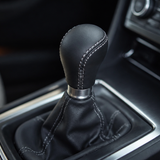
The original A45 W176 gear shift knob is made of faux leather, and it wears out quickly. Replacing it with an A45 AMG specific knob in factory aluminum and Nappa leather immediately changes the feel in daily use. It's one of the smallest investments that makes the biggest difference.

Mercedes A45 AMG gear shift knob
Specific to the W176 Class A. Nappa leather with red stitching, engraved AMG aluminum cap. Snap-on replacement without disassembly. 199 EUR
View knobBody kit, bumper blades and diffuser
After the roof spoiler, this is the most visible chapter of Mercedes A45 AMG tuning: everything that underlines the lower bodywork. Three families of parts make up the subject.
The front bumper blade
Also called a splitter or front blade, it attaches under the bumper and extends the nose of the car downwards. On an A45, the effect is immediate: the car looks lower and wider without any suspension modifications. It's the most effective optical illusion in the catalog.
The point to watch out for is the ground clearance. An aggressive blade descends three to six centimeters below the original bumper, placing it on the front line against speed bumps, sloped parking entrances, and parking stops. Two precautions make life much easier: choose a blade made of flexible material rather than rigid ABS for daily use, and get into the habit of approaching obstacles at an angle rather than head-on. Reserve rigid and low blades for cars that don't leave well-known roads.
Side skirts
Side skirt extensions visually connect the front and rear wheel arches. On a short-wheelbase compact like the Class A, they have a real visual lengthening effect. They are also the parts most exposed to gravel projections and road salt: a matte black or textured finish ages significantly better than glossy black in this precise area, where micro-impacts are inevitable.
The rear diffuser
The diffuser replaces or dresses the lower part of the rear bumper, between the exhaust outlets. On an A45, whose four outlets are already distinctive, a diffuser with vertical fins creates an impression of ground width that balances the roof spoiler. Pay attention to a detail that is often overlooked: compatibility with the tow hitch and with the parking sensors. A poorly chosen diffuser can partially block a sensor and generate phantom alerts during maneuvers.
Carbon on an A45: where to put it, or avoid it
Carbon is the most in-demand and most misunderstood material in tuning. Three industrial realities coexist under the same name, and they have neither the same price nor the same lifespan.
| Type | What it is | Longevity |
|---|---|---|
| Genuine carbon | Carbon fiber fabric impregnated with resin, baked under pressure | Excellent if the clear coat is UV-resistant. Yellows if the clear coat is low-end |
| Forged carbon | Randomly oriented fiber scraps, molded in bulk | Very good, non-repeating marble pattern |
| Imitation (hydrographic) | Decorative film transferred onto an ABS or plastic substrate | Average. The pattern can peel off or fade on exposed areas |
None of these three solutions is illegitimate. Hydrographic imitation has a real benefit on interior parts protected from the sun, where no one will ever touch the part and where the visual difference is nil from one meter away. It is, however, a bad choice for mirror caps, which take the sun, rain, car wash rollers, and projections all year round.
How to recognize genuine carbon upon receiving a package? Three simple tests. The weight: a carbon part is significantly lighter than an ABS equivalent of the same size. The reverse side: on genuine carbon, the weave is also visible on the inner face, even raw resin; on an imitation, the inside is smooth and uniformly black. Finally the continuity of the pattern on the edges: the weave must follow the curvature of the part, while a hydrographic film deforms or cuts in tight corners.
Where to put it on an A45, concretely? The locations that work best are those where carbon replaces an already black part: mirror caps, front blade, spoiler, grille surround, paddles. The locations to avoid are those where carbon competes with the body paint — a carbon hood on a road-going A45 restarts the aesthetic debate every time someone looks at it, and you really have to want it.
Exhaust and sound: what is legal in France
This is the slipperiest subject in tuning, and the one where misinformation circulates the most. Here is the French framework, without approximation.
The general principle is simple: a vehicle must remain compliant with its homologation. The sound level measured at a standstill, with the engine running, is recorded on the registration certificate and on the manufacturer's plate. Any modification that takes the vehicle outside this approved value makes it non-compliant. This applies to a drilled muffler, a line without a catalytic converter, or a device that deliberately increases the noise.
One point is particularly misunderstood: the removal or neutralization of a pollution control device — catalytic converter, particulate filter — is a separate offense and heavily sanctioned, regardless of noise. It also leads to a re-inspection at the technical inspection, where the absence of a catalytic converter is detectable from the gas values.
What remains possible? CE-approved exhaust lines, bearing an E marking followed by a country number and an approval reference, are designed to stay within tolerances. It's the only clean path. The marking must be legible on the part itself, and the certificate must be kept in the car. On an A45, approved cat-back lines exist and allow you to gain in sound character without going outside the framework.
Finally, a word on purely aesthetic exhaust tips. Replacing the pipes with wider tips, in stainless steel or carbon, does not change the noise or emissions, since nothing is changed upstream of the muffler. It's the only exhaust intervention that is totally neutral from a regulatory standpoint, and it's often the one that is visually sufficient.
Interior: steering wheel, seats, sills and ambient lighting
The interior is the place where you really spend time, and yet it's often the last area addressed. It's a mistake: on a car you keep, one euro invested in the interior provides more daily satisfaction than one euro invested in the bodywork.
The steering wheel
On the W176, the original AMG steering wheel is already good, but its smooth leather shines with the years, especially at the 9 and 15 positions. Two ways exist: re-upholstering by a trimmer, which allows you to choose Alcantara on the grip areas and leather on the rest, and complete replacement with a steering wheel from a newer generation or higher trim. The second option requires absolute vigilance regarding the airbag: it's a pyrotechnic element, whose removal and reinstallation is the responsibility of a professional. This is not a subject to improvise.
The door sills
Illuminated sills are a classic, for a simple reason: they are seen every time a door opens, that is, several times a day. The retro-lit versions with LEDs exist with battery power or by connecting to the courtesy lighting. The wired version is cleaner in use but requires running a wire through the door seal. The battery version avoids any disassembly but requires changing the batteries once or twice a year.
Ambient lighting
On A45s not originally equipped, fiber optic ambient lighting kits allow you to create a light strip in the door panels and on the dashboard. The result depends entirely on the care of the installation: a fiber correctly inserted behind the seal gives a result close to the original, a fiber glued in a hurry is immediately visible. Allow half a day of patient work for a clean result.
The mats and the trunk
An unglamorous but profitable area: custom-fit mats with matching stitching and a fitted trunk tray protect the interior and stand out at resale. On a compact used daily, it's probably the best value for money on this entire list.
Wheels and tires: dimensions, offset and mounting
This is the most visually structuring area, and the most technical. On an A45 W176, the original fits are in 18 or 19 inches depending on the trims and options. Three parameters decide the compatibility of a wheel.
- The bolt pattern (PCD): it describes the number of fixings and the diameter of the circle they draw. It is not negotiable: a wheel with the wrong bolt pattern cannot be mounted, period.
- The offset (ET): it's the distance between the hub mounting surface and the median axis of the wheel. A lower ET pushes the wheel outwards, a higher ET brings it in. A few millimeters are enough to create rubbing in the wheel arches when loaded or at full steering lock.
- The center bore: the diameter of the center hole. If the wheel has a larger bore than the hub, centering rings are mandatory. Without them, the wheel is centered by the bolts alone, which causes vibrations and premature wear.
On the French regulatory level, the rule to remember is that the fit must remain compliant with what is authorized for the vehicle. The approved dimensions are listed on the certificate of conformity. A different fit can be accepted if it respects the rolling circumference tolerances and if the wheels do not protrude from the wheel arches. A wheel protruding outside the bodywork dimensions is a reason for a re-inspection and is subject to a fine.
On the tire side, a reminder that is worth its weight in gold on a compact with nearly four hundred horsepower and all-wheel drive: the tires are the only contact with the road and the only element that transforms power into movement. Saving one hundred and fifty euros on a set of tires to invest in a spoiler is, objectively, a bad decision. The correct order is always: tires first, aesthetics next.
Manufacturer warranty and modifications: the legal reality
The fear of losing your warranty stalls many projects, often for no reason. Here is the principle applicable in Europe, explained simply.
A contractual warranty cannot be voided in its entirety solely because an aftermarket part has been fitted. The principle applied is that of the causal link: the manufacturer can refuse to cover a breakdown if it demonstrates that the modification caused it. In other words, fitting an adhesive roof spoiler cannot justify a warranty refusal on a gearbox. However, if an exhaust system modification causes damage to a sensor or the engine, the refusal is justified for that particular repair.
The practical consequence is clear. Aesthetic, reversible, and non-structural modifications — adhesive spoiler, mirror caps, paddle extensions, gear knob, mats, sills — carry almost zero risk to the warranty. Those affecting the engine, transmission, braking, or suspension require serious consideration and, ideally, a prior discussion with the workshop that services the car.
Two pieces of common sense accompany any project on a car that is still under warranty. First, keep the original parts carefully packaged and labeled: being able to return the car to factory configuration before a workshop visit or before resale is a considerable asset. Second, keep the invoices and certificates for all fitted parts. In the event of a dispute, being able to prove that a part is approved entirely changes the balance of power.
Approval and technical inspection: what passes, what gets blocked
The French technical inspection does not check aesthetics. It checks safety, emissions, lighting, and vehicle compliance. Here is how the most common modifications on an A45 stand.
| Modification | Status at technical inspection |
|---|---|
| Adhesive roof spoiler | Not applicable, as long as the part is securely attached and free of sharp edges |
| Trunk spoiler | Not applicable, same conditions |
| Mirror caps | Not applicable, if the mirror and adjustment remain functional |
| Front lip / side skirts | Not applicable, unless the part is broken, dangling, or sharp |
| Decorative exhaust tips | Not applicable, nothing is modified upstream |
| Non-approved exhaust system | Reason for re-inspection, plus risk of a fine |
| Catalytic converter or DPF removal | Refusal, serious offense |
| Non-approved lighting, non-compliant tints | Reason for re-inspection |
| Wheels protruding from wheel arches | Reason for re-inspection |
| Tinted front windows | Non-compliant on windshield and front windows |
Reading this table gives a simple rule to remember: anything visual, external, and securely fixed passes; anything affecting the exhaust, lighting, or wheel geometry is checked. This is also, and not by chance, exactly the line that separates bolt-on accessories from major modifications.
Maintaining a modified A45: the steps that make all the difference
A well-maintained tuning part can last as long as the car. Poorly maintained, it becomes in two years the detail that betrays a neglected vehicle. Here is the essentials.
Gloss black is the most fragile material in the entire catalog. It scratches with the slightest dust-laden cloth and any roller automatic wash leaves a veil of micro-scratches visible in full sun. The rule is the two-bucket wash — one for the foam, one for rinsing the mitt — and drying with a flat microfiber, without pressure. A light polisher once a year is enough to maintain the depth of the black.
Varnished carbon is treated exactly like paint: gentle wash, and above all, UV protection. That is where the whole difference lies between a part that will last ten years and one that turns brown. A wax or sealant applied twice a year significantly slows down the yellowing.
Glued parts require special attention around the high-pressure cleaner. A nozzle directed at a short distance on the joint of a spoiler can do what three years of highway driving would not have done. Keep at least thirty centimeters and avoid grazing jets on the glue edges.
In winter, road salt attacks the metal fixings and settles in the gaps of the side skirts. A rinse with clear water under the car after salt episodes is the most cost-effective action of the season, including for the original bodywork.
Total budget: how much to plan for a complete tuning?
| Accessory | Price | Fitting |
|---|---|---|
| Roof spoiler | 279 EUR | 30 min |
| Trunk spoiler | 119 EUR | 20 min |
| Paddle extensions | 79 EUR | 5 min |
| Carbon mirror caps | 89 EUR | 15 min |
| AMG gear knob | 199 EUR | 5 min |
| Total full pack | 765 EUR | ~1h15 |
Three project levels, three budgets
Not all owners have the same goals or the same budget. Here are three coherent trajectories, each complete at its level.
Level 1 — The discreet signature (300 to 450 EUR)
Objective: for the car to clearly stand out from an ordinary A-Class, without attracting attention. Contents: gloss black roof spoiler, paddle extensions, gear knob. All parts are bolt-on, the total installation takes less than an hour, and none of them raise the slightest question at technical inspection or with the warranty. It is the ideal level for a car still under manufacturer warranty or intended for resale in the medium term.
Level 2 — The complete visual pack (700 to 1,200 EUR)
Objective: a clear transformation, visible from the street. Contents: level 1, plus the trunk spoiler, carbon mirror caps, a front bumper lip, and exhaust tips. We reach the balance point here: the car is frankly personalized, everything remains reversible, and the removed parts can be sold separately if they are of good quality and have been properly removed. We do not promise any recovery rate on resale.
Level 3 — The finished project (2,000 to 3,500 EUR)
Objective: a car that looks like no other. Contents: level 2, plus a set of wheels, a rear diffuser, side skirts, a complete interior treatment (illuminated sills, ambient lighting, custom mats, steering wheel re-trimming). At this level, aesthetic coherence becomes the real subject: it is better to have a homogeneous set for two thousand euros than a pile of ideas for three thousand five hundred.
The 8 mistakes not to make
- Ordering without checking the chassis code. W176 and W177 look alike, their parts are not interchangeable. The VIN decides in ten seconds.
- Gluing in cold weather. Below fifteen degrees, the acrylic adhesive does not bond correctly. It is the first cause of a detached spoiler.
- Degreasing with glass cleaner. Residues prevent adhesion. Isopropyl alcohol, nothing else.
- Mixing finishes. Gloss black at the front, carbon at the rear, aluminum in the interior: the eye reads a patchwork, not a project.
- Neglecting the tires. On four hundred horsepower and four-wheel drive, no accessory compensates for a worn tire.
- Fitting everything at the same time. It is impossible afterwards to know which part brings what, or to go back on the one you dislike.
- Throwing away the original parts. They are worth money on resale and allow the car to be returned to factory configuration.
- Believing that a loud exhaust system will pass inspection. Without a visible approval marking, a re-inspection is announced.
FAQ: 12 questions about A45 AMG tuning
1. Does a W176 spoiler fit on a W177?
No. The geometry of the hatch and the curvature of the roof differ between the two generations. A part designed for one will leave visible gaps on the other, and the gluing surface will not be continuous. Always check the chassis code.
2. Does the adhesive spoiler really hold in a high-pressure wash?
Yes, once the full bond is achieved, that is to say after seventy-two hours. Simply avoid grazing jets at a short distance on the glue edges, which stress the adhesive by shear.
3. Can I remove a glued spoiler without damaging the paint?
It is possible but delicate. The method consists of gently heating the area, then sawing the adhesive with a nylon thread back and forth, before removing the residues with a scraper mounted on a low-speed drill. Entrust this operation to a professional if the car is in a dark metallic shade.
4. Does aesthetic tuning lower the resale value?
It depends entirely on the quality and coherence. Well-chosen, well-fitted parts in the spirit of the car have no negative effect and often widen the number of interested buyers. A sloppy installation, visible gaps, or a style that is too personal conversely restrict the market. The fact that you can return the original parts removes all concern.
5. Do I need to declare the modifications to my insurance?
Aesthetic accessories of significant value deserve to be reported, if only to be covered in case of theft or a claim. An undeclared part will not be compensated. A simple email to your insurer, with the invoices, is generally enough.
6. What is the difference between a spoiler and a wing?
The spoiler extends an existing surface, generally the edge of the roof or hatch, without free space underneath. The wing is a lifting wing mounted on supports, with air passing on both sides. In common language the two words are mixed up, but aerodynamically they do not do the same job.
7. Does carbon necessarily yellow?
No, if the varnish is treated against UV. The yellowing comes from the degradation of the resin under ultraviolet rays, not from the fiber itself. A part well varnished and protected twice a year holds perfectly over time.
8. Can I fit wheels larger than the original?
Yes, within the limits of what is authorized for the vehicle and subject to respecting the rolling circumference, the offset, and the absence of protrusion outside the wheel arches. Have the dimensions checked by a fitter before buying: it is free and avoids an unusable set of wheels.
9. Does a modified A45 consume more?
Aesthetic accessories have a negligible effect on consumption. Heavier wheels and wider tires, however, have a real impact, in the order of a few tenths of a liter per hundred kilometers. The main consumption factor on an A45 remains, by far, the right foot.
10. How long to fit a complete pack?
About one hour fifteen for the whole spoiler, wing, paddles, caps, and gear knob, working without rushing. Plan for half a day if it is your first intervention, the time to read the instructions and prepare the surfaces correctly.
11. Do I need a professional for the mirror caps?
Not necessarily. The operation is accessible with plastic bodywork levers and a little patience. The only real risk is breaking a clip in cold weather or by excess force. If you are not comfortable, a bodyworker generally charges for a short intervention.
12. Where to start if I only have a limited budget?
With the roof spoiler. It is the part that changes the perceived silhouette the most, it is fitted without a specific tool, it is neutral at technical inspection and with the warranty, and it pairs with all subsequent developments. If the budget allows, add the mirror caps: this duo represents the best transformation/price ratio of the entire A45 catalog.
4Matic and 7G-DCT gearbox: what really runs under an A45 AMG

This is the subject where the most approximations circulate, including among parts sellers. An A45 AMG 4Matic is a car with a transverse engine: the block is placed across the front compartment, exactly like on an ordinary A-Class. The entire transmission stems from this architecture, and it is what explains why comparisons with the big AMGs with longitudinal engines do not hold.
The torque starts from the gearbox towards a power take-off, then towards a shaft that joins the rear axle. There is the central part of the system: an electro-hydraulically controlled multi-disc clutch. As long as it remains open, the car drives in traction and consumes as such. As soon as the electronics detect slipping, a strong acceleration or a fast entry into a curve, it closes gradually and sends torque to the rear, up to a split that can approach 50/50. On the A45 S of the W177 generation, this rear axle gains two distinct clutches, one per wheel, which allows a real torque vectoring.
What an A45 has — and what it does not have
- 4-cylinder engine mounted TRANSVERSELY
- 4Matic with multi-disc clutch controlled at the rear axle
- W176: AMG Speedshift 7G-DCT, code 724.0
- Double clutch with OIL BATH
- W177: AMG Speedshift 8G-DCT (A45 and A45 S)
- A Volkswagen DSG gearbox
- A 7G-Tronic with torque converter
- A dry double clutch type DQ200
- A Torsen central differential
- A selectable rear-wheel drive mode
On the gearbox side, the A45 AMG automatic gearbox of the first generation is an AMG Speedshift 7G-DCT, seven-speed, dual-clutch, internal code 724.0. Its dual clutch operates in an oil bath: this is what allows it to handle the torque of a motor with over 350 horsepower without becoming a disposable item. The W177 moves to an eight-speed AMG Speedshift 8G-DCT, on the A45 as well as the A45 S. No A45 has ever been offered with a manual gearbox, despite what the search bar suggests.
Two confusions deserve to be cleared up, because they have real maintenance consequences. The first: it is not a DSG. The dual-clutch principle is the same, the mechanics are not — see our DSG7 DQ200 gearbox guide, whose dry clutch has nothing to do with an oil bath. The second: it is not a 7G-Tronic. That is a torque converter gearbox from a completely different family, reserved for longitudinal architectures. For the details of the in-house all-wheel drive, our 4Matic all-wheel drive guide covers the subject from scratch.
Order the paddle shifter with the correct reference


Is the A45 AMG engine a Renault engine?

The question comes up so often in the search suggestions that it deserves a clear answer: no, the A45 AMG engine is not a Renault engine. The M133 of the W176 and the M139 of the W177 are Mercedes-AMG blocks, assembled in Affalterbach according to the "one man, one engine" principle: each block bears the signature plate of the technician who assembled it, and it is visible when opening the hood.
Where does the misconception come from then? From the same bodywork, but not from the same car. Daimler and the Renault-Nissan Alliance cooperated for years on entry-level engines, and some A-Classes benefited from them. An owner reads "A-Class" and "Renault" in the same sentence, and applies it to the A45: the confusion is made. We have dedicated an entire guide to the subject, because it deserves better than a forum slogan — the reliability of Renault engines mounted on Mercedes, our objective opinion.
A technical detail worth knowing: on the M139 of the W177, AMG rotated the block 180 degrees compared to the M133. The turbo and the exhaust manifold end up on the firewall side, the intake on the grille side. This is not a catalog detail: it completely changes the accessibility of parts during reassembly, and it is one more reason never to order an engine compartment part "for A45" without specifying the generation.
A45 AMG reliability: what to check before spending on tuning
The reliability of the A45 AMG is the second most searched topic after price, and it directly conditions the tuning budget: there is no point in installing six hundred euros of accessories on a car that will require a major intervention within the year. The searches also explicitly distinguish the phase 1 (2013-2015, 360 horsepower) from phase 2 (2015-2018, 381 horsepower), and it is a relevant distinction: the first models suffered the growing pains of a four-cylinder that was unprecedented in its specific power.
The diagnosis to make BEFORE the first accessory
- Dual-clutch gearbox: jerks when cold, slipping on acceleration
- Turbo: unusual whistling, blue smoke on acceleration
- Oil circuit: level, cleanliness, oil change history
- Running gear: bushings, ball joints, geometry
- Tires: age of the rubber, uneven wear on the shoulders
- History: maintenance in the network, invoices kept
- Fault codes: complete OBD reading, not just the engine light
The maintenance of the A45 AMG is not that of an ordinary A-Class. The engine is heavily supercharged, the gearbox is an oil-bath dual clutch, the all-wheel drive adds a differential and its fluids. The engine oil change is the item everyone monitors, but it is the gearbox fluid, filter included, that we most often forget — and it is the one whose neglect costs the most. The exact intervals depend on the year and usage: the vehicle's logbook and an authorized workshop are authoritative, not a generic value read online.
For the purchase itself, the inspection points for the bodywork, the interior, and the electronics are detailed in our reliability guide for the used Mercedes A-Class W176: the A45 shares most of its structure with the civilian versions, and the early defects of the platform are listed one by one.
Real fuel consumption of an A45 AMG and the effect of accessories

The fuel consumption of the A45 AMG generates a search suggestion by year, from 2013 to 2020, which says a lot about the concern of buyers. First thing to understand: the official figures of the two generations are not comparable. The W176 was approved on the NEDC cycle, a lenient laboratory protocol; the W177 on the WLTP cycle, much closer to reality. An apparent gap between a 2015 A45 and a 2020 A45 can therefore be nothing more than a change in measurement method.
Orders of magnitude, in liters per 100 km
| W176 approval (NEDC cycle, mixed) | 7.0 l/100 km |
| W177 approval (WLTP cycle, mixed) | 9.0 l/100 km |
| Real usage, mixed trips | 10.5 l/100 km |
| Real usage, dense city | 13.0 l/100 km |
| Track usage | 16.0 l/100 km |
The first two lines are manufacturer approval values, measured on two different protocols and not comparable with each other. The next three are orders of magnitude of usage commonly reported by owners, given for information purposes: they are not measurements we have carried out.
What is the effect of accessories in this? Much weaker than we imagine for aerodynamics, much stronger than we think for wheels. A spoiler that takes the original geometry of the sporty versions is neutral at legal speed. On the other hand, moving from an 18 to a 19 inch with a wider rubber adds unsprung mass and rolling resistance: it is the only item in this guide that is paid for in fuel every day. If consumption is a criterion, keep the original fitment and play on the finish of the rim rather than the diameter.
Mercedes parts that do not penalize consumption


Stage 1, Stage 2, piggyback box: what French law says

The suggestions A45 AMG Stage 1, Stage 2, Stage 3 and chip tuning come out on top as soon as you type "a45 amg stage", and most of the pages that answer are English-speaking — so written for a regulatory framework that is not ours. In France, the rule holds in one sentence: modifying the characteristics of the engine takes the vehicle out of the reception under which it was approved.
What French law imposes, in order
- 1. The original reception no longer covers the vehicleAs soon as the power or engine management changes, the conformity to the approved type falls.
- 2. A new reception is necessaryThe modified vehicle must be presented for a reception on an isolated basis before circulating.
- 3. The registration card must followThe administrative power inscribed on the registration certificate must correspond to reality.
- 4. The insurer must be informedAn undeclared modification authorizes the insurer to discuss its guarantee after a claim.
- 5. The manufacturer can exclude the part in questionAn engine failure occurring after reprogramming falls out of the scope of the contractual warranty.
The piggyback box deserves a paragraph of its own, because it is sold as the clever solution. A box that interposes itself on the sensors modifies the operation of the engine exactly as a reprogramming would. The fact that it can be unplugged in thirty seconds does not make it compliant: it is the state of the vehicle at the time of the facts that is examined, not the one of the next day. Let's add that on an M133 already very stressed from the factory, the mechanical margin is thin, and that a boost pressure detected without working on the cooling is paid early or late.
It is precisely for this reason that this guide focuses on bolt-on and reversible aesthetics. An approved part, installed without drilling, does not ask any questions at the technical inspection and does not touch any reception. On the way to check that a part is really approved before ordering it, our approved tuning accessory guide details the markings to look for and the mentions that prove nothing.
Twelve questions about the mechanics of the A45 AMG
These twelve questions complete the previous FAQ, which was about the installation of accessories. They deal with the mechanics, the transmission and the legal framework — that is to say everything that decides if an aesthetic project is a good idea or a premature expense.
Is the A45 AMG rear-wheel drive or all-wheel drive?
All-wheel drive, on both generations. The engine is mounted transversely at the front; a power take-off at the gearbox output sends the torque to a multi-plate clutch placed on the rear differential. As long as this multi-plate remains open, the car drives in front-wheel drive; it closes gradually as soon as the electronics detect slipping or a strong acceleration, up to a share close to 50/50. There is therefore never a "rear-wheel drive mode" on an A45 W176.
What gearbox equips the A45 AMG W176?
An AMG Speedshift DCT with seven speeds and dual clutch, designated 7G-DCT and bearing the internal code 724.0. Its dual clutch operates in an oil bath, which allows it to handle the torque of a motor with over 350 horsepower. The W177 moves to an eight-speed AMG Speedshift 8G-DCT.
Is the A45 gearbox a Volkswagen DSG?
No. The two gearboxes share the dual-clutch principle, but they are different mechanics, designed by different manufacturers, with clutches, computers and maintenance procedures that have nothing to do with each other. Confusing the two leads to concrete maintenance errors: a dry DQ200 and an oil-bath 724.0 are not treated the same way.
Can an A45 have a 7G-Tronic?
No. The 7G-Tronic is a torque converter automatic gearbox, designed for the longitudinal architectures of Mercedes — C, E, S Class, SUV with a longitudinal engine. The A45 has a transverse engine: it receives a compact dual-clutch gearbox, never a 7G-Tronic.
Is the A45 AMG engine a Renault engine?
No. The M133 of the W176 and the M139 of the W177 are Mercedes-AMG blocks assembled in Affalterbach according to the "one man, one engine" principle. The confusion comes from other versions of the A-Class: some entry-level engines, they, come from the cooperation between Daimler and the Renault-Nissan Alliance. This does not concern the A45.
What is the real fuel consumption of an A45 AMG?
The approval figures of the W176 were measured on the NEDC cycle, around 7 l/100 km, and those of the W177 on the WLTP cycle, more severe, around 9 l/100 km: the two values are not comparable with each other. In real usage, the owner readings are most often between 9 and 12 l/100 km, and well beyond on the track. We give these orders of magnitude for what they are: usage readings, not a promise.
Does a spoiler increase consumption?
A spoiler that takes the original geometry of the sporty versions has a negligible effect at legal speed. What really weighs on consumption is the unsprung mass and the width of the tires: moving from 18 to 19 inches with a wider rubber is paid for in liters, every day. An oversized and poorly oriented wing can, however, significantly degrade the drag.
Is a Stage 1 remap legal in France?
Not as it stands. Any modification to the engine's specifications takes the vehicle outside its original type approval: a new type approval is required before it can be driven on public roads, and the official power rating must be updated on the registration certificate. Without this procedure, the vehicle is not compliant, and the insurer is entitled to refuse coverage after a claim.
Does an additional control box make a difference legally?
No, and this is the most common misunderstanding. A box that sits between the sensors modifies the engine's operation just as much as a remap. The fact that it can be disconnected in thirty seconds does not make it compliant: it is the state of the vehicle at the time of the incident that counts.
What should be checked on an A45 AMG before investing in tuning?
Three areas, in this order: the condition of the dual-clutch gearbox (jerking when cold, slipping under acceleration), the health of the turbo and oil system, and the wear of the running gear and tyres. A carbon spoiler does not compensate for any of these three points. Have a full diagnostic carried out before spending money on aesthetics.
How often should the 7G-DCT gearbox be serviced?
The vehicle's service manual is the authority, and the interval depends on usage: a car that sees the track or daily traffic requires more frequent servicing than a long-distance car. The key principle to remember is that a wet dual-clutch gearbox has a working fluid, filter included, and that this fluid is not "for life". Ask an authorised workshop for the exact interval for your model year, rather than a figure read on a forum.
Do A45 W176 parts fit a W177?
No, no bodywork parts are interchangeable between the two generations: the lengths, hatch radii, and bonding points differ. This is true for the spoiler, wing, mirror caps, and bumper lips. The chassis code, readable on the registration certificate, settles the matter in ten seconds.
Popular searches: a45 amg tuning, mercedes a45 amg tuning, a45 amg chip tuning, a45 amg tuning parts, a45 amg tuning kit, a45 amg spoiler, a45 amg w176 spoiler, a45 w177 spoiler, a45 amg w176, a45 amg horsepower, a45 amg technical specifications, a45 amg used, a45 amg used price, a45 amg 2013, a45 amg 2015, a45 amg 2016, a45 amg 2017, a45 amg reliability, a45 amg reliable, a45 amg phase 1 reliability, a45 amg reviews, a45 amg forum, a45 amg test drive, a45 amg maintenance, a45 amg oil change, a45 amg engine oil, a45 amg engine, a45 amg renault engine, mercedes a45 amg renault engine, a45 amg engine, a45 amg 4matic, a45 amg 4matic 2013, a45 amg 4matic 2015, a45 amg 4matic 2016, a45 amg 4matic turbo, a45 amg 4matic plus, a45 amg 4matic edition 1, a45 amg automatic gearbox, a45 amg manual gearbox, a45 amg gearbox, a45 amg fuel consumption, a45 amg 2013 fuel consumption, a45 amg 2015 fuel consumption, a45 amg 2017 fuel consumption, a45 amg 381 fuel consumption, a45 amg stage 1, a45 amg stage 2, a45 amg stage 3, a45 amg stage 1 acceleration, a45 amg tuning box, a45 amg wheels, a45 amg 18-inch wheels, a45 amg 19-inch wheels, a45 amg w176 wheels, a45 amg exhaust, a45 amg performance exhaust, a45 amg w176 exhaust, a45 amg brakes, a45 amg insurance, a45 amg insurance price, a45 s amg, a45 s amg horsepower, w177 a45 amg, w177 a45 body kit, w177 a45 kit, mercedes a45 amg used.
Learn more
If you are hesitating between the A45 AMG and its direct rivals, these articles complement this guide:

Gift for a new driver: what to give for a first car
Buying a gift for someone who has just got their driver’s license means resisting a certain temptation: that of a...

Best Wireless CarPlay Adapter: 2026 Comparison
Before comparing models, only one question matters: does your car already have wired CarPlay? The answer determines which of the...

BMW, Audi, Mercedes, Volkswagen key shell: find the right model the first time
Identify the family of your BMW, Audi, Mercedes or Volkswagen key, count the buttons and identify the blade to order...