Used Audi RS6 C7: Our Complete Reliability Guide
Buying a used Audi RS6 means treating yourself to one of the fastest estates ever produced: the RS6 Avant C7 (2013-2018) hides a 4.0 TFSI biturbo V8 producing 560 to 605 hp under its hood, along with quattro all-wheel drive and unique family versatility. But between the air suspension, turbos located in the engine's V, and the maintenance budget of a high-performance sports car, a cheap used Audi RS6 can quickly become a money pit if it has been neglected. This comprehensive reliability guide reviews the EA824 engine, the 8-speed Tiptronic gearbox, the chassis, the electronics, the critical mileage, the used Audi RS6 price observed in 2026, and all the points to check during a test drive.
TL;DR — the essentials in 30 seconds
- Overall reliability: good for a 560 hp sports car, provided there is a complete service history.
- Weak points: air suspension (compressor, shock absorbers) after 120,000 km, leaky thermostat module, and chain tensioners at high mileage.
- Very robust ZF 8HP Tiptronic gearbox: insist on an oil change every 60,000-80,000 km.
- Realistic annual maintenance budget: €2,500 to €4,000 excluding tires.
- 2026 valuation: from €45,000 (2013, high mileage) to €85,000 (2017-2018 Performance, well-maintained).
- Recommended version: RS6 Performance after 2015, steel brakes, complete Audi service history.
History and Versions: The 560 hp Estate That Defined Its Era
Unveiled at the 2013 Detroit Motor Show, the RS6 Avant C7 (Typ 4G) stood out from its predecessors: the C6's biturbo V10 was out, replaced by a lighter 4.0 TFSI biturbo V8 that reduced front-axle weight by nearly 100 kg. Available exclusively as an Avant estate — Europe will never get the sedan — it delivers 560 hp and 700 Nm from just 1,750 rpm.
It sprints from 0 to 100 km/h in 3.9 seconds, a supercar figure for a 4.98 m car capable of carrying 565 liters of luggage. In 2015, the facelift introduced Matrix LED lights, an improved MMI, and above all, the RS6 Performance: 605 hp, 750 Nm with overboost, and 0-100 km/h in 3.7 s.
Production ended in 2018, replaced by the C8. On the used Audi RS6 market, the C7 is now considered the generation with the best performance-to-price ratio — which is why choosing the right one is so important.
Key Takeaways: one body style (Avant), two power levels: 560 hp (2013-2018) and 605 hp Performance (2015-2018). The 2015 facelift brought Matrix LED lights and a faster MMI: it is the pivotal model year.
The 4.0 TFSI Biturbo EA824 V8: Architecture and Strengths
The 4.0 TFSI (EA824 family, with CRDB and then CWUC codes for the Performance model, is a 90° V8 powered by two twin-scroll turbochargers located in the V, between the two cylinder banks. This "hot vee" architecture shortens exhaust flow paths: reduced response times and a compact design.
It features FSI direct injection, front-mounted chain timing (unlike the RS4 B7's 4.2 FSI, which has chains at the rear), AVS (variable valve lift), and above all, COD — cylinder on demand — which shuts down 4 cylinders under partial load to keep fuel consumption around 9.8 l/100 km during relaxed highway driving... and closer to 13 to 15 l/100 km during spirited real-world driving.
When properly maintained, this engine block can exceed 250,000 km without being opened. Its requirements: high-quality 5W-40 oil changed every 10,000 km (forget the 30,000 km long-life intervals), gradual warm-ups, and monitored spark plugs/coils. It is the same engine, with only a few differences, as the Bentley Continental GT V8: the foundation is prestigious.
Known Engine Failures: What an Audi RS6 C7 problem Reveals
Type "Audi RS6 C7 problem" into a forum and three topics will repeatedly appear: the cooling system, oil leaks, and, at high mileage, the timing system. None are deal-breakers if anticipated.
Thermostat module and water pump: this is THE signature failure of the EA824. The thermostat housing leaks around 90,000-130,000 km (traces of pink G13 coolant, a sweet smell). Budget €900 to €1,500 including installation, as access is difficult.
Oil leaks: valve cover gaskets and upper casing seals seep with age. A light film is acceptable; a drip on the ground is not. Restoration cost: €800 to €1,800 depending on the extent.
Timing system: the chains are generously sized, but the hydraulic tensioners wear out after 150,000-180,000 km. Symptom: a metallic rattle for 2 seconds when starting from cold. Major job: €3,000 to €4,500.
Turbos: located in the V, they age well (180,000 km and beyond), but replacing them requires removing the entire intake system: €4,000 to €6,000 for both, using genuine parts. An abnormal whistle or blue smoke on deceleration should be a warning sign.
Oil consumption: up to 0.5 l / 1,000 km remains within the manufacturer's tolerance; beyond that, suspect piston rings or the breather system. Active engine mounts: vibrations at idle around 120,000 km, ~€600 per part.
| Failure | Typical mileage | Symptom | Repair cost |
|---|---|---|---|
| Thermostat module | 90-130,000 km | G13 leak, unstable temperature | €900-1,500 |
| Valve cover gaskets | 100-150,000 km | Seeping, hot oil smell | €800-1,800 |
| Chain tensioners | 150-180,000 km | Rattle when starting from cold | €3,000-4,500 |
| Turbochargers | 180,000 km+ | Whistle, blue smoke, power loss | €4,000-6,000 |
| Active engine mounts | 120,000 km | Idle vibrations | ~€600/part |
Key Takeaway: the EA824 V8 is reliable over the long term; the real risk is an example that has been drained every 30,000 km using long-life oil. A service book stamped every 10,000-15,000 km is worth more than 10,000 fewer km on the odometer.
8-Speed Tiptronic Gearbox and Quattro: The Strongest Link
Unlike the RS4 and RS5 of the era, which featured the S tronic dual-clutch gearbox, the RS6 C7 receives a ZF 8HP torque converter automatic gearbox (8-speed Tiptronic). Excellent news for the used market: this gearbox equips half of the world's top-end models and handles 700-750 Nm without flinching.
Its only requirement is ignored by too many owners: a complete oil change (oil + pan/filter) every 60,000 to 80,000 km, despite the original "lifetime" claim. Cost: €600 to €900. A gearbox that has never had its oil changed at 140,000 km may exhibit jerking when cold between gears 2 and 4 — often the mechatronics, €1,500 to €2,500.
The quattro drivetrain with Torsen self-locking center differential (40:60 distribution) is virtually indestructible. The optional rear sports differential deserves an oil change every 60,000 km; check its operation during a test drive (the car should track cleanly into corners under power). The half-shafts and driveshafts are robust; a clunk when starting on an incline betrays a worn flex joint or universal joint.
Key Takeaway: insist on seeing the ZF gearbox oil change invoices. Without them, budget €900 immediately and negotiate accordingly.
Chassis, Air Suspension, and Brakes: The #1 Area to Watch
The RS6 C7 comes standard with adaptive air suspension: four electronically controlled air springs, a compressor, and a pressure reservoir. Royal comfort... as long as everything is sealed. After 120,000-150,000 km, leaks occur: the car sags on one side overnight, the compressor runs for a long time at startup, then overheats and dies.
The figures to know: an original air spring costs €1,500 to €2,500 per part (installed), and the compressor €800 to €1,200. Quality aftermarket solutions cut the bill in half. The DRC (Dynamic Ride Control) option, with shock absorbers connected diagonally by hydraulic lines, eliminates the air suspension; its shock absorbers also leak (budget €900-1,400 per part), but the system is simpler.
On the braking side: 390 mm steel discs at the front (6-piston calipers) are more than sufficient on the road. The 420 mm carbon-ceramic option is a dream, but a set of front discs costs over €5,000: on a used car, worn or chipped ceramics are a major reason to negotiate, not a bonus. Running gear: front lower arm bushings and tie rod ends wear out around 100,000 km (complete front end: €1,200-2,000). 285/30 R21 tires: €1,400 to €1,800 per set, with rapid wear at the front.
Electronics and Equipment: MMI, Sensors, and Batteries
The C7's electronics are extensive but generally mature. The MMI Navigation plus (3G+) can become slow or freeze; a simple reset fixes 80% of cases — we have detailed the procedure in our guide on resetting the Audi MMI system. Maps are no longer updated on the very earliest model years: anticipate a CarPlay box if that is important to you.
Recurring points of concern: parking sensors that beep continuously (€80-150 per sensor), a clouded rearview camera, an ACC radar out of alignment after a poorly repaired front-end collision, and above all, the AGM battery: the start-stop and air suspension put a heavy strain on it; a weak battery generates cascading phantom faults. Every warning light on the dashboard must be identified before purchase — our complete list of Audi warning lights will help you with that.
The heated/ventilated RS seats, electric tailgate, and Matrix LED lights (post-2015) are reliable; a faulty Matrix light module, however, costs €1,500 to €2,500 new. Check every function one by one during a test drive, with an OBD scanner connected.
Bodywork and Interior: Aluminum Forgives Little
The fenders, hood, doors, and tailgate are made of aluminum: corrosion is extremely rare, but any repair requires a body shop equipped for aluminum — a poorly restored accident is evident from uneven panel gaps and rivet heads. Run your hand under the sills and check the chassis rails: a "stanced" or track-used RS6 may hide severe rubbing.
Inside, the quality is excellent: pay close attention to the driver's seat bolster (shiny leather/Alcantara from 120,000 km), carbon inserts that are peeling at the edges, and the headliner of examples heavily exposed to the sun. A smooth, shiny RS steering wheel on a "60,000 km" listing should raise doubts about the odometer: always cross-check with the HistoVec history.
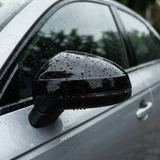
Want to tastefully personalize your future RS6? A Black Edition trunk badge or mirror caps transform the look without touching the mechanics:

Glossy black RS6 trunk badge — click to view the product page
Critical Mileage: The Thresholds Where Everything Is Decided
On an RS6 C7, costs do not arrive randomly: they follow predictable mileage thresholds. Knowing them allows you to buy at the right time... or negotiate the right price for an example approaching an expensive threshold.
0 to 80,000 km — the green zone: aside from routine maintenance, almost nothing happens. This is the most sought-after and expensive range on the market. However, beware of examples that have spent their lives in the city and never properly warmed up: short trips clog the intake and wear out the AGM battery.
80,000 to 130,000 km — the orange zone: this is the window for the thermostat module, the first upper casing seeps, front-end bushings, and engine mounts. A car in this range with invoices for these interventions already completed is often the best deal on the market.
130,000 to 180,000 km — the red zone: air suspension (shock absorbers, compressor), chain tensioners, mechatronics if the gearbox has never had its oil changed, and aging radiators and hoses. Budget a provision of €5,000 to €8,000 over 3 years if nothing has been anticipated.
Beyond 180,000 km: only for connoisseurs, at a bargain price, with a stack of invoices as thick as a phone book. The turbos and valvetrain generally remain healthy, but every peripheral component becomes a candidate for replacement.
Key Takeaway: the best buying window is between 90,000 and 120,000 km with the thermostat, running gear, and ZF oil change already done: the major costs are past, and so is the depreciation.
Maintenance and Parts Budget: The Real Figures
An RS6 C7 is maintained like a €120,000 new car, not like an A6 TDI. Here are the prices observed in 2026 at an independent specialist workshop (the official network is 20 to 40% more expensive):
| Operation | Frequency | Specialist cost |
|---|---|---|
| Oil change + filters | 10,000 km / 1 year | €350-500 |
| Major service (spark plugs, filters, fluids) | 60,000 km | €900-1,400 |
| Complete ZF 8HP gearbox oil change | 60,000-80,000 km | €600-900 |
| Set of 285/30 R21 tyres | 25,000-35,000 km | €1,400-1,800 |
| Front steel brake discs + pads | 40,000-60,000 km | €1,500-2,200 |
| Air suspension unit (OEM, fitted) | 120,000-160,000 km | €1,500-2,500 per unit |
| Thermostat module + water pump | 90,000-130,000 km | €900-1,500 |
| AGM battery | 5-7 years | €300-450 |
Add fuel (13-15 l/100 km of SP98), comprehensive insurance costing €1,500 to €3,000/year depending on your profile, and you get a total cost of ownership of €9,000 to €13,000 per year for 15,000 km. That's the price of a daily-use supercar — and that's exactly what it is.
Concrete example: 3-year cash flow plan
Let's take a typical real-life case: buying a 2015 RS6 with 105,000 km for €58,000, driving 12,000 km/year. Year 1: oil change, preventive AGM battery, undocumented ZF gearbox oil change, set of tyres — around €3,400. Year 2: major service and leaking thermostat module — around €2,600. Year 3: front discs and pads, aftermarket rear air suspension unit — around €3,200.
Total over 3 years: around €9,200 in maintenance and upgrades, or €3,100 per year. During the same period, the car only lost €6,000 to €8,000 in value — far less than an equivalent new premium SUV. That's the whole logic of the RS6 C7: maintenance costs, depreciation forgives.
Valuation and actual price of a used Audi RS6 in 2026
The used Audi RS6 price stopped falling in 2023: the C7 has entered its stabilisation phase, and well-specified Performance models are slowly recovering. French listings (La Centrale, Leboncoin) are 5 to 15% more expensive than a used Audi RS6 in Germany with equivalent equipment, but importing adds paperwork and a potential penalty.
| Version / model year | Typical mileage | 2026 range |
|---|---|---|
| RS6 560 hp 2013-2014 | 100,000-160,000 km | €45,000-55,000 |
| RS6 560 hp 2015-2017 (facelift) | 70,000-120,000 km | €55,000-70,000 |
| RS6 Performance 605 hp 2015-2018 | 50,000-100,000 km | €65,000-85,000 |
| Special editions (exclusive performance...) | < 80,000 km | €80,000-100,000 |
The criteria that determine the valuation: complete Audi service history (+10%), ceramic brakes in good condition, panoramic roof, Dynamic Plus pack (305 km/h), understated colours (Daytona, Sepang), or exclusive ones, first paint. Valuation killers: undocumented remapping, scuffed rims, smoked interior, gaps in history, recent import without follow-up. A cheap used Audi RS6 at €40,000 exists — it has simply already spent the €15,000 difference on future costs for you.
Points to check during the test drive: the 12-step checklist
A RS6 C7 test drive requires preparation: the car must be cold-started, an OBD scanner, a lamp, and at least 30 minutes. Here is the car-sniffing checklist:
- Cold start: listen for 5 seconds — chain rattle = heavy negotiation or leak.
- Ride height: are all 4 corners level? Compressor running for more than 30 s = suspicious.
- Leaks: check under the engine (oil) and around the thermostat (pink traces of G13).
- OBD scanner: zero engine/gearbox/chassis faults tolerated, including stored codes.
- Gearbox: 1-2-3 shifts cold without jerking; firm kick-down when hot.
- Straight line: full-load acceleration — no power loss, no smoke in the rearview mirror.
- Firm braking: no steering wheel vibration (common warped discs).
- Running gear: no clunking over speed bumps; inner-edge worn tyres = geometry.
- Electronics: every button, seat, 4-zone climate control, camera, sensor, Matrix LED.
- Service book: oil changes ≤ 15,000 km, ZF gearbox oil change, suspension invoices.
- Administrative history: HistoVec report + title check via service-public.fr.
- Remapping: ask straight out; an undeclared Stage 1 = compromised insurance and reliability.
To remember: refuse any test drive with a hot engine. 90% of major faults in an RS6 C7 (chains, suspension, gearbox) can only be heard when cold.
The 10 classic mistakes of the RS6 buyer
Our readers always report the same pitfalls. Here they are, so you don't repeat them:
- Buying based on mileage rather than history — the #1 mistake, by far.
- Neglecting the ZF gearbox oil change because "Audi says it's for life".
- Underestimating the cost of ceramic brakes and paying full price for an option at the end of its life.
- Test driving with a hot engine, letting the seller "prepare" the car.
- Ignoring ride height and discovering the air suspension 3 months later.
- Believing an ad without HistoVec or an independent inspection report.
- Buying the first Performance model you see without checking that the options on the registration certificate confirm the version.
- Forgetting the 21-inch tyre budget in the annual calculation.
- Importing without calculating the exact penalty with the administration before signing.
- Paying cash without a warranty when a professional offered 12 months for €1,500 more.
Versions and years to favour (or avoid)
The best rational choice: 2016-2017 facelifted RS6, 560 hp, steel brakes, controlled air suspension, complete history. It combines the facelift improvements (Matrix LED, smoother MMI, refined interior) without the Performance price premium.
The best enthusiast choice: 2016-2018 RS6 Performance. Its 605 hp and 750 Nm overboost turn the estate into an absolute weapon, and its value holds up better. Check that the Dynamic pack (285 or 305 km/h) is indeed the one stated on the options registration certificate.
Approach with caution: the very early 2013 model years with high urban mileage, examples with 3 or more owners in 4 years, recent imports without a digital service book, and any car where the seller refuses to let it go on the lift. The depreciation on these profiles is justified — it corresponds to very real costs.
Options that matter on the used market: sport differential, RS sport exhaust, Dynamic Plus pack, pneumatically adjustable RS seats, panoramic roof, retractable towbar (rare and sought after for a family estate). A bare model depreciates faster than a fully loaded one: at purchase, the equipment is almost free; at resale, it makes the difference.
Generation comparison: RS6 C6 vs C7 vs C8
The C7 is not alone on the market: the C6 (2008-2010) and its 580 hp 5.0 biturbo V10 appeal to collectors, while the C8 (since 2019) attracts those who want something recent. Here is how they compare on the used market:
| Criterion | RS6 C6 (V10) | RS6 C7 (V8) | RS6 C8 (48V hybrid V8) |
|---|---|---|---|
| Engine | 580 hp 5.0 biturbo V10 | 560-605 hp 4.0 biturbo V8 | 600 hp 4.0 biturbo V8 + 48V |
| Reliability | Delicate (V10, DRC) | Good | Good but electronics-heavy |
| Annual budget | Very high | High but predictable | High + heavy depreciation |
| 2026 price | €35,000-55,000 | €45,000-85,000 | €95,000-140,000 |
| Ideal profile | Discerning collector | The best compromise | Comfortable budget |
Comparison verdict: the C7 offers 90% of the C8's performance for half the price, with simpler mechanics than the C6. If your heart leans towards other Audi generations, our Audi A6 C6 reliability guide is a useful addition to this reading.
Against its rivals: E63 AMG estate, Panamera Sport Turismo, M5
In the segment of family cars with over 550 hp, the RS6 C7 mainly faces the Mercedes E63 AMG S212 (5.5 biturbo V8 M157, rear-wheel drive then 4Matic) and, in sedan bodywork only, the BMW M5 F10 — Munich has never dared the M5 estate. The Porsche Panamera Sport Turismo arrives later and much more expensive.
Against the E63 estate, the RS6 wins on all-wheel drive (permanent quattro versus long-time rear-wheel drive), interior build quality, and gearbox; the AMG counters with more demonstrative engine character and slightly lower used prices. Against the M5 F10, the RS6 simply adds what the BMW does not offer: the boot, the tailgate, and winter peace of mind.
In practice, 80% of buyers crossed in a specialist dealership hesitate between the RS6 C7 and E63 S212 — and the deciding criterion is almost always the same: the RS6 sells faster and for more. The market has spoken.
Insurance, penalties, and paperwork: the hidden cost of administration
An RS6 C7 bought in France has already paid its ecological penalty to the first owner: used French cars never pay it again. It is one of the major arguments against importing: a used Audi RS6 in Germany registered in France for the first time can, depending on the rules applicable on the registration date and the age-related abatement, trigger a substantial CO2 tax — do the exact calculation before signing, not after.
On the insurance side, the 560 hp places the RS6 at the very top of the pricing groups: expect €1,500 to €3,000/year for comprehensive coverage for a good profile, more for a young or recently penalized driver. Three habits that lower the bill: closed garage, capped annual mileage, and purchase value documented by invoice to be properly compensated in case of a claim.
Finally, the paperwork: the transfer now takes place entirely online via ANTS, the administrative status certificate is checked on service-public.fr and the complete history (declared claims, changes of ownership) on HistoVec. A seller who refuses to generate their free HistoVec report statistically has something to hide.
Living with an RS6 C7 daily: what the spec sheets don't say
The RS6 C7 is one of the few radical sports cars that accepts all roles: rear child seat, boot from 565 to 1,680 litres, Comfort modes allowing you to drive as smoothly as a classic A6. In air suspension "lift" mode, it even swallows steep parking lots without scraping — a luxury that lowered sports cars envy it.
The real constraints: a size of 4.98 m by 1.93 m that complicates city centers, 21-inch rims vulnerable to curbs (expect €400-700 for the repair of a scuffed rim), and a structural thirst that imposes the fuel card. The adaptive cruise control and soundproofing also make it an exceptional highway devourer: 1,000 km in a day is not an exploit, just a Tuesday.
Many owners personalize their example from the first months: black badges, aluminum paddle shifters, grille surrounds — reversible interventions that do not affect the warranty or the valuation, unlike heavy mechanical modifications.
Express buying guide: where to look, how to negotiate, what warranty
Where to look? Premium sports specialists remain the safest route: their cars are inspected, guaranteed, and often already upgraded. La Centrale and Leboncoin concentrate the largest volume of private listings, with prices 5 to 10% lower but zero safety net. Auctions and brokers require real prior expertise: reserve them for seasoned buyers.
How to negotiate? On an RS6 C7, negotiation isn't about fast-talking but about the service history. Every undocumented item has a price: missing ZF gearbox oil change = €900, tires with less than 3 mm tread = €1,500, questionable ride height = €2,000 set aside, worn carbon-ceramic brakes = €4,000. List them, put a price on them, add them up, and present the total to the seller: it's factual, hard to argue with, and works much better than a discount based on "gut feeling".
What warranty? With a dealer, the statutory warranty covers defects for at least 12 months; a specific mechanical extension for high-mileage cars costs €800 to €1,500/year and pays for itself at the first air suspension failure. Between private individuals, only a latent defect protects you—a long and uncertain process. Our position is clear: on a €60,000 car, the price difference with a dealer is insurance, not profit margin.
One last piece of advice from the field: always visit during the day, in dry weather, and refuse meetings in highway car parks. A car of this caliber should be shown at the owner's home or in a workshop, on a lift—anyone who refuses this basic arrangement is saving you time: move on to the next ad.
Finally, think about financing: at this price point, a standard loan is often healthier than a PCP plan designed for new cars, and some firms specializing in prestige vehicles accept the RS6 C7 for financing. A 30% deposit, a short term, and preserved maintenance funds: that's the trio of a worry-free owner.
Other Audi RS reliability guides
Still hesitating between several models before signing? Find our other used car buying guides, written using the same method (known faults, critical mileages, maintenance budget, and real market value):
- used Audi RS7 C7 reliability guide — the Sportback that shares all its mechanical parts with the RS6 C7.
- used Audi RS6 C6 buying guide — the 580 hp 5.0-liter biturbo V10, Audi's most extreme estate.
- used Audi RS4 B8 reliability guide — the 450 hp 4.2-liter FSI V8 estate and its S tronic 7.
- used Audi RS3 (8P/8V/8Y) reliability guide — the 2.5-liter TFSI 5-cylinder, the DQ500 S tronic, and carbon buildup.
- used Audi R8 Type 4S reliability guide — the 540-620 hp 5.2-liter naturally aspirated V10 and the S tronic 7.
- used BMW M5 F10 reliability guide — the 560 hp S63 biturbo V8 compared to the E63 W212 and the RS6 C7.
- used Mercedes-AMG E63 W213 reliability guide — 612 hp, 4Matic+, and Drift Mode in an estate.
Verdict: should you buy a used Audi RS6 C7?
Yes—and it's even one of the most sensible purchases in the super-estate segment. The EA824 V8 is durable, the ZF 8HP gearbox is an absolute benchmark, the quattro is virtually indestructible, and the aluminum bodywork stands the test of time. The real expenses are identified, quantifiable, and predictable: air suspension, thermostat, rigorous maintenance.
Our overall reliability rating: 8/10—exceptional for 560 hp. The golden rule remains unchanged: buy the history before you buy the car. Between a 2013 model for €45,000 without a service book and a 2016 model for €62,000 with full records, the latter will always be cheaper in the end. Set aside €3,000 as a safety fund for the first year, drive it, maintain it, and this 305 km/h estate will be with you for 250,000 km.
Our favorites for your Audi RS6


FAQ — 12 frequently asked questions about the used Audi RS6 C7
Is the Audi RS6 C7 reliable?
Yes, it is one of the most reliable 500+ hp sports cars of its generation. The 4.0-liter TFSI V8 and ZF 8HP gearbox are durable; weaknesses are concentrated in the air suspension, thermostat module, and neglected maintenance. A well-maintained example can exceed 250,000 km.
What is the price of a used Audi RS6 in 2026?
Expect €45,000 to €55,000 for a 2013–2014 model with over 100,000 km, €55,000 to €70,000 for a 2015–2017 model, and €65,000 to €85,000 for a well-maintained recent Performance model. Examples priced under €45,000 almost always hide a major expense.
What is the real fuel consumption of an RS6 C7?
Approximately 10 l/100 km on the highway thanks to cruise control, 13 to 15 l/100 km in mixed dynamic use, and over 20 l/100 km on the track. The 75-liter tank offers a real range of 500–600 km.
What annual maintenance budget should you plan for?
For 10,000–15,000 km/year: €2,500 to €4,000 on average, including servicing, consumables, and a breakdown fund. Add €1,400–€1,800 per set of 21-inch tires.
Is the RS6 C7 Tiptronic gearbox robust?
The ZF 8HP is one of the best automatic gearboxes ever produced. It simply requires a full oil change every 60,000–80,000 km. Without an oil change history, set aside €600–€900 and negotiate the price.
Is the air suspension a real problem?
It is the number one expense after 120,000 km: a shock absorber costs €1,500–€2,500 fitted with original parts, and the compressor €800–€1,200. Check the ride height after a night and the leveling time at startup.
Which RS6 C7 year should you choose?
The pivotal year is 2015: facelift, Matrix LED, faster MMI, and the launch of the 605 hp Performance. With an equivalent budget, opt for a well-maintained 2015+ model rather than a 2013 model with fewer kilometers.
RS6 or RS6 Performance: which should you buy?
The Performance (605 hp) costs €8,000–€12,000 more in equal condition and depreciates more slowly. Mechanically 95% identical, it is no less reliable. If the budget allows, it is the best investment.
Should you avoid used carbon-ceramic brakes?
No, but have them measured: a set of ceramic front discs costs over €5,000. Carbon ceramics at the end of their life justify an equivalent negotiation. 390 mm steel brakes are sufficient for 95% of uses.
What is the maximum mileage for buying an RS6 C7?
There is no absolute ceiling: a 160,000 km model with an impeccable history is better than an 80,000 km model without invoices. Beyond 150,000 km, you must check the timing chains, suspension, and engine mounts.
Should you avoid a remapped RS6 C7?
A serious Stage 1 remap (700–750 hp) is mechanically manageable, but it must be declared, documented, and carried out by a reputable tuner. An anonymous remap not declared to the insurance company is a double risk: avoid it or demand proof of a return to stock.
What to check before buying a used RS6 in Germany?
A used Audi RS6 in Germany is often cheaper and better equipped. Demand the complete Audi digital service book, a recent TÜV inspection, and check the history via the VIN. Allow for French registration, tax clearance, and a possible penalty on the first registration according to current regulations.
Conclusion: the super-estate to buy with a methodical approach
The RS6 C7 is probably the best pleasure/family purchase on the used premium market: memorable V8, flawless gearbox, 565-liter boot. Its reliability is real, provided you pay the right price for the right history and set aside funds for the air suspension. Avoid examples with unclear maintenance, opt for a well-maintained 2015+ model, and this Audi will reward you for years.
Once you have the keys, personalize your RS6: Black Edition emblems, grilles, spoilers, steering wheel paddles… find all our Audi performance accessories and the Audi A4/A5/A6 tuning pack to give it a unique character.
Popular searches: used Audi RS6, used Audi RS6 price, used Audi RS6 Germany, cheap used Audi RS6, used Audi RS6 La Centrale, used Audi RS6 Le Bon Coin, Audi RS6 C7 reliability, Audi RS6 C7 problem, Audi RS6 review, used Audi RS6 price, used Audi RS6 Performance, used Audi RS6 Belgium, 4.0 TFSI V8 reliability, used Audi RS6 France.
Recevez nos prochains guides en avant-première
Tutos pose, comparatifs aftermarket vs origine, sélection M Performance/AMG/RS, codes promos exclusifs.