Used Mercedes-AMG GLC 43: Our Complete Reliability Guide
Looking for a used Mercedes-AMG GLC 43 means aiming for the rare compact SUV capable of offering the sound and smoothness of a biturbo V6 while all the competition has switched to four cylinders. A direct technical cousin of the C43 sedan, the GLC 43 shares its M276 engine, its 9G-Tronic gearbox, and its 4Matic transmission, in a taller body style and a significantly rarer C253 Coupé variant. This guide fully covers reliability, commonly reported failures, critical mileages, maintenance costs, and its value on the French market.
TL;DR — the essentials in 8 points
- 3.0-liter M276 biturbo V6 producing 367 hp, then 390 hp after the 2019 facelift: a mature engine block with no major structural defects.
- The timing chain and its phasers are the real mechanical concern: a rattling noise on cold starts should stop the purchase.
- 9G-Tronic gearbox robust but maintenance-intensive: change the oil every 60,000 to 80,000 km, otherwise expect rough shifts and harsh downshifts.
- 4Matic with a fixed 31/69 split: very pleasant, but the transfer case oil is never mentioned in the manual and must be replaced.
- The GLC C253 Coupé costs €2,000 to €4,000 more and suffers from reduced rear visibility, without any real dynamic gain.
- Maintenance budget: €1,300 to €2,000 per year under normal use, including tires and brakes.
- 2026 value: from €32,000 for a high-mileage 2017 model to €55,000 for a low-mileage 2021 facelift model.
- The number one trap: a model whose gearbox and transfer case oil have never been changed, with a catch-up maintenance bill exceeding €2,500.
Table of Contents
- History and versions: X253, C253, and the facelift
- The M276 biturbo V6 thoroughly examined
- Timing chain and phasers: the sensitive point
- The 9G-Tronic gearbox and the maintenance we forget
- 4Matic, transfer case, and suspension links
- Electronics, COMAND, and driving aids
- Bodywork, brakes, and tires
- Critical mileages: what breaks and when
- The actual maintenance budget of a GLC 43
- Value and actual prices on the French market
- Model years to favor, model years to avoid
- GLC C253 Coupé versus classic GLC X253
- GLC 43 versus C43 and GLC 63: which one to choose
- Test drive checklist: 22 points to check
- Negotiating a GLC 43: the quantified arguments
- Personalizing your GLC 43 AMG
- Verdict
- FAQ: 12 frequently asked questions
History and versions: X253, C253, and the 2019 facelift
The GLC 43 AMG arrived in 2016, one year after the launch of the GLC, which replaced the GLK. Mercedes then applied a clear strategy: offer the C43's biturbo V6 in all body styles on the MRA platform, from the sedan to the coupe SUV.
Two body styles coexist. The GLC X253, a classic SUV with a right-opening tailgate, represents the majority of the fleet. The GLC C253 Coupé, with its sloping roofline, plays the style card and is aimed at a younger or more urban clientele.
The first phase, from 2016 to 2018, produces 367 hp and 520 Nm. The 2019 facelift brings 390 hp, a revised grille, new digital instrumentation, and above all, the switch to the MBUX infotainment system, replacing COMAND Online.
The badge also evolved over time: the first cars bore the designation "Mercedes-AMG GLC 43 4Matic", then the commercial name stabilized. This detail has no mechanical consequences but can help you quickly date a poorly detailed listing.
It is important to keep in mind AMG's range logic. The 43 designates a fast and versatile car with an engine sourced from the Mercedes parts bank and reworked by AMG. The 63 designates an exceptional car with an in-house engine assembled by hand, here the 4.0-liter M177 biturbo V8.
The 367 to 390 hp M276 biturbo V6 thoroughly examined
The M276 DE30 LA is a 60-degree V6 with three liters, featuring two turbochargers housed in the V, which shortens the gas paths and dramatically reduces response time. It is a mature engine, produced on a very large scale across the entire Mercedes range.
Its fundamental robustness is good. The cylinder bores, liners, and bearings have no known issues, and it is not uncommon to come across examples exceeding 250,000 kilometers with the original block.
The first point to monitor concerns oil leaks. The valve cover gasket and especially the oil cooler housed in the V eventually begin to seep. The part is not expensive, but access requires removing a good portion of the intake: allow €700 to €1,100 all in.
Second point: the coils and spark plugs. Six cylinders mean six coils, and replacing them all costs €400 to €550 for quality parts. The observed lifespan is between 90,000 and 130,000 kilometers.
Third point: the turbochargers. They are reliable, but their central position makes them sensitive to degraded oil. A GLC 43 whose oil is changed every 25,000 kilometers for convenience is a poor candidate; the reasonable interval is 12,000 to 15,000 kilometers under sporty use.
Fourth point: carbon buildup on the intake valves, a classic consequence of direct injection. Around 120,000 to 150,000 kilometers, a carbon cleaning restores the engine's responsiveness for €400 to €600 depending on the method used.
Finally, the water pump and thermostat are part of the long-term consumables. A leak often manifests as the smell of hot coolant, more rarely as a temperature warning. Allow €500 to €800 for the set.
Timing chain and phasers: the sensitive point
This is the subject that comes up in all serious discussions about the M276. The engine uses a timing chain and hydraulically controlled camshaft phasers, whose behavior depends directly on oil quality and pressure.
The symptom to listen for is very recognizable: a brief metallic rattle on cold start, lasting between one and three seconds, which then disappears completely. It indicates a tensioner that no longer maintains pressure at rest, or worn phasers.
This wear is not systematic and is highly related to maintenance. Cars whose oil is changed too late, with unsuitable oil, or used exclusively in urban environments, are the most affected. A GLC 43 whose oil is changed every year generally presents no issues.
The cost, however, is dissuasive: between €2,000 and €3,500 for a complete replacement of the chain, guides, tensioner, and phasers, with the removal of the engine or front end often necessary. This is the amount that should be negotiated if the noise is present.
The best practice is to listen to the strictly cold start, after the engine has spent the night outside. A seller who has warmed up the car before your arrival deprives you of the only truly discriminating check. Insist on coming back another day.
The 9G-Tronic gearbox and the maintenance we forget
The 9G-Tronic is a nine-speed torque converter automatic gearbox designed to handle high torque. On the GLC 43, it receives a livelier AMG programming, with multiple downshifts and earlier torque converter lockup.
Mechanically, it ages well. What puts it in difficulty is maintenance: Mercedes long communicated about an oil designed for the life of the gearbox, which led thousands of owners to never have it changed.
The practice of specialists is unanimous: a change of oil every 60,000 to 80,000 kilometers, filter included, significantly extends its lifespan. The operation costs €350 to €500 and requires precise temperature adjustment to set the level.
The symptoms of a tired gearbox appear gradually. First, a jerk between second and third when cold is observed, then harsh downshifts as you approach a stop, finally a clear hesitation when pulling away on a slight incline.
The torque converter is the first component to suffer. Its linings release particles that contaminate the oil and hydraulic block. A complete overhaul costs between €2,200 and €3,200 depending on the workshop.
To delve deeper into the question of intervals and oils according to generations, consult our guide to the reliability and maintenance of Mercedes automatic gearboxes.
4Matic, transfer case, and suspension links
The GLC 43's 4Matic uses a fixed mechanical split, rear-biased, with about thirty-one percent of the torque at the front and sixty-nine percent at the rear. This configuration gives the SUV a rear-wheel-drive-like behavior when exiting a corner, which is highly appreciated in use.
The system is simple and robust, but it relies on a transfer case whose oil does not appear anywhere in the regular maintenance schedule. Specialized workshops nevertheless recommend a replacement around 90,000 to 120,000 kilometers.
Exhausted oil causes a low rolling noise, perceptible at a steady speed between 60 and 90 km/h, often confused with a wheel bearing. The oil change costs €150 to €250 and avoids a four-figure repair.
Our complete guide to the 4Matic all-wheel drive details the differences between fixed-split architectures and the clutch-controlled versions found on compact cars.
On the running gear side, the GLC 43 receives multi-link axles at all four corners and, very often, the AIR BODY CONTROL air suspension. It is a remarkable comfort feature, but it constitutes the main financial risk of the chassis.
The air springs crack with age, generally beyond 120,000 kilometers or after eight to ten years. The symptom is a car that sags on one side after a night at rest, or a compressor that runs for a long time on startup.
Allow €700 to €1,100 per replaced original air spring, a little less for an aftermarket part. The compressor, stressed to compensate for leaks, often ends up failing in turn: an additional €600 to €900.
Models equipped with the classic steel suspension are firmer but infinitely less expensive to maintain. On a tight budget, this choice is perfectly defensible.
Electronics, COMAND, and driving aids
Pre-facelift GLC 43s use the COMAND Online system with a central rotary dial and touchpad. It is reliable but aging: the maps are no longer updated, and smartphone connectivity remains basic on the very first cars.
The switch to MBUX in 2019 completely changes the game in terms of ergonomics, at the cost of more talkative electronics. The spontaneous screen restarts reported on the first series are corrected by a workshop update.
To precisely identify the infotainment generation of a car before buying it, our article explaining how to know your Mercedes NTG system version will save you from a bad surprise about the available functions.
The driving aids constitute the other sensitive area. The grille radar, front camera, and ultrasonic sensors do not tolerate sloppy bodywork repairs well. A bumper repainted without recalibration results in untimely warnings.
A classic and fortunately inexpensive defect concerns the electric tailgate, whose actuators weaken: the trunk rises slowly or lowers on its own. Allow €250 to €400 for the pair of actuators.
Finally, as on all recent Mercedes, a tired battery generates an avalanche of phantom faults. Before fleeing a car covered in warning lights, simply check the age and voltage of the battery.
Our guide to the Mercedes dashboard warning lights details all the alerts and the course of action for each.
Bodywork, brakes, and tires
The GLC body is particularly well treated and corrosion is not an issue, even on the earliest model years. The points of attention concern above all gravel impacts on the front bumper and the condition of the 20 or 21-inch rims.
The braking is severely tested by the vehicle's 1,800 kilos. The 360-millimeter front discs and their four-piston calipers offer decent endurance, but the replacement bill is significantly higher than on a sedan.
A complete set of front discs and pads costs €900 to €1,300 for original parts, about €600 to €800 for a top-tier aftermarket brand. The rear follows at half the pace, for €450 to €700.
The tires are the most underestimated area. In 265/45 R20 or 295/35 R21 at the rear, a complete set of premium tires frequently exceeds €1,200. The 21-inch fitments are spectacular but expensive and fragile against potholes.
| Maintenance item | Frequency | Network | Specialist |
|---|---|---|---|
| Annual service | 1 year / 20,000 km | €450 - €620 | €290 - €400 |
| 9G-Tronic gearbox oil change | 60,000 - 80,000 km | 480 - 560 € | 350 - 430 € |
| Transfer case oil | 90,000 - 120,000 km | 220 - 300 € | 150 - 220 € |
| Six coils + spark plugs | 90,000 - 130,000 km | 620 - 820 € | 400 - 550 € |
| Front discs + pads | 45,000 - 65,000 km | 900 - 1,300 € | 600 - 800 € |
| Air suspension | case by case | 700 - 1,100 € | 450 - 750 € |
Critical mileages: what breaks and when
The GLC 43 follows a fairly predictable spending curve, allowing you to calibrate an offer based on the mileage shown in the listing.
Up to 60,000 kilometers, the car only requires its regular services and a first set of pads. This is the most carefree zone, and also the most expensive to buy.
Between 60,000 and 100,000 kilometers, the first gearbox oil change, front discs, and often a full set of tires arrive. Budget 2,000 to 2,500 € if nothing has been done.
Between 100,000 and 150,000 kilometers, the oil cooler starts to seep, the coils wear out, the transfer oil must be renewed, and the first air bags can fail. This is the most expensive bracket of the vehicle's life.
Beyond 150,000 kilometers, everything depends on the history. A rigorously maintained GLC 43 continues without drama; a neglected example accumulates timing chain, converter, and suspension, easily 6,000 € of catch-up work.
Actual maintenance budget of a GLC 43 AMG
For normal use of around 15,000 kilometers per year, the maintenance and wear budget stands between 1,300 and 2,000 € per year, excluding insurance and fuel. Tires and brakes alone account for more than half of this sum.
The actual fuel consumption hovers around 11 to 12.5 liters per hundred kilometers in mixed use, about 9 liters on the highway at legal speed, and easily 16 liters in dynamic driving. The biturbo V6 does not work miracles on a SUV of nearly two tons.
The insurance is generally between 1,000 and 1,500 € per year for comprehensive coverage for an experienced driver. The value of the vehicle and the high tax horsepower weigh heavily in the calculation.
The registration card deserves to be anticipated: with a significant administrative power, the registration certificate often exceeds several hundred euros depending on the region. Check the exact amount before concluding the purchase on service-public.fr.
Valuation and actual prices on the French market
The used GLC 43 AMG market remains tight, precisely because the supply of six-cylinder gasoline compact SUVs has dried up. Good examples sell quickly and the depreciation is slower than on equivalent diesels.
| Model year | Common mileage | Price range | Comment |
|---|---|---|---|
| 2016-2017 | 110,000 - 160,000 km | 31,000 - 37,000 € | Demand a cold start and a complete service book |
| 2018 | 90,000 - 130,000 km | 35,000 - 41,000 € | Last year before facelift, good value |
| 2019 facelift | 70,000 - 110,000 km | 40,000 - 47,000 € | 390 hp and MBUX, our choice |
| 2020 | 50,000 - 90,000 km | 44,000 - 51,000 € | Often very well equipped |
| 2021 | 30,000 - 70,000 km | 48,000 - 56,000 € | End of series, still actively depreciating |
Four options really move the valuation: the AIR BODY CONTROL suspension, the panoramic roof, the Burmester sound system and the Night AMG package. Together, they can represent a 3,000 to 5,000 € difference between two identical cars on paper.
Systematically check the administrative history on Histovec before committing. This official service reveals declared accidents, recorded mileages, and changes of ownership.
Model years to favor, model years to avoid
Not all GLC 43s are equal, and the gap goes far beyond the question of mileage. Equipment evolutions, factory corrections, and production maturity have created real differences between the years.
The 2016 and 2017 model years make up the first series. They are the most affordable today, but they are also the ones whose timing chain has the most kilometers on the odometer. They are only justified with an impeccable annual maintenance history and a perfectly silent cold start.
The 2018 model year is the best value for money on the market. Production is refined, the standard equipment is generous, and the price does not yet have the requested facelift supplement. It is the choice of the pragmatic buyer.
The 2019 and 2020 facelifted model years bring 390 horsepower, digital instrumentation, and the MBUX system. The difference in performance is marginal, but ergonomics and resale value improve significantly. This is our main recommendation.
The 2021 model year, the last of its career, remains very expensive for what it brings. Its depreciation is not over: waiting an additional twelve months can represent several thousand euros in savings on a strictly identical car.
Three profiles should be ruled out regardless of the model year. First, the former company fleet vehicle that has racked up short urban trips, particularly unfavorable to the engine and timing chain. Then the undeclared remapped example, which puts abnormal strain on the gearbox and turbos.
Finally, the recent import without viewable history. The listed price is often several thousand euros lower, but the inability to check oil changes makes the gamble too risky on an engine whose weak point depends precisely on the quality of the oil.
One last criterion deserves to enter the consideration: the presence or absence of the air suspension. On a car with more than 120,000 kilometers, the absence of this equipment removes a major financial risk, at the cost of slightly lower comfort.
GLC Coupé C253 versus classic GLC X253
The question comes up in all searches: should you pay the requested supplement for the GLC Coupé C253? The answer depends entirely on your priorities, because the two body styles share strictly the same mechanics.
The Coupé loses about 100 liters of trunk volume and above all a good part of the rear roof clearance. Two tall adults travel less comfortably in it than in the X253, whose interior space is impeccable.
Dynamically, the gap is marginal. The Coupé is slightly heavier and displays an almost identical center of gravity. We do not feel any significant difference in behavior on the open road.
Its asset is visual, and it is real: the sweeping roofline, the marked shoulders, and the slanted rear window give the GLC 43 Coupé a much more assertive look. On the used market, this difference costs 2,000 to 4,000 €.
One last practical argument must come into play: the rear visibility of the Coupé is mediocre. Without a 360-degree camera, maneuvers in the city quickly become painful on a vehicle of this width. Check for the presence of this option.
GLC 43 versus C43 and GLC 63: which one to choose
The GLC 43 shares most of its mechanics with the C43 W205. The choice therefore comes down to the body style, driving position, and usage budget rather than mechanics.
The C43 is nearly 200 kilos lighter, lower, more agile, and noticeably more economical. It consumes one to one and a half liters less per hundred kilometers and wears its tires more slowly, in less expensive dimensions.
The GLC 43 wins on the other hand in terms of interior space, modularity, ride height, and comfort on bad surfaces. For a family, the argument is decisive. Our used C43 AMG W205 reliability guide details the sedan version point by point.
Compared to the GLC 63, the report changes completely in nature. The 63 gets the hand-assembled V8 4.0 biturbo M177, an incomparable sound and otherworldly performance, but also a consumption that easily exceeds 15 liters and wear parts at a high price.
At purchase, the gap between a GLC 43 and a GLC 63 of the same model year frequently reaches 25,000 to 35,000 €. The 43 therefore remains the choice of reason for daily use, the 63 the choice of passion.
| Criterion | GLC 43 | C43 W205 | GLC 63 S |
|---|---|---|---|
| Engine | V6 3.0 biturbo | V6 3.0 biturbo | V8 4.0 biturbo |
| Power | 367 to 390 hp | 367 to 390 hp | 510 hp |
| Actual fuel consumption | 11 to 12.5 l | 9.5 to 11 l | 14 to 17 l |
| Annual budget | 1,300 to 2,000 € | 1,100 to 1,700 € | 2,500 to 4,000 € |
Test checklist: 22 points to check
This SUV deserves a methodical inspection. Print this list and refuse any visit dispatched in fifteen minutes.
- Strictly cold start, engine having spent the night stationary.
- Listen carefully to the first three seconds: no chain rattling.
- Check the level and color of the engine oil.
- Inspect the engine V with a lamp: traces of oil around the cooler.
- Check the date of the last oil change and its mileage.
- Proof of a 9G-Tronic gearbox oil change if the odometer exceeds 80,000 km.
- Proof of a transfer case oil change beyond 120,000 km.
- Cold 2-3 shift: no marked jolt.
- Downshifts when approaching a stop: progressive, never abrupt.
- Car left stationary overnight: it must remain perfectly level.
- Listen to the air compressor at startup: short cycle.
- Low rolling noise at stabilized speed between 60 and 90 km/h.
- Firm braking from 100 km/h: no vibration or pulling.
- Thickness of front discs and wear groove still visible.
- Tire condition: dates, identical brand per axle, even wear.
- 20 or 21-inch rims: wobble, cracks, previous repairs.
- Full test of the electric tailgate opening and closing.
- Reading faults with a Mercedes-compatible scanner.
- Check the screen, sound, and smartphone connectivity.
- Test all driving assistance sensors in traffic.
- Check the age of the battery and its resting voltage.
- Consult Histovec and the last technical inspection.
Negotiating a GLC 43: the quantified arguments
On a vehicle of this value, negotiation is not done by feeling. It is built with verifiable workshop amounts, item by item, that the seller can hardly contest.
The first lever is overdue maintenance. An unperformed gearbox oil change represents 400 to 500 €, a transfer oil 200 €, a carbon cleaning 500 €. Added together, these items easily justify a depreciation of 1,000 to 1,200 € on the listed price.
The second lever concerns wear parts at the end of their life. Front discs at the limit represent 700 to 900 €, a full set of tires more than 1,000 €. Photograph the wear indicators and the tire manufacture dates to support your argument.
The third lever, a heavier one, is mechanical doubt. A rattle when cold, a pneumatic compressor that runs for a long time, or a noticeable transmission jerk cannot be negotiated for a few hundred euros: these are four-figure repairs that must either lower the price by €2,000 to €3,000 or make you walk away.
The fourth lever is seasonal and commercial. A petrol GLC 43 sells significantly less well at the end of the year, when buyers are looking at fuel costs, than in the spring. A professional dealer at the end of the quarter is also more flexible.
Finally, keep in mind the real balance of power: this model is becoming rarer, and good examples find buyers in a few days. Being too aggressive in negotiating a flawless car will simply cause you to lose the deal to the next buyer.
Personalize your GLC 43 AMG
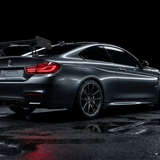
Once you have found the right example, a few reversible touches are enough to enhance its character without touching the mechanics or compromising any existing warranty: tailgate spoiler, steering wheel paddle shifters, and door sill lighting.

GLC C253 / W253 spoiler
Designed for 2016 to 2022 GLC and GLC Coupé models.

Carbon steering wheel paddle shifters
Check compatibility with your model year.

Aluminum steering wheel paddle shifters
Three finishes, installation without removing the steering wheel.

AMG door sill lighting
Logo projection on the ground, without drilling.
Explore the Mercedes spoiler, Mercedes grille, Mercedes mirror cap, and Mercedes performance accessory collections.
Verdict: should you buy a used GLC 43 AMG?
Yes, if you are willing to pay the price of a flawless example rather than what appears to be a good deal. The GLC 43 offers a combination that is becoming rare: a smooth and powerful six-cylinder engine, efficient all-wheel drive, and the practicality of a family SUV.
Its weaknesses are known and can be identified in a single well-conducted inspection: timing chain, transmission and transfer case maintenance, and the air suspension. None of these issues are design flaws; they are all the result of insufficient maintenance.
Our recommendation: aim for a 2019 or 2020 facelift model with between 60,000 and 100,000 kilometers, with a complete service history, documented transmission fluid change, and flawless cold start. Set aside €2,500 for the first year.
Our other reliability guides that complement this one
- Used Mercedes-AMG C43 W205: reliability guide
- Used Mercedes-AMG C43 Coupé and Cabriolet: reliability guide
- Used Mercedes C-Class W205: reliability guide
- Used Mercedes-AMG A35: reliability guide
- Used Mercedes-AMG GT: reliability guide
- Used Mercedes GLA X156: reliability guide
- Which Mercedes ML is the most reliable: comparison guide
- Used BMW X3 M and X4 M: reliability guide
FAQ: 12 frequently asked questions about the used GLC 43 AMG
Is the GLC 43 AMG reliable?
Overall, yes. The V6 M276 biturbo is a mature engine with no structural flaws. Concerns exist regarding the timing chain if maintenance is neglected, the 9G-Tronic transmission if the fluid is never changed, and the air suspension at the end of its life.
What are the known issues with the GLC 43?
Timing chain rattle on cold start, oil cooler seepage in the V, transmission converter wear, transfer case noise, cracked air springs, and weakened tailgate struts.
How much does a GLC 43 AMG consume?
Expect 11 to 12.5 liters per 100 kilometers in mixed use, about 9 liters on the highway at legal speeds, and 16 liters or more in spirited driving on winding roads.
What annual maintenance budget should you plan for?
Between €1,300 and €2,000 per year for 15,000 kilometers, excluding insurance and fuel. Tires and brakes account for more than half of this amount.
Should the 9G-Tronic transmission be flushed?
Yes, absolutely. Specialists recommend a fluid and filter change every 60,000 to 80,000 kilometers, costing between €350 and €500. A torque converter rebuild costs over €2,200.
What is the difference between the 367 hp GLC 43 and the 390 hp model?
The move to 390 horsepower came with the 2019 facelift. The performance difference remains modest; it is mainly the digital instrumentation and MBUX system that justify the price difference.
Is the GLC 43 Coupé worth the extra price?
Only for its style. The two body styles share the same mechanics, but the Coupé loses about 100 liters of trunk space, rear headroom, and a lot of visibility. The observed premium is between €2,000 and €4,000.
How much does it cost to repair the air suspension?
Between €700 and €1,100 per original air spring, and €600 to €900 for the compressor. Leaks generally appear after 120,000 kilometers or eight to ten years.
What maximum mileage should you accept?
A GLC 43 with 160,000 kilometers that has been perfectly maintained is safer than an example with 80,000 kilometers and no history. Above all, check the annual fluid changes, transmission, and transfer case.
How much does a used GLC 43 AMG cost in 2026?
From €31,000 for a high-mileage 2016 or 2017 model to around €56,000 for a low-mileage 2021 model. The heart of the market is between €40,000 and €47,000 for a facelifted 2019 model.
GLC 43 or C43: which should you choose?
The C43 is lighter, more agile, and consumes about one and a half liters less per 100 kilometers. The GLC 43 gains in interior space, comfort, and family versatility. The mechanics are identical.
Can the GLC 43 tow a trailer or caravan?
Yes, its towing capacity is generous and the V6's torque makes the task very comfortable. Simply check that the installed towbar is original or approved, and inspect the electrical wiring during the test drive.
Conclusion: personalize your Mercedes-AMG GLC 43
The GLC 43 AMG belongs to an endangered species: the premium compact SUV with a generous, smooth, and powerful six-cylinder engine. This is precisely what makes it a worthwhile used purchase, provided you select an example with a flawless service history.
Once yours is parked in front of your home, all that remains is to give it your signature. Tailgate spoiler, aluminum or carbon steering wheel paddle shifters, redesigned grille, mirror caps, door sill lighting: all reversible modifications that transform the car's presence.
Discover all Mercedes performance accessories
Popular searches: used Mercedes GLC 43 AMG, GLC 43 AMG reliability, GLC 43 AMG review, GLC 43 AMG fuel consumption, GLC 43 AMG test drive, GLC 43 AMG 2017 reliability, GLC Coupé 43 AMG review, GLC 43 AMG 2018 fuel consumption, GLC 43 AMG used price, M276 engine reliability, 9G-Tronic fluid change, GLC 43 vs C43, GLC 43 Coupé C253, GLC air suspension, GLC 43 AMG 390 hp.
Recevez nos prochains guides en avant-première
Tutos pose, comparatifs aftermarket vs origine, sélection M Performance/AMG/RS, codes promos exclusifs.