Carbon vs. fiberglass vs. ABS front lip: complete 2026 comparison
Three materials, three philosophies for your spoiler
Are you looking for a “carbon or fiberglass spoiler” or a “carbon or ABS spoiler”? When placing an order, the same part number can offer three, four, or sometimes five different finishes, with price differences ranging from double to tenfold. Between injected ABS, carbon effect (vinyl or textured ABS mimicking the weave), fiberglass, and genuine carbon fiber, it can be difficult to choose without a clear comparison of each material's weight, rigidity, strength, and, above all, its true value for money.
This 2026 guide details the technical characteristics of each material used to manufacture aftermarket spoilers and wings, using actual parts from our catalog that offer several finishes for the same model—the perfect opportunity to objectively compare ABS, carbon fiber, and alloys on a spoiler that is identical in shape and dimensions.

Audi TT RS MK3 MK2 spoiler—5 finishes, from €799
ABS: the standard material for aftermarket spoilers
ABS (acrylonitrile butadiene styrene) is the most widely used plastic in the manufacture of aftermarket spoilers, wings, grilles, and body kits. This is no coincidence: it combines good impact resistance, ease of molding (allowing complex shapes to be faithfully reproduced to match the original bodywork), full paint compatibility (paint, primer, and clear coat adhere perfectly), and a production cost significantly lower than that of carbon fiber.
Its main drawback is weight: for the same volume, ABS is significantly heavier than carbon fiber. On a medium-sized spoiler, this difference remains marginal for everyday road use, but it becomes noticeable on large GT wings with mounts. ABS is also more sensitive to UV rays over the long term when left unpainted (causing “unpainted” versions exposed to direct sunlight to gradually yellow), which is why a painted finish or a UV-protective clear coat should always be preferred for bare ABS spoilers.
Carbon effect: the clever visual compromise
Many of our parts offer a “carbon effect” finish (also known as carbon imitation): this is an ABS spoiler with a surface that visually reproduces the characteristic woven pattern of carbon fiber, either through a factory-applied vinyl film or a surface treatment integrated directly into the molding process. The visual result is impressive from a few meters away, at a fraction of the price of genuine carbon fiber. On our Mercedes C-Class W205 C63 AMG Sedan spoiler, the gloss black version costs €129, while the carbon effect version is just €149—a €20 difference for a significantly sportier look.

Mercedes C-Class W205 C63 AMG spoiler—from €129
The downside of carbon effect remains structural: it offers no weight or rigidity gains over standard ABS, as the base material is identical. It is purely an aesthetic option, best suited for budgets that prioritize style over technical benefits. For more on the long-term visual durability of this type of finish compared to genuine carbon fiber, our genuine carbon fiber vs. carbon imitation guide details the differences in how they hold up over time, which we will not repeat in full here.
Genuine carbon fiber: lightness and prestige

Genuine carbon fiber is a composite material made of woven carbon filaments embedded in epoxy resin, which is polymerized under pressure and heat (using an autoclave or vacuum infusion process, depending on the manufacturer). The result is a remarkably rigid material—but the weight savings often attributed to it do not come from its density, contrary to a widespread misconception. A carbon-epoxy laminate weighs approximately 1.50 to 1.60 g/cm³, while injected ABS weighs around 1.04 to 1.06 g/cm³: for the same volume, carbon fiber is therefore heavier. The weight savings come from its thickness. While an ABS spoiler requires 3 to 4 mm of material and reinforcing ribs to maintain its shape without vibrating, a 1.5 to 2 mm carbon fiber skin provides the same rigidity: the finished part is typically 30% to 50% lighter. It is this ratio of rigidity to thickness, rather than the material being inherently “light,” that makes carbon fiber the standard for competition spoilers and wings.
On our Porsche GT4 RS spoiler, directly inspired by the 718 Cayman GT4 RS, the black ABS version is offered at €1,119, while the genuine carbon fiber version costs €1,499—a €380 difference that reflects carbon fiber's significantly higher manufacturing costs (raw materials, weaving time, autoclave curing, and meticulous manual finishing of the glossy clear coat, which reveals the woven pattern).

Porsche GT4 RS spoiler—ABS €1,119 / Genuine carbon fiber €1,499
Forged carbon: the third option

Less well known to the general public, forged carbon uses chopped carbon fiber fragments that are compressed in a mold under high pressure, rather than continuous woven filaments. The visual result is a marbled pattern that is more irregular and textured than a traditional weave, making it highly sought after in premium markets because it allows for the molding of more complex shapes without the constraints of traditional weaving. It is featured on our Audi TT RS MK3 MK2 spoiler, which offers no fewer than five finishes on a single product page: gloss black ABS (€799), matte black ABS (€799), aluminum alloy (€999), genuine carbon fiber (€1,199), and genuine forged carbon fiber (€1,299)—a complete range that allows you to see at a glance the price hierarchy between the different materials available on the aftermarket.
In terms of mechanical properties, forged carbon generally falls between ABS and traditional woven carbon fiber: it is more rigid and lighter than ABS, but slightly less rigid than high-performance woven carbon fiber, while offering a unique visual appearance that appeals to enthusiasts looking to stand out from the now very common woven pattern.
And where does fiberglass fit in?
Fiberglass (fiberglass or GRP for glass-reinforced plastic) is a composite material older than carbon fiber, widely used in the marine industry and, historically, for certain custom body kits and handcrafted spoilers before carbon fiber and injected ABS became mainstream. Compared to the other two materials, it is the densest of the three, weighing approximately 1.70 to 2.00 g/cm³ for a glass-polyester laminate, compared to 1.50 to 1.60 for carbon-epoxy and 1.05 for ABS: at the same thickness, a fiberglass part is the heaviest of the three, and it only reaches the weight of ABS by using a thin wall; it offers good rigidity at a lower raw material cost than carbon fiber; however, it is more prone to microcracks upon impact, and its handcrafted construction (contact molding, manual lamination) makes manufacturing consistency vary more from one workshop to another than industrial ABS injection or controlled carbon fiber weaving.
In today's aftermarket, fiberglass remains a minority choice for standard road vehicle spoilers: most manufacturers, including ourselves, have favored injected ABS (for value and consistency) and carbon fiber (for high-end models), with fiberglass being more commonly reserved for custom body kits, one-off competition parts, or the restoration of classic vehicles. If you come across a fiberglass spoiler, pay particular attention to the quality of the lamination and the place of manufacture, as this parameter varies much more from one workshop to another than with industrial ABS or carbon fiber.
How to distinguish genuine carbon fiber from an imitation
With the proliferation of “carbon fiber” offers online, knowing how to distinguish genuine carbon fiber from an imitation is a useful skill before making a purchase. Several clues are reliable. First, the texture: genuine woven carbon fiber has a slight texture that can be felt, with each strand of fiber physically present under the resin, while a carbon effect vinyl film remains perfectly flat. Next, the weight: lift the part before buying if possible, or compare the weights listed on the product page—a spoiler that is identical in shape but significantly lighter in the “carbon fiber” version than in the ABS version is a good indicator of genuine carbon fiber. The price is also a reliable indicator: a spoiler advertised as “genuine carbon fiber” at a price only slightly higher than the ABS version should raise suspicion, as genuine carbon fiber always involves a significant manufacturing cost premium, as seen with our Audi TT RS and Porsche GT4 RS examples. Finally, the visual depth of the pattern under the clear coat: genuine carbon fiber creates an impression of three-dimensional depth and shine depending on the viewing angle, while a carbon effect print remains flatter and more uniform regardless of the viewing angle.
The manufacturing process: why such large price differences
Understanding the manufacturing process helps explain the price differences between materials. An ABS spoiler is produced by injecting material into a metal mold: once the mold is paid for by large production runs, the unit production cost becomes highly competitive, which explains the affordable price of this material. A woven carbon fiber spoiler, on the other hand, requires cutting carbon fiber fabric sheets by hand or with semi-automatic equipment, draping them into a mold with the fibers precisely oriented (the direction of the weave directly affects the final rigidity), impregnating the entire assembly with epoxy resin, and then curing it in an autoclave under controlled pressure and temperature for several hours, followed by meticulous manual sanding and clear coating to reveal the woven pattern under a perfectly transparent glossy layer. Each step adds skilled labor time, which explains a production cost significantly higher than that of ABS, even when accounting for economies of scale on the most popular models, such as Audi RS or BMW M spoilers.
Forged carbon follows a different process: chopped fiber fragments are pre-impregnated with resin, placed in the mold, and then compressed under very high pressure between the two halves of a heated mold. It is a compression molding process, not injection molding like ABS: the material is pressed into the open mold, which is then closed, rather than being pushed by a screw into a closed mold. It is precisely this process that allows for the reproduction of more complex shapes in a single operation, without manual draping. Nevertheless, this process remains more expensive than standard ABS injection molding due to the raw materials used and the molding pressures required, justifying its price positioning between woven carbon fiber and ABS on most models where both options coexist.
The material's impact on total weight and vehicle balance

Although the weight difference between an ABS spoiler and a carbon fiber spoiler is negligible compared to the total weight of a vehicle (generally between 1,200 and 2,000 kg), it becomes significant on large wings with mounts, where every hundred grams saved at the rear of the vehicle contributes, however marginally, to a better mass balance. This is a common consideration for owners of Porsche GT4 RS, Audi RS3, or BMW M3/M4 Competition vehicles, whose factory versions already rely heavily on carbon fiber to reduce the overall weight of the vehicle (hood, roof, spoiler, optional wheels). Choosing an aftermarket genuine carbon fiber spoiler rather than an ABS one therefore aligns with the overall lightweight philosophy of the original vehicle, rather than being merely an isolated aesthetic choice.
Environmental impact: which material is easiest to recycle?
An increasingly important criterion for our customers is the environmental impact of the chosen material. ABS is a recyclable thermoplastic according to established recycling streams, making it the easiest material to process at the end of its life among the three options. Carbon fiber, however, is a thermosetting composite (irreversibly polymerized resin) and remains much more difficult to recycle: carbon composite recycling streams exist but are still in their infancy compared to those for conventional plastics, as separating the fiber from the resin requires specific thermal or chemical processes. Fiberglass occupies an intermediate position, with crushing and reuse recycling streams for other composite materials that are more developed than those for carbon fiber, but still significantly less mature than ABS plastic recycling. This factor remains secondary in most purchasing decisions, but it is worth mentioning for buyers who are sensitive to this issue.
Comparison table: weight, rigidity, price
Resistance to UV rays, impacts, and aging over time
Each material ages differently. Painted ABS resists UV rays well as long as the paint and clear coat remain intact, but a chip in the paint exposes the bare plastic, which can then yellow locally over time. A vinyl carbon effect film carries the same risk, along with the risk of the edges peeling if the original application was imperfect or if the spoiler is subjected to repeated high-pressure washing too close to the surface. Genuine carbon fiber, protected by a high-quality UV clear coat (specific gelcoat or clearcoat), retains its glossy appearance and woven pattern for significantly longer, provided it is not constantly exposed to extreme sunlight without maintenance.
In terms of impact resistance, ABS retains a natural advantage: its plastic nature allows it to absorb a minor impact (gravel, door ding) without cracking, while a more severe impact on carbon fiber can create a crack or delamination of the fiber layers, which is more difficult to repair than simply sanding and repainting ABS. This is an important consideration if your vehicle is parked outdoors in a dense urban environment, where the risk of minor impacts is more frequent.
Installation: different requirements depending on the material
The chosen material also influences how the spoiler should be handled and installed. An ABS spoiler tolerates drilling well for additional screw mounting alongside 3M adhesive, as the plastic is not prone to delamination when drilled. A genuine carbon fiber spoiler, on the other hand, requires more precautions: drilling directly into a carbon part without proper care (appropriate drill bit, reduced drilling speed, no vibration) can cause the fibers to splinter around the hole, weakening the area. For this reason, high-end carbon spoilers are generally designed for structural bonding only, without additional drilling, and come with positioning templates or factory-machined mounting points. Forged carbon and aluminum alloy (available on our Audi TT RS spoiler) generally tolerate drilling better than woven carbon, although they do not match ABS in terms of tolerance in this specific regard.
Another practical difference: weight directly affects ease of handling during installation. A large ABS spoiler often requires two people to hold it in position while the adhesive cures, whereas an equivalent carbon spoiler, being significantly lighter, can often be positioned and held by one person using blocks or temporary masking tape, making solo installation considerably easier.
▸ Our recommended accessories


Warranty and material: what changes
The nature of the material can also influence the applicable warranty conditions. Across our entire catalog, all spoilers are covered by our standard warranty, but it is useful to know that covered incidents naturally differ depending on the material: a paint chip on ABS can be easily repaired with a local touch-up, while a crack in genuine carbon fiber requires a more thorough inspection to determine whether the composite remains structurally sound beneath the visible crack. This is another factor to consider if your vehicle is likely to be exposed to demanding conditions (dense urban parking, driving on minor roads with gravel spray): in these contexts, the ease of repairing ABS can compensate for its slight weight disadvantage compared to carbon fiber.
Multi-brand overview: which material dominates according to the manufacturer
Over the years, certain trends have emerged across different brands. For BMW, the M Performance, M4 Style, and PSM Style ranges (particularly the 4 Series F32/F33/F36) are overwhelmingly offered in glossy black ABS or carbon-effect finish, with genuine carbon fiber reserved for more exclusive models such as the M3/M4 Competition. For Mercedes-AMG, the logic is similar: ABS and carbon-effect finishes cover most of the catalog (C-Class W205, GLE Coupe, CLS), with genuine carbon fiber mainly found on the sportiest models in the range. For Audi, the range is the widest of all the brands we distribute: from classic ABS (Audi A3, A4 B8) to exclusive forged carbon (TT RS MK3), with every intermediate option in between, making it a particularly suitable brand to illustrate this comparison guide. For Porsche, genuine carbon fiber is proportionally more common, in line with the brand's premium and sporty positioning, including on entry-level aftermarket spoilers.
Material and technical inspection: is there a difference?
A question we are often asked: does the material of a spoiler affect whether it passes the technical inspection? In France, the technical inspection does not distinguish between spoilers based on their manufacturing material (ABS, carbon fiber, fiberglass, or aluminum): what is checked is the secure attachment of the part, the absence of dangerous protruding or sharp edges, and that it does not obstruct regulatory equipment (lights, license plate). A poorly attached carbon spoiler poses exactly the same risk of non-compliance as a poorly attached ABS spoiler. The material is therefore not directly considered in the regulations, with the quality of installation taking precedence over the nature of the material. For any specific regulatory questions, you can consult official resources on service-public.fr or our dedicated guide spoilers and technical inspection: the legal guide.
Concrete example: the 5 finishes of the Audi TT RS MK3 spoiler
The Audi TT RS MK3 MK2 spoiler perfectly illustrates the entire hierarchy of materials available on the aftermarket, as it is offered in five versions that are strictly identical in shape:
- Glossy Black ABS — €799: the entry-level option, robust and easy to repaint.
- Matte Black ABS — €799: the same technical base, with a matte finish that better hides minor wear scratches.
- Aluminum alloy — €999: a metallic alternative, stiffer than ABS, with a distinctive brushed finish.
- Genuine carbon fiber — €1199: the weight/stiffness/aesthetics compromise most sought after by purists.
- Genuine forged carbon — €1299: the top-of-the-range option, with an exclusive marbled pattern and high stiffness—greater than that of ABS, but less than woven carbon, whose continuous fibers perform better under tension.
This price gradation (€799 → €1299, or +62% between the entry-level and top-of-the-range options) accurately reflects the order of magnitude of the manufacturing cost differences between the materials mentioned in this guide for a single product reference—a textbook case for objectively comparing your available budget with your technical and aesthetic priorities.
The Audi A5/S5 case: three levels of carbon on a sedan spoiler
Another telling example: our Audi A5 S5 Spoiler (2017-2023) offers a three-tier gradation that clearly shows the difference between imitation carbon and real carbon: glossy black at €199, carbon-effect print at €219 (barely more expensive, but still ABS), and genuine carbon fiber at €299. The difference between imitation and genuine carbon remains modest here (€80), making it a good example of a segment where investing in genuine carbon remains affordable without blowing the project's total budget.

Audi A5 S5 Spoiler — from €199, genuine carbon at €299
What budget for which material?
In summary, here are the budget benchmarks we observe across our entire catalog: glossy or matte black ABS remains the most economical entry point, often between €99 and €300 depending on the size and model. The carbon effect (ABS) generally adds 10 to 20% to the base price for a significantly sportier visual appearance, without any technical gain. Genuine carbon fiber represents a 40 to 100% surcharge compared to equivalent ABS, but provides a real gain in weight and stiffness, in addition to a premium finish that stands out to the naked eye with the depth and texture of the weave. Forged carbon, which is rarer, is generally positioned at the top of the range, reserved for enthusiasts seeking visual exclusivity as much as performance.
Maintenance according to the chosen material
Maintenance differs considerably from one material to another. A painted ABS spoiler is cleaned like the rest of the bodywork, with mild soapy water, with occasional polishing to maintain its shine. A carbon-effect vinyl film spoiler requires avoiding high-pressure cleaners too close to the edges of the film, which can cause it to peel over time. A genuine carbon fiber spoiler requires a wax or sealant specifically designed for clear-coated carbon, which protects the clearcoat from UV rays and prevents the woven pattern from fading over time—a standard bodywork care product also works, but a dedicated product maintains the shine for longer. Our comprehensive guide on maintaining carbon fiber and ABS parts details all best practices for each material, including products to absolutely avoid.
Which material for which type of buyer?
If you drive daily in the city, with a risk of minor impacts (parking, gravel), painted ABS often remains the most pragmatic choice: easily repairable, economical, and sufficiently attractive once painted in your bodywork color. If you want the carbon appearance without the carbon budget, ABS carbon effect offers an excellent visual compromise for a minimal surcharge. If you are looking for a real weight saving (particularly useful on large bracket spoilers) and a finish that does not deteriorate over time, genuine carbon fiber remains the essential benchmark, especially on vehicles already positioned as high-end (Porsche, Audi RS, BMW M). Finally, forged carbon is aimed at collectors and enthusiasts who want a unique visual appearance and are willing to pay the exclusivity premium that comes with it.
Painting your ABS spoiler: the best of both worlds?
For tight budgets that still want a finish perfectly matching the bodywork, the unpainted ABS option remains an interesting and underestimated route: you buy the bare spoiler, which is cheaper than the pre-finished versions, and have it painted by a body shop in the exact color of the vehicle (manufacturer color code). This approach combines the affordable price of ABS with a completely custom finish, impossible to achieve with a generic glossy black or standardized carbon-effect shade. It is an option worth seriously considering if you already have a trusted body shop or if your bodywork color is an uncommon metallic or pearlescent shade, for which a standard black spoiler would create a contrast you do not want.
The weight of the spoiler in the overall calculation of mass distribution
For the most meticulous enthusiasts, the choice of material can also be part of a broader consideration of the vehicle's mass distribution. A lighter spoiler at the rear helps, even marginally, to limit the addition of mass at the rear overhang. The terminology deserves clarification, because it is often used incorrectly: a spoiler is glued or screwed onto the trunk lid or tailgate, therefore above the springs—it is unsprung mass. Unsprung mass, the reduction of which actually changes the handling of the running gear, only concerns the wheels, tires, discs, calipers, and part of the suspension arms: no spoiler, regardless of its material, affects it. The effect of a lighter spoiler is therefore modest, and is only noticeable on vehicles already oriented toward performance, during dynamic driving (fast corners, hard braking). Although this gain is difficult to measure in everyday driving, it explains why the factory configurators of premium brands (carbon option on Porsche, BMW M, or Audi RS) systematically charge a significant premium for the weight saving, a premium that is logically reflected in our own price differences between ABS and carbon versions of the same spoiler.
Can you mix materials on the same vehicle?
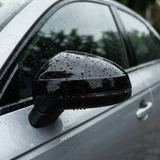
A common question concerns visual consistency when several aftermarket parts are installed: must the material of the spoiler necessarily match that of the mirror caps, grille, or paddle shifters? In practice, our customers who achieve the most harmonious look prioritize consistency in the finish between the exterior parts visible together in a single glance (the spoiler and mirror caps, for example), while interior parts (paddle shifters, dashboard inserts) can follow an independent material logic, as the eye does not compare them simultaneously from outside the vehicle. However, there is no absolute rule: many successful projects combine a genuine carbon fiber spoiler with glossy black ABS mirror caps, the subtle contrast between the two textures even creating a sense of depth appreciated by some enthusiasts rather than a styling mistake.
FAQ — Carbon, fiberglass, or ABS spoiler
Is a carbon fiber spoiler really lighter than ABS?
Yes, but not for the reason people think. At an identical volume, carbon-epoxy laminate (1.50 to 1.60 g/cm³) is denser than ABS (1.04 to 1.06 g/cm³). The weight saving comes from the wall thickness, which is much thinner at the same stiffness, and results in a finished part that is generally 30 to 50% lighter—a difference measured in hundreds of grams, which is particularly noticeable on large bracket spoilers.
Is a carbon-effect spoiler as strong as a classic ABS spoiler?
Yes, the base material remains identical (ABS): only the surface treatment changes. The mechanical impact resistance is therefore comparable to that of a classic painted ABS spoiler.
Do you sell fiberglass spoilers?
Our catalog focuses on ABS and carbon fiber (woven or forged), the two current standards in the aftermarket for road vehicles. Fiberglass remains a minority in this segment and is used more for custom-made or restoration parts.
Can you repaint a genuine carbon fiber spoiler?
This is generally not recommended: the woven pattern provides all the visual appeal and value of genuine carbon fiber. Repainting would hide this pattern—it is better to choose an ABS version directly if you plan to have a custom paint job in your bodywork color.
What is the difference between woven carbon and forged carbon?
Woven carbon uses continuous fibers woven in a regular pattern (the famous "checkerboard" effect), while forged carbon compresses chopped fiber fragments in a mold, creating an irregular marbled pattern and allowing for more complex shapes.
Does an ABS spoiler really yellow over time?
Only unpainted versions that are exposed to UV rays for extended periods. A properly maintained painted and clear-coated ABS spoiler does not experience this problem over the normal lifespan of a vehicle.
Is forged carbon more expensive than classic woven carbon?
It depends on the specific part: on our Audi TT RS MK3 spoiler, forged carbon (€1299) is positioned slightly above woven carbon (€1199), in line with its more exclusive character and its manufacturing process under very high pressure.
Is an aluminum spoiler a good compromise between ABS and carbon?
Yes, as shown by the aluminum alloy version of our Audi TT RS spoiler (€999), this material offers greater stiffness than ABS at an intermediate price, with a distinctive metallic visual appearance that appeals to some enthusiasts looking for an alternative to carbon weave.
Should carbon fiber be avoided in very sunny regions?
No, provided that the UV protection varnish is of good quality, as is the case with our genuine carbon fiber products. Regular maintenance with a dedicated UV protection product further extends the life of the finish in areas with intense sunlight.
What to keep in mind before comparing two product pages
Before comparing two seemingly similar spoilers from different shops, keep in mind that the term "carbon" is not always used with the same level of rigor from one seller to another: some use it to refer to a simple visual effect in ABS, others to genuine woven carbon, and others still to forged carbon. Across all our product pages, we systematically distinguish three categories in the variant name—"Carbon Effect" or "Carbon Effect Print" for ABS imitation, "Genuine Carbon Fiber" for woven carbon, and "Genuine Forged Carbon" for forged carbon—precisely to avoid any ambiguity at the time of purchase. Before confirming your order on any shop, always take the time to check this precise terminology rather than relying solely on the photo, which can be misleading when zoomed in on screen.
Our recommendation based on your project
If your customization project is primarily driven by budget and aesthetics, with standard daily use, glossy black or carbon-effect ABS will perfectly meet your expectations without compromising on robustness. If you already own a high-end sports vehicle whose identity is partly based on weight reduction (Porsche, Audi RS, BMW M Competition), investing in genuine carbon fiber logically extends this technical and aesthetic consistency. If you are looking to stand out visually from the vast majority of carbon spoilers already widespread on the market, forged carbon offers that sought-after exclusivity, albeit at a higher investment. Whatever your final choice, keep in mind that the quality of installation (bonding, alignment, and any additional drilling) remains at least as important as the chosen material for long-term durability and the final aesthetic result of your spoiler.
Density, thickness, actual weight: the three figures missing from product pages

All the confusion surrounding the carbon spoiler stems from a shortcut: "carbon is light". Taken literally, this is false, and it leads to unrealistic expectations when unboxing. What you are buying with a composite is not a lightweight material, but a material so rigid that you can use much less of it. Here are the three figures that allow you to reason correctly, and which no product page displays.
Specific gravity of spoiler materials (g/cm³)
| Injected ABS — 1.05 | 1.05 g/cm³ |
| Woven carbon / epoxy — 1.55 | 1.55 g/cm³ |
| Forged carbon — 1.50 | 1.5 g/cm³ |
| Fiberglass / polyester — 1.85 | 1.85 g/cm³ |
| Aluminum alloy — 2.70 | 2.7 g/cm³ |
The first figure is the density, and it ranks the materials in the reverse order of intuition. ABS is the least dense of the four. Carbon-epoxy is about 50% denser than it, fiberglass almost twice as dense, and aluminum two and a half times. If we cut a one-centimeter cube from each of these materials, the ABS cube would be the lightest of all. Carbon fiber is not a lightweight material: it is a rigid material.
The second figure is the wall thickness, and that is what makes all the difference. An injected ABS spoiler holds its shape thanks to a 3 to 4 mm wall, often reinforced with internal ribs to prevent the lip from vibrating at constant speed. A woven carbon skin achieves the same stiffness with 1.5 to 2 mm, without ribs. Multiply: a part 2.2 times thinner in a material 1.5 times denser weighs about 30% less, and up to half as much less on large parts where ABS ribs add significant weight.
The third figure is the only one that really counts: the weight of the finished part, the one you will feel in the box. On a lip-style trunk spoiler, the weight range is 1.2 to 2.5 kg in ABS compared to 0.8 to 1.6 kg in carbon. On a wing with mounts, the absolute difference increases but remains in the same ratio. In other words: we are talking about a few hundred grams on a one-and-a-half-ton car. It is real, it is measurable, it is not what will transform the handling of your vehicle—and a seller who promises you otherwise is selling you a story.
A word on the price of carbon fiber per kilo, a question that comes up often: it is not bought by the kilo but by the square meter of fabric, and the cost of the raw material represents only a fraction of the final price. What you are paying for is the draping time, the curing, and the manual finishing, as detailed in the section on manufacturing processes above.
What the material does not change: downforce, handling, and safety

This section exists because the opposite is read everywhere, and an honest comparison must state its limits before boasting about its differences. There are three things that no spoiler material changes, and knowing them prevents buying for the wrong reasons.
Aerodynamic downforce does not depend on the material, but on the shape and speed. A woven carbon trunk spoiler and the same spoiler in ABS, with strictly identical geometry, produce exactly the same effect on airflow: the boundary layer does not know what is under the varnish. And this effect, on a trunk lip at legal French speeds, amounts to a few kilograms of downforce at most—aerodynamic force increases with the square of the speed, which means that a device designed to work at 250 km/h does almost nothing at 130. The trunk spoiler is primarily a styling piece, secondarily an aerodynamic piece, and acknowledging this takes nothing away from its appeal.
Handling does not change any further. The hundreds of grams saved by carbon are lost in the statistical noise compared to the weight of a full tank of fuel or a rear passenger. No honest road test shows a difference in handling between two material versions of the same spoiler.
And above all: a trunk spoiler is not a safety device, regardless of its material. It is not part of any programmed deformation structure, it does not absorb anything during a rear impact, it does not protect anyone. Carbon fiber is used in competition for survival cells and anti-crash structures, but these are parts designed, calculated, and approved for that, with ply orientations and thicknesses that have nothing to do with a 1.5 mm decorative skin bonded to a trunk. A carbon spoiler does not inherit any of these properties. The only parameter of your spoiler that affects safety is its mounting: a poorly bonded part that detaches at highway speed is a projectile, whether in ABS or carbon. This is also the only point that the technical inspection looks at, as explained in the dedicated section above, and that is why surface preparation before bonding deserves more attention than the choice of material: our guide choosing and preparing a 3M bond details the method, and installing a trunk spoiler shows the complete installation step by step.
Repairing a cracked spoiler: three materials, three very different scenarios
Repairability is the criterion that no one looks at when buying and that everyone discovers after a parking lot bump. Yet this is where the difference between materials is most concrete, much more so than weight.
After an impact: what really happens
- It bends and whitens before breaking
- Crack welded with liquid plastic
- Filler, primer, paint: invisible
- An ordinary body shop is enough
- Chip touched up with a brush, without removal
- It takes the hit, then breaks cleanly
- Invisible delamination under the surface
- Ply repair, resin, curing
- Specialized composite shop
- The weave never matches up
Two clarifications behind this table. On the ABS side, a clean crack is welded with liquid plastic or a hot staple, then hidden with polyester filler: a general body shop takes care of it, spoiler in hand, and the result is invisible. On the carbon side, the repair requires stripping the area, re-laying the plies, re-impregnating, curing, and re-varnishing—a composite shop job, at the end of which the match of the woven pattern remains almost always perceptible from a certain angle.
The important point is not that carbon is fragile—it is not, its tensile strength crushes that of ABS. It is that it behaves in a mechanically fragile way: it does not warn you. ABS bends, whitens, marks, and lets you see it coming. A laminate takes the hit without flinching until the breaking point, and an impact that has left only a micro-star on the surface can have delaminated several plies underneath, over a much larger area than the visible mark. This is what is called delamination, and it is the reason why an expert looks at a crack on a composite differently than a chip on plastic.
Fiberglass occupies an intermediate position, and that is its real argument: it is repaired with the same products as any boat hull—glass cloth, polyester resin, filler, sanding—in an ordinary shop and at a modest cost. A cracked fiberglass wing is re-stratified from the back in an afternoon, which explains its persistence in the world of amateur track racing and restoration, where parts take hits and you do not replace, you repair.
Translation into a buying decision: if your car sleeps outside in a narrow street, painted ABS is not a default choice, it is the rational choice. If it sleeps in the garage and goes out on the weekend, the repairability argument loses most of its weight.
Painting a spoiler: what each material requires before primer

“Painting a car spoiler” and “spoiler paint” are among the most frequent searches around this topic, and for good reason: the raw version is almost always the cheapest in the catalog. Still, you need to know what the material requires, because the preparation does not translate from one material to another.
Preparation before painting, material by material
- Raw ABSSilicone-free degreasing, sanding P320 then P400 with water, plastic filler primer.
- Already glossy black ABSThe factory varnish serves as a base: fine buffing, dusting, direct paint.
- FiberglassFill micro-bubbles with fine filler, sand, then pore-filling primer.
- Varnished carbonBuff the clearcoat without ever reaching the fiber: too hard sanding is irreversible.
- All materialsPaint the spoiler removed, before installation, and let it cure for several days.
Four comments on these steps, because these are the points where you make mistakes. On raw ABS, there is no need to flame the part: the flame treatment concerns the polypropylene of bumpers, not ABS, which naturally bonds well to lacquer. On already glossy black ABS, there is no need to strip down to the plastic, the factory varnish makes an excellent base. On fiberglass, the micro-bubble step is the one everyone skips: a single unfilled bubble will show through after the varnish, and it will be too late. On varnished carbon, finally, the preliminary question is why you are painting: hiding a weave that you paid several hundred euros for is a strange choice, and sanding that cuts into the fabric creates a permanent defect, the resin cannot be touched up.
One method remark that applies to all four cases: the area that will receive the structural adhesive must not be painted, or else the paint must be perfectly bonded to it. Double-sided tape bonds very well to lacquer—but if the lacquer itself does not bond to the plastic, it is the paint that will fail, taking the spoiler with it. Many peel-offs attributed to the glue are actually preparation defects under the paint.
Finally, wrapping is an alternative that deserves to be mentioned here rather than rejected: a quality vinyl film applied to a raw ABS spoiler costs less than a paint job in a booth, comes off without a trace, and allows you to change your mind. It is also what makes the boundary between "carbon effect" and "carbon" blurrier than it should be, the subject of the next section.
Forged carbon, "forged carbon" wrapping, and 3D vinyl: three different things
Genuine forged carbon has become in a few years the most misused sales pitch in the industry. The associated searches show it clearly: alongside "forged carbon price" and "forged carbon car", you find "forged carbon wrapping", "blue forged carbon" and "red forged carbon". Yet these three families of products have neither the same price, nor the same nature, nor the same lifespan.
Genuine forged carbon is a structural composite part: chopped fiber strands, pre-impregnated, hot-pressed in a closed mold. The marbled pattern is the material itself, it goes through the entire thickness. Sand the surface, the marbling is always underneath. This is what the "Genuine Forged Carbon" mention on our pages refers to, and it is what justifies the €1299 of the high-end version of the Audi TT RS MK3 spoiler.
The "forged carbon" wrapping is a printed adhesive film that reproduces this marbling. The part underneath remains ABS, polypropylene, or even sheet metal. It is a perfectly honest solution as long as it is announced as such, and it has its advantages: very low cost, reversibility, choice of colors impossible in composite—the famous blue and red versions we see going around are, in the vast majority of cases, films. A real tinted forged carbon exists, but it requires a pigmented resin and remains rare and expensive.
The "3D carbon" or "5D" vinyl, finally, is a textured film that imitates the classic weave with a relief molded into the plastic material of the film. This is what makes the touch test less reliable than before: a good quality 5D presents a relief. The test that remains discriminating is that of the edge—look at the edge of the part, where it ends. A composite shows the cut of its laminate, a film shows an edge where the vinyl folds over. The second test is that of the tight radius: on a sharp edge, the pattern of a film stretches and visibly deforms, that of a composite follows the shape without distortion, since it was molded with it.
The same reasoning applies word for word to interior parts, where the film dominates even more widely: see our guide carbon dashboard inserts: imitation or real carbon. On large bodywork parts, however, the question arises differently, the composite quickly becoming indispensable for rigidity—this is the case of the carbon fender flares and wide body kits.
Carbon spoiler by model: RS3 8Y, Tesla Model 3 and Model Y, M3 E92, Alpine A110
The most frequent searches around the carbon spoiler are not about the material in general, but about a specific model: "carbon spoiler RS3 8Y", "carbon spoiler Tesla Model Y", "carbon spoiler Tesla Model 3", "carbon spoiler Alpine A110", "carbon spoiler Alfa Romeo Giulia", "carbon spoiler M3 E92", "carbon spoiler M4 F82", "carbon spoiler M2 Competition". This list says something useful about the market, and the material reasoning is not the same from one car to another.
On the Tesla Model 3 and Model Y, the trunk lip is short and the bonded surface area is small: the weight savings of carbon are negligible in absolute terms, and the choice is almost exclusively based on looks, between gloss black which disappears on a black car and a weave that catches the light on a light-colored body. The ABS carbon effect is, objectively, the best value for money.
On the BMW M3 E92, M4 F82 and M2 Competition, the logic changes: these cars often receive a CSL- or PSM-style high-lip spoiler, with a much larger exposed surface area that must resist bending without vibrating at high speed. This is exactly the use case where the rigidity of the composite is technically justified, not just aesthetically. Let's add that a woven carbon E92 is consistent with an interior and roof that already feature it on the relevant versions.
On the Audi RS3 8Y and Alpine A110, two cars whose identity is based on lightness and chassis, carbon plays mainly a role in design consistency. The A110 in particular, built around an obsession with weight, makes the argument credible even if the actual difference remains symbolic — and that's perfectly fine: aesthetic consistency is a perfectly legitimate reason to buy, as long as it isn't dressed up with imaginary performance.
Spoilers and carbon parts by brand


Additional FAQ: densities, repair, paint and faux carbon
Twelve questions that come up after reading a material comparison, and which complement the FAQ above without repeating it. The stated specific gravity values are standard engineering values for common laminates; the prices mentioned in this guide were verified in our catalog as of the article's update date.
Is carbon really lighter than ABS, yes or no?
The finished part, yes: 30 to 50% less in general. The material, no: a carbon-epoxy laminate weighs 1.50 to 1.60 g/cm³ compared to 1.04 to 1.06 g/cm³ for ABS, so it is denser at the same volume. All the weight savings come from the wall thickness, 1.5 to 2 mm in carbon compared to 3 to 4 mm plus ribs in ABS.
How much does a trunk spoiler really weigh?
On a classic trunk lip, count on 1.2 to 2.5 kg in ABS and 0.8 to 1.6 kg in carbon depending on the size. The useful difference is therefore measured in hundreds of grams. On a wing with mounts, the difference increases in absolute terms but remains in the same ratio.
Does a carbon spoiler make the car safer?
No. A trunk spoiler is not part of any safety structure and does not absorb anything during an impact, regardless of its material. The carbon anti-crash structures in competition are parts calculated and approved for this, unrelated to a decorative skin bonded to a trunk. The only safety parameter of a spoiler is the quality of its mounting.
Is fiberglass lighter than ABS?
No, it is even the densest of the common spoiler materials: 1.70 to 2.00 g/cm³ for a glass-polyester laminate. At the same thickness, a fiberglass part is heavier than an ABS part. It only comes back to the level of ABS by playing on a thin wall, which its rigidity allows.
What is the difference between real forged carbon and forged carbon wrap?
Real forged is a composite: the marbling is the material itself and goes through the entire thickness. The wrap is a printed adhesive film applied to an ABS or sheet metal part. The blue and red versions we encounter are almost always films: a tinted forged exists, but it assumes a pigmented resin and remains rare.
How to recognize a 5D carbon film from a real weave by touch?
Touch is no longer enough: a 5D film has relief. Look at the edge of the part — a composite shows the cut of its laminate, a film shows the edge where the vinyl folds. Second test: on a tight radius, the pattern of a film visibly stretches, that of a composite follows the shape without distortion.
Is a cracked carbon spoiler repairable?
Yes, but not by a general body shop. You need a composite workshop: re-laying plies, resin, curing, repainting — and the woven pattern never matches up completely. The real risk is delamination: an impact that left only a micro-star on the surface may have detached several plies underneath, over a much larger area.
Should you flame an ABS spoiler before painting it?
No. The flame treatment concerns the polypropylene of the bumpers, not ABS. An anti-silicone degreasing, sanding P320 then P400 with water and a plastic filler primer are enough: ABS naturally grips the lacquer well.
Can you paint over a spoiler that is already gloss black?
Yes, and it is even easier than starting from raw: the factory varnish serves as a primer. Complete matting with a fine abrasive pad, dusting, then paint. No need to strip down to the plastic.
Can you glue a spoiler on a freshly painted area?
Not right away, and never on paint whose adhesion is not certain. The adhesive holds very well on a lacquer, but if the lacquer does not stick to the support, it is the lacquer that will let go, taking the spoiler with it. Let it cure for several days and check the adhesion before installing.
Is carbon justified on a Tesla Model 3 or Model Y?
Aesthetically yes, technically little: the trunk lip is short, the weight savings are negligible in absolute terms and the rigidity of ABS is more than enough on this geometry. The ABS carbon effect offers the best value for money. The reasoning is reversed on the high-lip spoilers like CSL on the BMW M.
Does a carbon spoiler hold up better over time than painted ABS?
On the finish, yes, as long as the anti-UV varnish remains intact: the pattern does not fade and there is no paint to peel. On the structure, both hold up just as well in normal road use. The difference is played out on the day of the impact, not over the years.
Frequent searches: carbon spoiler, carbon spoiler RS3 8Y, carbon spoiler Tesla Model Y, carbon spoiler Tesla Model 3, carbon spoiler Alpine A110, carbon spoiler Alfa Romeo Giulia, carbon spoiler M3 E92, carbon spoiler M4 F82, carbon spoiler M2 Competition, carbon spoiler, carbon wing, universal carbon wing, carbon wing Mégane 4 RS, carbon wing Audi TT MK2, fiberglass wing, fiberglass spoiler, carbon fiber car, carbon fiber price, carbon fiber price per kilo, carbon fiber composition, carbon fiber manufacturing, forged carbon, forged carbon price, forged carbon car, forged carbon wrap, blue forged carbon, red forged carbon, paint car spoiler, paint a spoiler, spoiler paint, plastic spoiler, ABS carbon.
In summary
Before any order, take the time to carefully re-read the name of the chosen variant on the product sheet: ABS, carbon effect, fiberglass, real woven carbon or forged carbon never designate the same user experience, nor the same budget. The choice between ABS, carbon effect, fiberglass and real carbon fiber (woven or forged) depends above all on your budget, your daily use and your priorities between pure aesthetics and real technical gain. ABS remains the safe economic and robust value, the carbon effect an excellent visual compromise, and real carbon fiber the premium choice for those seeking lightness and prestige. Always compare the different finishes available on the product sheet of your exact model, such as on our Audi TT RS, Audi A5/S5 or Porsche GT4 RS references which offer several materials on a spoiler of identical shape.
If in doubt, never hesitate to contact us before ordering to confirm the exact nature of the material of a reference that interests you: we always prefer to answer a question beforehand than to manage a disappointment after receipt. Find our entire range of multi-material spoilers on our Car Spoiler Collection, and complete your reading with our guide real carbon vs imitation carbon as well as our article on what size of spoiler to choose according to your car to refine your project as a whole.
Recevez nos prochains guides en avant-première
Tutos pose, comparatifs aftermarket vs origine, sélection M Performance/AMG/RS, codes promos exclusifs.