Audi TT RS MK3: The compact coupe that defies supercars
- On an Audi TT RS Mk3, two paths open up: the subtle pack (spoiler + interior carbon) or the radical pack (sized fixed wing).
- The choice is not a matter of taste but of actual use: daily driving or occasional track use.
- The 2.5 TFSI 5-cylinder is the heart of the car. The core of the perceived pleasure comes through the sound — with an approved exhaust system, without exception.
- To preserve the warranty: favor bonded or clipped elements, non-invasive, and keep all invoices.
- The TT Mk3 shares many interior elements with the RS range — a real advantage in terms of choice and prices.
- Keep all original parts. On an RS, their absence weighs heavily at the time of resale.
- Allow €1,000 to €1,500 for a coherent Audi TT RS Mk3 tuning, and always check the 8S phase before ordering.
Audi TT RS MK3, 400 horsepower, 0-100 in 3.7 seconds, 2.5 TFSI inline 5-cylinder with an inimitable sound. Ingolstadt's compact coupe has never been so close to a real supercar. Here is how to enhance it even further with smart tuning.
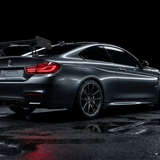
The TT RS MK3 rear spoiler
It is the most subtle aero element: a trunk spoiler extending the roofline, identical to the factory Performance option. Clean style but immediate racing signature.

Audi TT RS MK3 / MK2 spoiler (2008-2020)
Woven carbon fiber, Performance pack look. Compatible with TT, TTS and TT RS. €799
View the spoilerThe XXL carbon wing: for track enthusiasts

If you take your TT RS to track days, the fixed rear wing in real carbon fiber radically changes the behavior at high speed.

Audi TT RS MK3 wing - carbon fiber
Real carbon fiber, GT racing structure, reinforced mountings. €1299
View the carbon wingRS range carbon paddles
The same carbon paddle that equips the Audi R8, RS3, RS4, RS5. Economies of scale that allow offering real carbon at €99.

RS range carbon steering paddle
Compatible with R8, RS3, RS4, RS5, TT RS, RS Q3, Q8. Real carbon fiber. €99
View the paddlesTT MK3 mirror caps
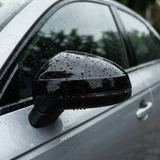
Specific TT MK3 replacement mirror caps in carbon fiber or glossy black. Clip-on installation on the original cap.

Audi TT MK3 mirror cap
L/R pair. Real carbon or glossy black ABS. 10-minute installation. €99
View the capsBudget by use
| Pack | Composition | Total |
|---|---|---|
| Daily driving | Spoiler + paddles + caps | €997 |
| Occasional track day | Carbon wing + paddles | €1398 |
The complete guide to customizing a TT RS Mk3
What preceded gives the four most immediate modifications. What follows is the foundational guide, designed for a complete project. We will address the car itself and its particularities, the central question of generations, the choice between spoiler and wing, carbon, wheels, exhaust, interior, warranty, approval, maintenance and a reasoned budget progression.
Understanding what a TT RS Mk3 really is
Before modifying a car, you must know what makes its character. The third generation TT RS is based on a transverse architecture with original front-wheel drive, equipped with an all-wheel drive system with a multi-plate clutch controlled on the rear axle. This technical point has direct consequences on the way the car should be prepared.
The weight distribution is clearly oriented towards the front: the inline five-cylinder is a long block, placed cantilevered in front of the front axle. This architecture gives the car exceptional traction coming out of corners, but also a natural tendency to understeer when approaching too fast. Any aerodynamic modification that adds downforce to the rear without compensating at the front mechanically accentuates this tendency at high speed. This is the reason why an oversized wing, mounted alone, is not neutral.
The second particularity lies in the 2.5 TFSI five-cylinder, a motor that has become emblematic for its atypical firing order and the resulting sound. It is a supercharged block whose enjoyment comes as much from the way it delivers its torque as from its raw power. A large part of the driving pleasure comes through the sound experience, which explains why the exhaust is the first item most owners think of.
Finally, the TT Mk3 stands out for an interior built around the full digital instrument cluster, without a central screen. This architecture, very clean, leaves little surface available for decorative inserts, but on the other hand strongly highlights the circular vents, the steering wheel and the console. These are therefore the three areas to target first inside.
Generations and phases: never order without checking
The designation "TT" covers three very different generations, and the third has itself experienced a significant facelift. This is the first source of ordering errors, far ahead of all others.
| Generation | Visual cues | Parts consequence |
|---|---|---|
| TT Mk2 (8J) | Rounded shapes, narrower grille | Specific spoilers and bumpers, not shared with Mk3 |
| TT Mk3 (8S) phase 1 | Taut lines, wide hexagonal grille | Large carbon offer, mobile spoiler standard |
| TT Mk3 phase 2 | Retouched bumpers, redesigned air intakes | Specific front lips, check mountings |
| TTS and TT RS | Own bumpers, different exhaust outlets | Diffusers not interchangeable with the standard TT |
| Roadster | Soft top, completely different rear | Coupe spoilers incompatible |
One point deserves special attention on the TT RS Mk3: the presence of a mobile spoiler with automatic deployment depending on the versions and finishes. This device comes out from a certain speed threshold and then retracts. Adding a fixed element on a hatch equipped with a mobile spoiler requires carefully checking that the mechanism's travel is not obstructed, under penalty of damaging the deployment motor. The announced compatibilities remain to be checked according to the finish and the year.
Spoiler or wing: the choice that structures the entire project

It is the most important decision of the project, because it determines the car's register and conditions all following choices. It should not be taken based on aesthetic criteria but on the actual use of the vehicle.
The spoiler extends the bodywork and acts on the flow separation point at the roof exit. Its effect is moderate but real: it stabilizes the rear at sustained speed without significantly penalizing drag, and therefore without degrading consumption or top speed. On a car used daily, including on long highway trips, it is the rational choice.
The wing works according to a different principle: it is a profile carried by mounts, separated from the bodywork, which generates downforce by pressure difference between its two faces. The obtained downforce is incomparable with that of a spoiler, but it comes with a notable increase in drag. On the open road, we pay this drag constantly for a downforce we never really benefit from, the speeds concerned being outside the legal framework.
There is a third criterion, often decisive: the mounting. A spoiler is bonded. A sized wing is mechanically fixed, which generally requires drilling the hatch. This operation is irreversible, exposes to a risk of corrosion if the drillings are not correctly treated, and weighs at the time of resale.
Our recommendation, for the vast majority of owners: the spoiler. The wing is only justified if the car actually sees the track several times a year, and if its owner fully assumes the definitive nature of the modification.
Carbon: coherence before quantity
Carbon is the natural material of the TT RS, which Audi itself has used in series on certain finishes. Adding more is therefore not a transgression, but an extension of intention. Still, you must respect a few principles.
The first principle is that of the unique finish. Glossy or matte, you must choose once and for all and stick to it. Glossy captures the light, highlights the curves and matches well with light bodywork; it however requires more attentive maintenance because it marks more. Matte produces a more technical, more discreet result, and forgives micro-scratches better; it is however more difficult to revive once dull.
The second principle is that of the unique weave. A twill weave and a plain weave do not look alike. Two adjacent pieces of different weaves create a dissonance immediately perceived, even by an untrained eye. Buy if possible all your carbon parts from the same supplier.
The third principle is that of authenticity. On a car of this level, a printed film imitating carbon is instantly spotted: the pattern remains regular in the corners instead of following the curvature, and the optical depth is completely missing. Between a fake carbon and a part painted in glossy black assumed, the second option always produces a better result.
The areas where carbon works best on a TT Mk3 are, in order of effectiveness: the mirror caps, the spoiler, the front bumper lip, the rear diffuser, then the interior inserts. Starting with the mirrors is wise: low cost, simple installation, immediate effect, and it allows to validate the chosen finish before committing further.
Wheels: filling rather than diameter
On a TT, whose wheel arches are wide and marked, the choice of wheels weighs heavily on the overall look. Six parameters must be respected simultaneously, and none are negotiable.
The diameter determines the remaining sidewall height. On an already firm car, mounting too large degrades comfort significantly without real dynamic gain on the road. The width conditions the available tires. The mounting bolt pattern must match exactly. The center bore ensures centering on the hub: a suitable ring can compensate for a larger bore, never smaller. The offset positions the wheel in the arch and conditions the clearances with the brake caliper. The load capacity must be at least equal to the required one.
The most useful aesthetic cue is the following: the filling of the wheel arch counts more than the raw diameter. A moderate-sized wheel, with a well-chosen offset that comes flush with the fender, produces a much more finished result than a large recessed wheel. On the most powerful versions, you must also check the clearance of the brake calipers, larger than on the entry-level versions.
On the regulatory level, the mounted dimensions must remain within the possibilities allowed for the vehicle. Our guide on the reading of wheel specifications explains this logic in a way that is transposable to all brands.
Exhaust: the most desired, the most regulated item
The 2.5 TFSI five-cylinder owes a considerable part of its reputation to its sound, a direct consequence of its architecture and its particular firing order. It is therefore perfectly logical that the exhaust figures at the top of the desires.
The legal framework must however be stated without ambiguity. In France, an exhaust system must be approved and marked as such. The removal or neutralization of an anti-pollution device is prohibited and sanctioned. The sound level is controllable, and a non-compliant line exposes to an immobilization as well as a refusal of the technical inspection.
This leaves room for a real and perfectly legitimate option: road-legal valved exhaust systems allow you to modify the tone and volume while staying within regulatory limits. The correct approach is to request the approval documentation before purchase, to check that it covers the exact version of the vehicle, and to keep it on board.
One technical point is worth noting: on modern turbocharged engines, an exhaust modification can interact with the electronic management and sensors. An improperly handled modification can trigger warning lights or limp modes. This is another argument in favor of systems designed and approved specifically for the model.
The interior: three areas to target

The TT Mk3 interior is remarkably uncluttered. This simplicity leaves few decorative surfaces, but focuses attention on three areas to work on first.
The steering wheel and its paddles. This is the permanent point of contact. The original paddles, decent but short, require slightly moving the hand in a tight corner. Longer paddles, or added extensions, allow you to keep your hands in position. The improvement is as ergonomic as it is aesthetic, and is felt on every drive. It is the best value for money in the entire interior.
The circular air vents. A visual signature of the TT since its inception, they incorporate the climate controls in their center on the Mk3. Trims in a contrasting finish highlight this design without overloading it. It is a discreet but very effective modification.
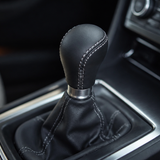
The center console and gear lever surround. A highly visible area, where a carbon or brushed aluminum insert fits naturally. This is also where consistency with the exterior carbon, if you have installed any, must be respected.
Add the classic accessories: illuminated door sills, floor logo projectors, homogeneous ambient lighting. On this last point, one rule: a single color temperature for the entire interior. Mixing whites is the most common flaw in LED-lit interiors.
An absolute precaution is required: never place a rigid element in an airbag deployment zone, especially the steering wheel hub, the upper part of the passenger side dashboard, and the side pillars.
Preserving the warranty and approval
Two distinct subjects, often confused, and which call for different answers.
The warranty
Installing an accessory does not automatically void a manufacturer's warranty. A manufacturer can, however, refuse to cover a fault directly attributable to the modification. On a vehicle that is still covered, the prudent strategy is therefore to favor non-invasive modifications — glued or clipped elements, interior inserts, interior lighting — and to postpone anything related to mechanics, management electronics, or structure. Always keep the invoices for the parts and the installation.
Approval
The table below summarizes the overview applicable to common aesthetic modifications, knowing that each individual situation must be confirmed with an approved body.
| Modification | General situation |
|---|---|
| Discreet glued spoiler | Without difficulty if securely fastened and free of sharp edges |
| Mirror caps | Without difficulty if visibility and functions are preserved |
| Interior inserts | Without difficulty outside airbag zones |
| Front lip, diffuser | Caution regarding overhang and edges |
| Wheels of different dimensions | Stay within accepted limits |
| Exhaust system | Approval mandatory |
| Large wing | Considered as a standalone modification |
▸ Our recommended accessories


Three levels of preparation
Level 1 — Interior only. Paddles, inserts, homogeneous lighting, logo projectors. Nothing is visible from the outside, everything is reversible, the warranty is not exposed. This is the ideal step on a recent vehicle or one intended for resale soon, and it is the one you enjoy the most on a daily basis.
Level 2 — The coherent exterior pack. Mirror caps, spoiler, possibly front lip, all in the same finish. The car changes its register while staying within the spirit of the most refined versions in the catalog. This is the most consensual approach, generally neutral or even favorable for resale.
Level 3 — The track orientation. Fixed wing, complete aerodynamic kit, specific wheels. The result can be spectacular, but it mechanically reduces the number of potential buyers and involves irreversible modifications. Reserved for owners who keep their car for a long time and who actually use the full potential of the chassis.
Maintenance and longevity of added elements
A successful installation can be ruined by improper maintenance. A few simple rules considerably prolong the hold and appearance of the parts.
Respect the curing time. No washing for seventy-two hours after the installation of a glued element, regardless of the washing method considered.
Ban high-pressure jets on the edges. This is the leading cause of gradual peeling. A jet that gets under a peeling edge lifts the adhesive millimeter by millimeter, without anything being visible before the part moves significantly.
Avoid station brushes. The brushes catch the edges of the added elements and exert significant lateral forces.
Protect carbon from ultraviolet rays. It is not the fiber that ages but the varnish that protects it. A regularly applied protection and parking away from direct sunlight preserve the original appearance for years.
Check the edges twice a year. An early detected start of peeling is easily fixed; advanced peeling requires a complete re-installation.
The most common mistakes on a TT RS
Ordering without checking the generation and phase. The leading cause of returns, far ahead of all others.
Ignoring the original moving spoiler. Adding a fixed element without checking the mechanism's travel exposes you to damaging the deployment motor.
Choosing a wing for looks. On a car that never sees the track, you endure all its disadvantages without ever getting the benefit.
Mixing finishes and carbon weaves. Consistency always takes precedence over quantity.
Gluing in cold weather. The number one cause of elements peeling off after a few weeks. Our complete installation guide details the method.
Drilling without treating the holes. An unprotected hole in sheet metal is a guaranteed corrosion point in the medium term.
Getting rid of the original parts. Their absence weighs heavily at the time of resale.
Detailed budget: three priced packages
The table at the top of the page gives two typical packs. Here is the complete view, item by item, for an Audi TT RS Mk3 tuning carried out to the end. The amounts are orders of magnitude observed on the French market, installation included when entrusted to a professional; they vary according to materials, finishes, and regions.
| Item | Discreet | Balanced | Track |
|---|---|---|---|
| Paddle shifters | 100 € | 100 € | 100 € |
| Inserts and air vents | 120 to 250 € | 200 to 400 € | 200 to 400 € |
| Mirror caps | 100 € | 100 € | 100 € |
| Spoiler or wing | 800 € | 800 € | 1,300 € |
| Front lip, diffuser | — | 400 to 900 € | 900 to 1,600 € |
| Wheels and tires | — | 2,000 to 3,500 € | 3,000 to 5,000 € |
| Approved exhaust | — | 1,500 to 3,000 € | 2,500 to 4,500 € |
| Total package | 1,000 to 1,300 € | 5,000 to 8,800 € | 8,000 to 13,000 € |
Two lessons stand out from this table. First, the gap between the discreet level and the balanced level is almost entirely played out on two items: wheels and exhaust. Everything else — paddles, inserts, caps, spoiler — represents a modest budget compared to the value of the car, and yet concentrates the bulk of the perceived visual effect.
Next, you must include an item absent from all amateur budgets: the maintenance reserve. A TT RS consumes wide tires with a high speed rating, heavily stresses its braking, and its all-wheel drive requires rigorous maintenance. Committing the entire budget to aesthetics while leaving maintenance uncovered is the most common management error on this type of car — and the most expensive to catch up.
In what order to modify: the calendar over twelve months
The most frequent mistake is not about the choice of parts but their order. Modifying out of order leads to buying again, repainting, removing what was just installed. Here is a proven progression, spread over a year.
Months 1 to 2: the interior and settings
Start with what you touch: paddles, inserts, harmonized ambient lighting. These elements are reversible, have no effect on the warranty, and are installed inside, therefore independently of the weather. This is also the period where you decide on your guiding finish — glossy carbon, matte carbon, or glossy black — by validating it on a low-cost part before applying it everywhere.
Months 3 to 4: mirror caps
First exterior element, deliberately modest. It confirms your finish choice in the daylight, on your body color, before any heavier commitment. Many owners change their minds at this stage — that is precisely its purpose.
Months 5 to 6: the rear element
Spoiler or wing, according to the decision already made. Favor the good season: gluing requires a stable temperature, and an element installed in cold weather often peels off a few weeks later. This is the moment when the car's silhouette truly shifts.
Months 7 to 9: wheels and tires
The most expensive item, therefore the one that benefits the most from a reflection period. Make it coincide with the natural renewal of your tires: you thus avoid throwing away still valid tires. Check the clearance of the calipers before any firm order.
Months 10 to 12: the approved exhaust
Deliberately last, for three reasons. It is the most regulated item, therefore the one that requires the most prior checks. It is also the one whose effect is the least visual, therefore the least urgent. Finally, having lived a year with the car considerably refines what one really expects from the sound.
The TT RS versus its rivals: how tuning changes things
The TT RS Mk3 competes in a small but fiercely contested segment. Understanding its position helps you choose modifications that enhance its unique character rather than those that distance it from what makes it special.
Versus the Audi RS3
The two cars share the same mechanical philosophy—five cylinders, all-wheel drive, and a compact layout. The RS3 offers greater practicality and a larger community, and therefore a more extensive range of accessories. The TT RS, meanwhile, benefits from a lower center of gravity and a pure coupé silhouette. The practical consequence is direct: some interior elements are shared across the RS range, which genuinely expands the choice and lowers prices—paddle shifters are the clearest example. Bodywork elements, however, remain strictly specific.
Versus the BMW M2
Rear-wheel drive versus all-wheel drive, six cylinders versus five: these are two opposing visions of the compact coupé. In terms of customization, the M2 has a larger ecosystem, inherited from BMW's tuning culture. The TT RS compensates with a more cohesive style that is easier to maintain: its clean design does not tolerate excess, which naturally leads to understated choices—and understated choices age better.
Versus the Porsche 718 Cayman
Mid-engine versus front-engine: the Cayman retains an advantage in balance during high-speed driving. The TT RS responds with its rear-biased handling and all-weather accessibility. This is where the aerodynamic choice makes perfect sense: on a front-heavy architecture, adding downforce only to the rear does not improve balance, it shifts it. A cohesive front-to-rear setup, or nothing.
Versus the Volkswagen Golf R
A less obvious comparison, but a common one on the used market at an equivalent price point. The Golf R offers versatility and lower running costs; the TT RS offers an exceptional engine and a silhouette unlike any other. For the TT RS owner, the conclusion is clear: the sound and the lines justify the entry price. These are therefore the two dimensions that modifications should serve first and foremost.
What owners report
As conversations with TT Mk3 and TT RS owners continue, a few observations emerge with striking regularity. They are not statistical certainties, but they are worth knowing before committing a budget.
Paddle shifters consistently top the list of owner satisfaction. This is the least expensive modification in the guide, and yet it is the one owners most often cite as "the one they should have done first." The reason is simple: it is the only thing you touch every time you change gears.
The spoiler is clearly divisive. Those who actually drive on the track would not give it up for anything. Those who chose it for looks more often express regrets, linked to wind noise, rear visibility, and above all, irreversible holes in the tailgate. This is exactly the trade-off discussed above.
The most common disappointment concerns imitation carbon. Carbon-look films and parts satisfy for a few months, then disappoint: peeling corners, patterns that do not follow the curvature, fading. Many end up buying the part in genuine carbon—and therefore paying twice.
The recurring regret concerns the order of the work. Fitting a spoiler before deciding on a finish, or changing wheels right after buying new tires, comes up in almost every conversation. Hence the calendar proposed above.
Finally, the question of sound is the most emotional. The five-cylinder engine inspires a particular attachment, and the temptation of an unapproved exhaust is real. The feedback, however, is consistent: administrative troubles, failure at the technical inspection, and listener fatigue on long journeys make owners regret this choice far more often than they justify it.
Resale and value: what adds value and what detracts
The TT RS Mk3 belongs to that category of sports cars whose value depends heavily on condition, history, and configuration. Modifications play a real role, in both directions.
What works in your favor
- Reversible and cohesive modifications, in the spirit of factory options: they broaden the audience rather than narrowing it.
- Keeping all original parts, packaged and labeled. A buyer who knows they can return to the factory configuration is more likely to buy.
- A complete file: invoices for parts, installation invoices, and exhaust homologation documentation. This is what distinguishes a well-maintained car from a tinkered-with car.
- Parts from identifiable brands, preferred over anonymous elements that are impossible to trace.
What works against you
- Any drilling into the sheet metal, especially the tailgate. It is irreversible and immediately visible upon inspection.
- An exhaust system without documentation: the buyer will have to replace it, and they will deduct the cost from the price.
- Undocumented engine management modifications, which immediately raise questions about reliability and past use.
- Highly personal aesthetic choices: rare colors, full wraps, colored lighting. They narrow the audience to just a few buyers.
- A mix of finishes, which gives the whole car the appearance of having been assembled over time rather than thoughtfully designed.
The summary can be stated in one sentence: the more reversible and documented a modification is, the less it detracts from the resale value. A TT RS equipped with a cohesive exterior pack, with its original parts in boxes and its invoices in the service book, generally sells better than a strictly stock car with no history.
Frequently Asked Questions
What is the difference between the TT RS Mk2 and Mk3 in terms of accessories?
The two generations have distinct bodies: bumpers, lights, and mounting surfaces differ. Some interior elements may be shared across the range, but everything related to the bodywork is specific. Compatibility still needs to be checked according to the trim and model year.
Is the spoiler compatible with the Roadster?
No, in the vast majority of cases. The Roadster has a completely different rear architecture from the coupé, with the soft-top housing. Spoilers designed for the coupé do not find an equivalent mounting surface there.
Can a spoiler be fitted to a TT equipped with the retractable spoiler?
This depends entirely on the spoiler model and its placement. The critical point is the travel of the deployment mechanism, which must not be obstructed in any position. This is a check that must be done before purchase, with the seller, by specifying the exact trim.
Does the 2.5 TFSI need to be remapped?
It is a supercharged engine, so it has theoretical margins higher than those of a naturally aspirated engine. But any modification to the engine management immediately raises questions about warranty, compliance, and long-term reliability. For most owners, the investment is much better justified on aesthetics, approved sound, and tires.
Will a fixed wing pass the technical inspection?
The points examined are concrete: solidity of the mounting, absence of sharp edges or dangerous protruding elements, full visibility of the license plate and lights. A large wing may also require a separate approval process. The right approach is to consult an approved body before starting the work.
Matte or glossy carbon: which should you choose?
Glossy carbon catches the light and highlights the curves; it pairs well with light-colored bodies but shows marks more easily. Matte produces a more technical look and forgives micro-scratches better, but is difficult to revive once it fades. Neither is superior: what matters is to choose once and stick with it.
Can you fit the mirror caps yourself?
Yes, it is one of the most accessible modifications, generally doable in about ten minutes per side. The only serious precaution concerns the plastic clips, which are brittle in cold weather: work in a warm environment and use a clip removal tool rather than a screwdriver.
Is the TT RS expensive to maintain?
It is a high-performance sports car, with the usual consequences: wide tires with high speed ratings, heavy braking, and all-wheel drive that requires maintenance. The rule of thumb is to secure the maintenance budget before the aesthetics budget, never the other way around.
Do modifications lower the value?
This depends entirely on their nature. Reversible, high-quality elements in the spirit of factory options are generally neutral or even value-adding. What weighs negatively are irreversible modifications, drilling, highly personal choices, and the absence of original parts.
What is the first modification to do?
Paddle shifters, without hesitation. Low cost, easy installation, no risk, and an ergonomic benefit felt on every drive. It is also a completely reversible modification, so it has no consequence on resale.
How to avoid the "overloaded" look?
By imposing a single constraint: one dominant material, one finish, maintained throughout the project. A car with three perfectly matching elements always looks more polished than a car with eight mismatched elements.
Is it better to buy a TT RS that is already modified?
It is risky without documented history. A car that is already modified can hide an approximate installation, poorly treated holes, or lost original parts. If you are interested in the deal, demand the invoices for the parts and installation, and check the availability of the original elements.
What is the minimum budget for a visible result?
About one thousand euros, split between paddle shifters, mirror caps, and a rear element. Below that, you get occasional touches; above that, you enter the heavy categories—wheels and exhaust—where the ratio of visual impact to money invested is significantly less favorable.
Do the paddle shifters from the RS range really fit a TT RS?
Several models in the RS range share the same steering wheel architecture, which makes certain paddle shifters common to several vehicles. However, this still needs to be checked according to the model year and trim of the steering wheel: ask the seller for confirmation by specifying the exact year and version, rather than relying solely on the model name.
Can a front lip be fitted without drilling?
Many lips are fitted using structural adhesive, sometimes supplemented by existing clips on the bumper. Adhesive alone requires a perfectly degreased surface and a suitable installation temperature. Be careful with ground clearance: a lowered lip catches curbs and parking ramps much faster than you might think.
Do you need to declare modifications to your insurer?
Practices vary from one insurer to another, but many ask to be informed of notable modifications, especially those that change the exterior appearance or the value of the vehicle. The issue arises at the time of a claim: an undeclared part may not be covered. A call to your advisor is enough to clarify the situation—keep their answer in writing.
How long does it take to fit a spoiler yourself?
Allow half a day working without rushing: dry fitting, marking out, degreasing, fitting, and then curing time. Preparation represents most of the time; the gluing itself only takes a few minutes. The absolute rule remains the same: never glue in cold weather or on a damp surface.
TT RS Mk3 technical sheet: the figures that dictate the choice of parts

After "tuning", the most searched queries around this car are audi tt rs mk3 technical sheet, audi tt rs mk3 dimensions, and audi tt rs mk3 weight. This is not idle curiosity: each of these figures directly dictates a parts purchase decision, from wheel offset to wing size.
The engine first. The Mk3 2.5 TFSI produces 400 horsepower—that is the answer to audi tt rs horsepower—for 480 Nm of torque, and Audi announces 3.7 seconds from 0 to 100 km/h, the data sought by audi tt rs mk3 0 100. The top speed is limited to 250 km/h, increased to 280 km/h when the corresponding option was selected at the time of order. Transmission is handled by a seven-speed dual-clutch gearbox, the only one offered on this generation: the searches tt rs dsg and audi tt rs dsg have no other answer; there has never been a Mk3 with a manual gearbox.
Two technical clarifications are worth making, because they are constantly confused on forums. The all-wheel drive of this car is an all-wheel drive with a multi-plate clutch placed on the rear axle, on a transverse traction base: it is not a Torsen-type center locking differential, like on the Audi with a longitudinal engine. And the Mk3 2.5 TFSI is a block designed in the 2010s, with an aluminum casing—about 26 kg lighter than the cast-iron five-cylinder that preceded it on the Mk2. It does not mechanically descend from the five-cylinders of the 1980s: what it inherits from them is the five-in-line cylinder architecture and the 1-2-4-5-3 firing order that gives it its signature sound. The practical consequence is direct: you do not order "Audi five-cylinder" parts in general; you order tt rs 8s parts.
TT RS Mk3 coupé: the command references
| Overall length | 4191 mm |
| Width excluding mirrors | 1832 mm |
| Height | 1344 mm |
| Wheelbase | 2505 mm |
The bodywork dimensions are around 4.19 m long, 1.83 m wide, and 1.34 m high, with a wheelbase of 2.50 m—manufacturer values, useful for checking that an element advertised as "TT" actually corresponds to the Mk3 coupé and not the Roadster or the Mk2. Regarding weight, sources diverge, and it must be stated clearly: the coupé's manufacturer sheet announces around 1,440 kg empty according to the DIN method, while the mass in European running order, including driver and full load, is published around 1,515 kg. This is not a contradiction but two different measurement conventions; it is the value on your registration certificate that is authoritative for any homologation question.
Why do these figures matter for tuning? Because a short, wide, and low car does not forgive approximation. A wing designed for a longer coupé will look cramped; a wheel with a poorly chosen offset will stick out from the fender or remain recessed in a wheel arch that is nevertheless very pronounced; and a wing sized for a sedan will be out of scale on 4.19 m. This is also why tt rs 8s spoiler and audi tt rs 8s carbon fiber parts are among the most frequent queries in English: buyers immediately look for the reference by platform code rather than by commercial name. This is the right approach, and it is the one we recommend throughout the catalog.
Phase 1 or Phase 2: what the facelift changes before ordering

The query audi tt rs mk3 facelift comes up as soon as an owner is about to order an exterior part, and it is justified: the Mk3 underwent a mid-life facelift in 2019 on the European market. The power did not change—still 400 horsepower—but several elements that directly concern you have changed.
What changes between the two phases
- Paddle shifters and interior parts
- Mirror caps
- Coupé trunk spoiler
- Vent surrounds
- Console inserts
- Front bumper lips
- Bumper elements and air intakes
- Diffuser and exhaust tips
- Exhaust system (particle filter)
- Certain mounting brackets
The most significant point of difference concerns the exhaust. On the European market, the facelift is accompanied by the introduction of the petrol particulate filter. An exhaust system designed for a pre-facelift model cannot therefore be used as is: the geometry differs, and above all, the removal or neutralisation of an emissions control device is prohibited. This is precisely the issue behind the audi tt rs 8s exhaust search, which yields many results from markets where regulations differ from ours. The rule stated earlier in this article remains completely unchanged: documented road approval, or nothing.
In terms of bodywork, the logic is that of the bumpers. Everything that attaches to them—front splitter, scoops, diffuser—must be ordered for the exact pre- or post-facelift model. Everything else—boot spoiler, wing mirror caps, interior parts—generally carries over without difficulty. A simple way to decide without making a mistake: check the date of first registration on your vehicle registration document and provide it to the seller before ordering any bumper components. We explain the approval logic for the items mentioned in our guide to spoilers, wings and MOT testing.
Buying a used TT RS Mk3: what to check before thinking about tuning

used audi tt rs mk3, used audi tt rs price, tt rs reviews: many visitors to this page do not yet own the car. Setting aside a budget for accessories for the wrong car is the easiest way to waste it, so let's tackle the issue in the right order.
We will not publish a specific price: the market for a limited-production sports car moves too quickly for a figure published today to remain accurate in six months. What is stable, however, is the hierarchy of criteria that determines the price difference between two examples from the same year.
The seven checks that matter on a TT RS Mk3
- Complete service history, supported by invoices, not just a stamped service book
- Exact pre- or post-facelift model and options list: manual or fixed spoiler, exhaust, seats
- Actual condition of the tyres: brand, speed rating, even wear across all four
- Consistency between the mileage and the wear on contact points and the workshop history
- Signs of repair: gaps in the bonnet and tailgate, paint shade differences, silicone in the wheel arches
- Existing modifications and the presence of the removed original parts
- No holes drilled in the tailgate if the car is advertised as original
Mileage checks deserve particular attention on this type of car, precisely because the price difference between two odometers can make fraud financially worthwhile. The complete method, applicable to any used car, is explained in our guide to detecting an accident or tampered mileage before buying a used car.
One final point, often overlooked: a TT RS that has already been modified is not necessarily a bad deal, provided the original parts are included. An example fitted with carbon mirror caps and paddle shifters, sold with its original parts in cardboard boxes, will save you exactly what you would have spent. Conversely, a modified example without any original parts forces you to accept the previous owner's configuration—and pay the cost of restoring it if you do not want it. This is a negotiation point, not a minor detail.
Audi parts verified in the catalogue


Reliability, maintenance, fuel consumption: what a TT RS Mk3 really costs
The searches tt rs reliability, tt rs problem, audi tt rs mk3 reliability and audi tt rs maintenance cost form a coherent group: they reflect the same concern—that the running costs of a 400-horsepower sports car will exceed the accessories budget. The honest answer has two parts.
First, the architecture. The Mk3's 2.5 TFSI combines direct and indirect injection. This dual-injection system limits the build-up of carbon deposits on the intake valves that affects engines with direct injection only—a genuine structural advantage and one of the reasons this engine has a better reputation for durability than its predecessor. This does not make it immune to the way it is treated.
Second, the maintenance schedule. Three areas are specific to this car and fall outside the usual "annual service" routine. The dual-clutch gearbox oil, including the filter, is replaced periodically. The oil in the rear multi-plate clutch also needs replacing: this is the most commonly forgotten item, and the one that costs the most to overlook, as it determines how the all-wheel-drive system operates. Finally, the cooling system works hard on a compact, turbocharged five-cylinder engine. The exact intervals vary depending on the year and usage: they are listed in your vehicle's maintenance schedule, which is the only source that carries a guarantee.
The order of spending on a TT RS
- Secure the maintenanceGearbox, rear transmission, cooling, braking
- Budget for tyresFour wide tyres with a high speed rating
- Insurance and registrationGet a quote before buying, never after
- Only then, aestheticsInterior, then exterior, then sound
Regarding fuel consumption—audi tt rs fuel consumption—the official figures published for this generation are around 9 l/100 km in the combined cycle, depending on the year and testing method. Real-world figures reported by owners are significantly higher, and sustained driving easily pushes consumption past 13 l/100 km. Take the official figure for what it is: a benchmark for comparing vehicles, not a budget forecast.
Tyres, searched via audi tt rs tyres, make up the other major cost. The standard fitment is wide, with a high speed rating, and 19 inches on the most common configurations. Increasing the diameter for styling costs twice: when buying the wheels and again with every set of tyres. This is another argument in favour of the principle stated earlier—filling the wheel arch before considering the overall diameter.
As for audi tt rs insurance price, no specific figure is reliable: the premium depends on your age, no-claims bonus, county, and declared annual mileage, with factors that dwarf any average. The only advice worth following is chronological: ask for quotes before signing, not after. In this segment, the difference between two insurers often exceeds a full year's accessories budget.
Stage 1, Stage 2: what tuners promise and what they commit you to
It is impossible to ignore tt rs mk3 stage 1 and tt rs stage 2 0-100: these searches are among the most common in the tt rs 8s performance parts world. This article recommends not starting there, and this position deserves to be argued rather than simply stated.
First, what these terms entail. Stage 1 refers to a control unit remap without hardware modifications. Stage 2 requires parts before or after the engine—intake, intercooler, exhaust—and a map tailored to those parts. The claimed gains are real on a turbocharged engine, which by design has margins that a naturally aspirated engine does not. However, they are not free.
Remapping: the two sides of the balance sheet
- Noticeable torque increase at mid-range
- Sharper throttle response
- More forceful acceleration at high revs
- Real margins on a turbocharged engine
- Immediate results, without disassembly
- Questionable manufacturer warranty coverage
- Vehicle compliance at the point of inspection
- Increased strain on the transmission and brakes
- Traceability required by future buyers
- Informing your insurer, depending on your policy
Three consequences deserve to be stated clearly. Modifying the engine management of a vehicle inspected for road use raises questions about compliance, manufacturer warranty coverage, your insurance policy—which you must read before, not after, signing—and resale. On a car that already produces 400 horsepower, the investment pays off more in tyres, approved soundproofing and aesthetic consistency than in a remap. The same reasoning applies to the other five-cylinder models in the group, as shown in our tuning comparison between the Audi RS3 and the Mercedes A45. And if your project is primarily visual, choosing between genuine carbon and its imitation remains the first decision to make: our guide to genuine carbon versus carbon imitation explains how to tell them apart in ten seconds.
To put the aesthetic budget into perspective against these mechanical promises, the four parts mentioned at the beginning of this article were listed in the Becquet Voiture catalogue on 12 August 2026, from €99 for the RS range carbon paddle shifters and TT Mk3 wing mirror caps, and from €799 for the carbon boot spoiler to €1,299 for the track wing. These prices were recorded on that date and are subject to change: the product page is authoritative. For any questions about compatibility with your exact trim and year, or for a request not listed in the catalogue, use the shop's contact form rather than relying on compatibility deduced from a table.
FAQ: TT RS Mk3 technical specifications, used cars, reliability and maintenance
What is the exact power of an Audi TT RS Mk3?
400 horsepower and 480 Nm of torque throughout the Mk3 generation's production run, including the facelift. The manufacturer quotes 0 to 100 km/h in 3.7 seconds, and the top speed is limited to 250 km/h, increased to 280 km/h when the corresponding option is included in the original order.
What are the dimensions and weight of a TT RS Mk3?
Approximately 4.19 m long, 1.83 m wide excluding wing mirrors, and 1.34 m high, with a 2.50 m wheelbase. Two values coexist for its mass, depending on the measurement standard: approximately 1,440 kg unladen using the DIN method for the coupé, and approximately 1,515 kg for the kerb weight in the European sense. The value on your vehicle registration document is authoritative.
Is the TT RS Mk3 a quattro with a Torsen differential?
No. On this front-wheel-drive layout, the TT RS Mk3's all-wheel drive is achieved by a controlled multi-plate clutch located on the rear axle. The central self-locking Torsen differential is fitted to Audi models with longitudinal engines, which is not the case with this car. The confusion is common and has no bearing on the choice of bodywork parts, but it does affect maintenance: the rear clutch oil needs replacing periodically.
Does the Mk3's 2.5 TFSI descend from the five-cylinder engines of the 1980s?
No, not mechanically. It is an engine block designed in the 2010s, with an aluminium casing that is approximately 26 kg lighter than the cast-iron five-cylinder of the previous generation. What it shares with historic five-cylinder engines is the five-in-line cylinder architecture and the 1-2-4-5-3 firing order, which gives it its distinctive sound.
Is there a TT RS Mk3 with a manual gearbox?
No. The Mk3 was only offered with the seven-speed dual-clutch gearbox. This is also why paddle shifters are the first modification recommended in this guide: on this car, they are the primary control for the transmission, not a decorative accessory.
What changes between the pre-facelift and post-facelift TT RS Mk3?
The power does not change. The bumpers and air intakes are revised, making the front splitters, diffusers and attached components model-specific. On the European market, the facelift is also accompanied by the introduction of the petrol particulate filter, which means exhaust systems cannot be used across the two versions. Interior parts, wing mirror caps and the coupé's boot spoiler generally carry over.
What is the real maintenance cost of a TT RS Mk3?
It depends too much on the dealership, region and condition of the vehicle for a figure stated here to be accurate. The key areas are certain: dual-clutch gearbox oil and filter, rear multi-plate clutch oil, cooling system, brakes, and wide tyres with a high speed rating. Ask your workshop for a specific quote on these items before buying.
How much fuel does an Audi TT RS Mk3 consume?
The official figures published are around 9 l/100 km in the combined cycle, depending on the year and testing method. In real-world use, owners report significantly higher figures, and sustained driving easily pushes consumption past 13 l/100 km. Official figures are intended for comparing vehicles, not for establishing a budget.
Is the TT RS Mk3 reliable?
Its engine has a structural advantage: the combination of direct and indirect injection, which limits the build-up of carbon deposits on the intake valves. This does not preclude the need for rigorous maintenance, particularly of the transmission and cooling system. On a used car, a documented history is more important than the displayed mileage.
Should you Stage 1 a TT RS Mk3?
It is a turbocharged engine and therefore technically receptive. However, modifying the engine management raises questions about the vehicle's compliance at the point of inspection, manufacturer warranty coverage, your insurance policy—which you must read before, not after, signing—and resale. On a car that already produces 400 horsepower, the investment pays off more in tyres, approved soundproofing and aesthetic consistency.
How can I tell if a part advertised as "TT" is suitable for my car?
Three pieces of information are enough to eliminate almost all mistakes: the generation (Mk2 8J or Mk3 8S), the pre- or post-facelift model, and the coupé or Roadster body style. Add the exact trim and the date of first registration for any bumper or exhaust component, and provide them to the seller before ordering.
How much do the parts mentioned in this guide cost?
Recorded in the Becquet Voiture catalogue on 12 August 2026: from €99 for the RS range carbon paddle shifters and TT Mk3 wing mirror caps, from €799 for the carbon boot spoiler, and from €1,299 for the carbon track wing. These are dated estimates: the product page is authoritative, and any questions about compatibility should be addressed with customer service before ordering.
Popular searches: audi tt rs mk3 tuning, used audi tt rs mk3, audi tt rs mk3 spec sheet, audi tt rs mk3 specs, audi tt rs mk3 dimensions, audi tt rs mk3 weight, audi tt rs mk3 weight, audi tt rs mk3 0-100, audi tt rs mk3 facelift, audi tt rs mk3 price, audi tt rs used price, used audi tt rs, audi tt rs horsepower, audi tt rs spec sheet, tt rs 8s, tt rs 8s performance parts, tt rs 8s spoiler, audi tt rs 8s exhaust, audi tt rs 8s carbon fiber parts, audi tt mk3 spoiler, audi tt rs spoiler, tt rs review, tt rs reliability, tt rs problem, audi tt rs mk3 reliability, audi tt rs mk3 common problems, audi tt rs maintenance, audi tt rs maintenance cost, audi tt rs fuel consumption, audi tt rs tire, audi tt rs insurance price, tt rs dsg, audi tt rs dsg, tt rs mk3 stage 1, tt rs stage 2 0-100. Source: Google Suggest fr/fr, collected on August 12, 2026 (Ubersuggest over quota that day); the terms are ranked in order of appearance in the autocomplete, no volume could be measured.
Learn more
Recevez nos prochains guides en avant-première
Tutos pose, comparatifs aftermarket vs origine, sélection M Performance/AMG/RS, codes promos exclusifs.