BMW M2 Competition: 5 accessories to enhance the purest M coupe
The essentials in 30 seconds
- BMW M2 Competition tuning is first and foremost about looks and the interior: the F87 doesn't need more power; it needs the right finishing touches.
- The most worthwhile BMW M2 F87 accessories are carbon steering-wheel paddles, a trunk spoiler, a rear diffuser, mirror caps and door lighting.
- The real question is BMW M2 F87 carbon parts: between genuine M Performance carbon and quality 3K aftermarket carbon, the price difference is as much as fourfold for a very similar look.
- A cohesive visual package costs between 400 and 1,500 euros, depending on the level, with no engine modifications and no risk at the roadworthiness test if you follow a few simple rules.
- Everything that follows is bolt-on: 3M adhesive, factory clips or existing fasteners. No cutting, no drilling, no ECU remapping.
The BMW M2 Competition packs 410 horsepower into 1,550 kg, with an S55 inline-six and the shortest chassis in the M range. It's probably the purest M in BMW's recent lineup, and one of the most popular to modify. Here are five accessories that really work on an M2 Competition, without ever touching the engine electronics.
This guide goes well beyond a simple list: it details each category of parts, explains how to tell real carbon fiber from an imitation, reviews roadworthiness-test requirements, suggests three sample budgets and ends with a 12-question FAQ. If you're looking to get your BMW M2 Competition tuned without making the usual mistakes, you're in the right place.
Contents
- Why the M2 Competition deserves a custom tuning approach
- Understanding the F87: phases, model years and trims
- 1. Carbon-fiber steering-wheel paddles
- 2. M Performance logo door projectors
- 3. LED door lighting
- 4. M2 trunk spoiler: which styles work
- 5. Rear diffuser and exhaust tips
- Diagram: the difference a welcome light makes in the M2
- Genuine M Performance carbon vs. aftermarket carbon
- The interior: what ages and what can be changed
- Wheels, lug nuts and wheel styling
- Legality and roadworthiness testing
- Budget
- Caring for carbon-fiber and gloss-black parts
- 8 mistakes to avoid
- FAQ: 12 questions about M2 Competition tuning
- M2 Competition and S55 engine reliability
- Suspension, brakes and tires: road or track
- M2 Competition, M2 CS or M2 G87: which one to buy
Why the M2 Competition deserves a custom tuning approach

The M2 Competition holds a special place in the M lineup. It inherits the S55 engine from the M3 F80 and M4 F82, detuned to 410 horsepower, but fitted into a body nearly twenty centimeters shorter and narrower. The result is a lively, highly responsive car whose character comes as much from its compact proportions as from its power. This compact geometry has a direct impact on BMW M2 Competition tuning: anything you add stands out immediately. A splitter that's two centimeters too thick, a poorly proportioned spoiler or wheels an inch too large, and the visual balance is gone.
It's exactly the opposite of a large sedan, where accessories blend into the overall shape. On an F87, every part matters. That's why we advocate a coherent, additive approach to tuning: the goal isn't to turn the M2 into something else, but to highlight what's already there. The factory-fitted flared fenders, twin-kidney grille, high beltline and quad exhaust outlets form a visual vocabulary. Well-chosen BMW M2 F87 accessories speak the same language.
Second reason: the M2 Competition is a car people keep. Unlike many sports cars that are sold after two years, the F87 has become a future classic, with its value stabilizing and then firming up. That changes how you approach modifications. Prioritize reversible options: 3M adhesive instead of drilling, factory clips instead of cutting. Everything we recommend in this guide can be removed in an hour without leaving a trace, helping protect the car's value.
Third reason, a more practical one: BMW's official M Performance accessories catalog for the M2 is both extensive and prohibitively expensive. A simple set of genuine carbon mirror caps costs more than all three interior accessories featured below. Quality aftermarket parts fill that gap, provided you know how to tell the good ones from the bad. That's exactly what the section on carbon fiber covers.
Understanding the F87: phases, model years and trims
Before buying any parts, you need to know exactly which M2 you have, because the F87 designation covers several different versions. The original M2, launched in 2015, came with the 370-horsepower N55 engine. The M2 Competition, launched in 2018, adopted the 410-horsepower S55 twin-turbo, along with a redesigned grille, different front air intakes and a slightly revised hood. Finally, the limited-production M2 CS adds a carbon-fiber hood, a carbon-fiber trunk spoiler and a specific front splitter.
This distinction is crucial for front-end parts. A splitter or bumper lip designed for the N55 M2 won't fit an M2 Competition properly because the cooling openings aren't in the same places. By contrast, parts for the rear, trunk and interior are generally shared across the F87 range. The mirrors are an exception: the M2 Competition received the dual-stalk mirrors derived from the M3 F80 and M4 F82, while the N55 M2 retains the standard 2 Series mirrors. So mirror caps listed for the M2 Competition won't fit the first-generation M2, and vice versa. Some differences remain depending on the phase, model year and trim: always check your vehicle's exact part number before ordering, in particular using the last seven characters of your VIN.
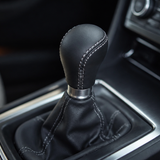
The second point to watch is the transmission. The M2 Competition is available with a six-speed manual or a seven-speed dual-clutch DCT. Steering-wheel paddles, of course, are only for the DCT version. Manual owners can instead opt for a gear knob, an Alcantara shift boot or a leather-wrapped handbrake lever to create a similar effect in the cabin.
Third point: the steering-wheel trim. Depending on the market and options, the M2 Competition came with a plain Merino leather steering wheel, one with M tricolor stitching or one with a marker at the top. Steering-wheel customization parts aren't all interchangeable across these versions. Take a photo of your steering wheel before ordering; it's the simple step that prevents half of all returns.
| Version | Engine | Front-end parts | Rear and interior parts |
|---|---|---|---|
| M2 (2015-2018) | N55 370 hp | N55-specific | Largely shared |
| M2 Competition (2018-2021) | S55 410 hp | Competition-specific | Largely shared |
| M2 CS | S55 450 hp | Factory carbon fiber | Factory carbon-fiber spoiler |
1. Carbon-fiber steering-wheel paddles
BMW fitted the M2 Competition with fairly decent magnesium paddles, but they're too short. For getting the most out of the S55's 7-speed DCT, carbon extensions are the most worthwhile upgrade. They're 38 mm longer, making them easy to reach with your hands at 12 o'clock or in the 9-and-3 position.
It's worth understanding why the extra length makes such a difference. On a track or a mountain road, the steering wheel turns. With short paddles fixed to the wheel, once you've turned it past a quarter-turn, the upshift paddle ends up at the lower left and becomes difficult to reach without letting go of the wheel. The 38 mm extensions bring the controls farther out toward the edge of the wheel: even at a third of a turn, your thumb or index finger can reach the paddle without moving your hand. In a car as compact and lively as the M2, this detail directly inspires confidence when pushing hard.
Material matters, too. Chrome-finished ABS paddles look like metal but feel warm and hollow. Paddles made from genuine woven 3K carbon fiber, on the other hand, are rigid enough to eliminate any flex when you shift, giving you a crisper feel under your finger. Some models also feature an anodized aluminum back for added weight and a cooler feel to the touch, much appreciated in a performance car.
Installation is this accessory's biggest advantage: it clips onto the factory paddle without tools or removing the steering wheel, so you never have to go near the airbag. The pair takes five minutes to fit. It's the only BMW M2 F87 accessory you can install out on the street or in a parking lot without getting your hands dirty—and feel the difference from the very first corner.

BMW M2 Competition carbon steering-wheel paddle
Genuine woven 3K carbon fiber. Clip-on installation, no tools required. 1-year warranty. 290 EUR
View M2 paddlesFor detailed step-by-step installation instructions, including what to watch for with the clips, see our dedicated tutorial: how to install steering-wheel paddles.
2. M Performance logo door projectors
Small accessory, big impact: when you open the M2's door, a beam of light projects the M Performance logo onto the ground. Counterfeit BMW originals are very common, but quality aftermarket kits with high-definition glass are available for 49 EUR. Installation takes 10 minutes and involves replacing the factory courtesy light.
A door projector's quality comes down to three specific criteria. First is projection sharpness: engraved mineral optical glass produces an image with crisp edges, while a simple plastic film creates a blurry halo that immediately gives away a budget product. Second is the LED color temperature: for a BMW, aim for neutral white at around 6,000 kelvins to match the factory ambient lighting. An overly blue-white light clashes with the interior. Third is electrical stability: the circuit board must include a properly rated resistor to prevent a bulb-failure warning from appearing on the dashboard.
On the F87, the courtesy-light housing is at the bottom of the door panel. It can be removed by sliding a plastic trim tool along the edge of the lens, then gently levering it out. Disconnect the factory plug by pressing its tab. The replacement module uses the exact same connector, making the job completely plug-and-play—and, importantly, reversible in 30 seconds if you sell the car.

BMW M Performance door logo projector
HD glass with engraved logo, high-intensity LED. Fits the entire M range. 49 EUR
View projector3. M Performance LED door lighting
A natural complement to the logo projector: an LED strip at the bottom of the door that lights up when you open it. It delivers a guaranteed showroom effect at night without altering the factory wiring, as it draws power from the door lights.
These kits fall into two categories. The first is battery-powered, with an opening sensor: no wiring, a two-minute installation, but limited battery life and the risk of a delay between opening the door and the light coming on. The second option, which we recommend, connects directly to the courtesy-light circuit already in the door. It comes on and off exactly with the factory light and requires no maintenance. On an M2, where everything should look integrated, it's the only convincing solution.
One installation detail makes all the difference: surface preparation. The bottom of the door collects dust, wax and washing residue. Without cleaning it with isopropyl alcohol and using an adhesion promoter, the tape will come loose after a few weeks, especially in winter. Our guide, which 3M adhesive to choose and how to prepare the surface, explains the full procedure, which applies to all adhesive parts in this guide.

BMW M Performance door lighting
Self-adhesive LED strip with embroidered M logo. Plug-and-play power connection to factory wiring. 49 EUR
View lighting4. M2 trunk spoiler: which styles work

The spoiler is the part that changes the M2 Competition's silhouette the most—and, paradoxically, the one people most often get wrong. The F87 has a short trunk and a steeply sloped rear window. Three types of M Performance and aftermarket spoilers dominate the market, and they create very different effects.
The discreet trunk lip, known as a low ducktail, sits on the upper edge of the trunk and rises two to three centimeters. It is the modern interpretation of the historic CSL spoiler. On an M2, it visually elongates the rear and breaks the roundness of the trunk without ever looking added on. It is the safest choice, the one that ages best, and the one that goes completely unnoticed from a regulatory standpoint.
The M Performance-style spoiler, taller and more pronounced, with a raised lip and marked side cheeks, is more assertive. It works very well on an M2 with dark wheels and blacked-out exterior trim. However, on a car with original chrome trim, it creates a stylistic clash. It is therefore best paired with a full Shadow Line package.
Finally, the raised spoiler, known as a gooseneck or wing on standoffs, belongs to the track register. On a road-going M2 Competition, it is generally out of proportion and, above all, requires drilling the trunk, making it an irreversible modification that penalizes resale. We advise against it except for dedicated track use. For a complete overview of dimensions and their suitability for each body style, read what spoiler size to choose for your car.
Regarding material, the debate pits glossy black ABS, fiberglass, and carbon fiber. Quality injected ABS offers excellent dimensional stability, resists temperature fluctuations well, and takes paint perfectly. Fiberglass, which is stiffer, allows for complex shapes but requires careful paint preparation. Carbon fiber provides lightness and texture, at the cost of real sensitivity to ultraviolet rays if the clear coat is not treated with UV protection. Our comparison carbon fiber vs fiberglass vs ABS spoiler examines all three materials thoroughly.
5. Rear diffuser and exhaust tips
The diffuser is the logical complement to the spoiler: one works the top of the rear, the other the bottom. On the M2 Competition, the original rear bumper already integrated a black ribbed element, but it remains understated. A replacement diffuser in carbon fiber or glossy black ABS, with more pronounced fins, visually lowers the car and widens its stance. It is a very effective optical effect on such a short body.
Installation is most often done by replacement: the original element is removed, generally fixed by a series of clips and two to four screws, and the new one is reinstalled on the same points. No drilling is necessary when the part is designed for the model. Beware of universal adhesive diffusers: on an M2, the curvature of the bumper is pronounced and a flat part will always end up peeling off at the corners. Our article AMG and M Performance rear diffusers details the actual mounting points.
However, pay attention to a common practice: fake exhaust outlets integrated into the diffuser. On an M2 Competition, which already has four real outlets, they are of no use and pose a potential regulatory problem if they mask or duplicate the real outlets. The subject is covered in detail in rear diffuser and fake exhaust outlets: legal for the technical inspection.
Exhaust tips, on the other hand, are a simple and highly visible accessory. On the F87, the four original outlets are in polished stainless steel. A set of matte black or glossy black tips, in 304 stainless steel with a high-temperature ceramic coating, transforms the rear signature for a modest cost. The critical point is the mounting: opt for models with double side screws with an internal tightening ring, and absolutely avoid single-screw tips that eventually vibrate and shift. Our complete advice is in black exhaust tips: how to choose and install them.
Diagram: the difference in reception in an M2 Competition
▸ Our recommended accessories


Original M Performance carbon vs aftermarket carbon

This is the central subject of any serious BMW M2 Competition tuning, and the one where the most misconceptions circulate. The BMW M2 F87 carbon parts sold by the network under the M Performance label are produced using prepreg autoclave. Specifically, the carbon fabric is already impregnated with resin, placed in a mold, then cured under pressure and vacuum at high temperature. The result is a very light part, with a high fiber content, perfectly stable geometry, and a thick clear coat. It is a slow and expensive process, which explains the prices.
Quality aftermarket carbon most often uses vacuum infusion or resin transfer molding. The dry fabric is placed in the mold, then the resin is drawn through. The fiber content is slightly lower, the part is a little heavier, but the difference on a two-kilogram spoiler is around one hundred to two hundred grams. Visually, a well-varnished 3K weave is indistinguishable from a meter away. The value for money is therefore excellent, provided that the manufacturer uses a UV-treated clear coat.
The third category, which you need to know how to identify to avoid it or accept it knowingly, is so-called cosmetic carbon: an ABS or fiberglass part covered with a hydrographic film imitating the weave. This is perfectly acceptable for a thirty-euro dashboard insert, but it should never be sold at the price of structural carbon. The test is simple: look at the edge of the part and the inside. Real carbon shows the weave on both sides and on the edges. Hydrography stops sharply at the edge of the film and reveals the gray or matte black support. Our guide real carbon vs carbon imitation shows all the verification methods.
| Criterion | M Performance Carbon | 3K Aftermarket Carbon | Hydrographic Imitation |
|---|---|---|---|
| Process | Prepreg autoclave | Vacuum infusion | Film on ABS |
| Weave visible on the edge | Yes | Yes | No |
| Weight savings | Maximum | Very close | None |
| Price index | 100 | 25 to 40 | 8 to 15 |
| Recommended use | Structural part | Spoiler, diffuser, covers | Interior insert |
The interior: what ages and what can be changed
The interior of the M2 Competition is a success of ergonomics, but some areas age poorly, and these are precisely the ones that are most interesting to treat. The first is the soft-touch coating of the center console buttons and control surrounds. As with many German productions from this period, the soft varnish eventually becomes sticky under the effect of heat, sunscreens, and unsuitable cleaning products. The problem is perfectly reversible and we have documented it for the handles in sticky BMW door handles: the definitive solution.
The second area is the steering wheel. On an M2 used regularly, the leather of the 9h and 3h positions shines and loses its grain in a few tens of thousands of kilometers. Two options exist: leather restoration, or the installation of a quality steering wheel cover in perforated leather, Alcantara, or soft carbon. The steering wheel cover has the advantage of being immediate, inexpensive, and permanently protecting the original trim. Our guide steering wheel cover: how to install it and choose leather, Alcantara, or carbon compares the three materials.
The third area concerns the decorative inserts. The M2 Competition received, depending on the trim, factory carbon inserts or glossy black plastic. On the non-carbon versions, a set of replacement inserts radically changes the atmosphere of the dashboard. Here, a well-made carbon imitation is perfectly legitimate: the part is not structural, it is never exposed to direct ultraviolet rays, and the price difference is considerable. Our article dashboard carbon inserts helps to decide.
Finally, the center armrest and the headrests are two points of comfort often neglected. On a compact coupe used for long-distance travel, an armrest whose foam has compressed quickly becomes uncomfortable. The replacement is simple and documented in how to replace a car center armrest.
Wheels, lug nuts, and wheel aesthetics
The M2 Competition comes from the factory in 19 inches, with an asymmetrical fitment of 245 in the front and 265 in the rear. This is already a generous dimension for the body. Mounting 20 inches on an F87 is technically possible but significantly degrades comfort and above all drivability on degraded roads, without real aesthetic benefit since the wheel arches are already well filled. Our recommendation is therefore to keep the original diameter and work on the finish.
The first lever is color. An original wheel finished in satin black or anthracite gray completely changes the perception of the vehicle, visually deepening the wheel arches and highlighting the calipers. This can be done by painting, by powder coating, or by wrapping. Beware, the modification of the color of the wheels is not a technical inspection subject in itself, but it must remain consistent with the mentions of the registration certificate if you change the dimension.
The second lever is detail: center caps, lug nuts, and rings. A set of black or anodized lug nuts coordinated with the wheel color gives an impression of factory finish, for a very low cost. The third is the question of wheel spacers, highly discussed on the F87. Thin spacers, ten to fifteen millimeters, fill the slight recess of the rear wheels and improve the visual stance. But they have real consequences on the geometry, the bearings, and the regulations. Imperatively read wheel spacers: utility, safety, and legality in France as well as fender flares and wheel spacers: what the law says before any decision.
Legality and technical inspection
This is the question that systematically comes back, and the answer is more reassuring than we think. In France, the technical inspection does not verify the aesthetic conformity of a vehicle in the broad sense. It verifies precise safety points, listed in an official nomenclature. A spoiler, a diffuser, mirror caps, paddles, or door lighting are not among the control points, as long as they do not create a danger.
The criteria that trigger a remark are concrete: a poorly fixed part, a protruding or sharp element likely to injure a pedestrian, a device that masks a license plate or a regulatory light, or a non-homologated light source visible from the outside. A correctly glued spoiler, with rounded edges, that masks neither the third brake light nor the plate, poses no problem. Our reference article on the subject is spoiler, wing, and technical inspection: is it legal in France.
The most sensitive point on an M2 concerns the lighting. Any modification of a regulatory light, headlight, turn signal, brake light, or position light must retain the European homologation marking. However, a logo projector on the ground and an LED strip at the bottom of the door are not road lighting devices: they turn on with the door open, vehicle stopped, and are therefore not concerned. To go deeper, see ambient light and interior neon lights: what the law says in France.
Last point, insurance. An undeclared aesthetic modification can theoretically be opposed in case of a claim if it contributed to the damage. In practice, for reversible and non-structural parts, the risk is low. We nevertheless recommend informing your insurer if you perform a full pack, if only so that the parts are covered in case of theft or breakage. Our guide how to know if a tuning accessory is homologated before buying gives the verification method.
Budget for the 5 M2 essentials
| Accessory | Price |
|---|---|
| M2 Competition carbon paddles | 290 EUR |
| M Performance logo projector | 49 EUR |
| LED door sill lighting | 49 EUR |
| Welcome + driving pack | 388 EUR |
Three budget levels for your M2
Beyond this basic pack, it is useful to think in tiers. The entry level, between four hundred and six hundred euros, focuses on the interior and welcome: carbon paddles, door projectors, door sill lighting and possibly a set of inserts. It is the investment with the best value for money, felt every day, completely reversible, and without the slightest impact on the bodywork.
The signature level, between eight hundred and twelve hundred euros, adds the exterior: trunk spoiler, glossy black or carbon mirror caps, black exhaust tips and blacked-out grille. This is the tier where the car really changes its look on the road, while remaining understated. Installation remains accessible to a careful individual over a weekend.
The full level, between fifteen hundred and two thousand five hundred euros, includes the rear diffuser, the front bumper lip, the refurbished rims and the entire set of carbon parts. At this stage, it becomes relevant to entrust the installation of the bodywork elements to a professional, if only for the alignment and painting of the parts delivered raw.
| Level | Content | Budget | Installation time |
|---|---|---|---|
| Entry | Interior and lighting pack | 400 to 600 EUR | 1 h |
| Signature | + spoiler, caps, tips | 800 to 1,200 EUR | 3 to 4 h |
| Full | + diffuser, front lip, rims | 1,500 to 2,500 EUR | 1 day |
Maintenance of carbon parts and glossy black
Installing the parts is only half the work. Carbon and glossy black are two magnificent and two fragile finishes, which require a specific routine if you want them to last five years rather than two seasons.
The main enemy of varnished carbon is ultraviolet. Under the effect of solar radiation, the resin gradually yellows and the weave loses its depth. The solution is simple: apply two to three times a year a ceramic protection or a UV-resistant polymer sealant on all exterior carbon parts. Five minutes per part is enough. On a car parked outside permanently, go up to four applications per year.
Glossy black, on the other hand, fears micro-scratches. It does not tolerate brush washing, dry wiping on a dusty surface, or station rollers. Two-bucket washing with a microfiber mitt is the only method that durably preserves a lacquered mirror cap. A detail often forgotten: always dry with a long-pile microfiber and by dabbing, never by circular rubbing.
For adhesive parts, spoiler, LED strip, side skirt lip, there is a simple rule: no high-pressure cleaner within thirty centimeters of the adhesive joint, and never directly on the edge. Pressure can peel off a 3M adhesive that is perfectly installed. Our article maintaining carbon fiber and ABS tuning parts details the entire routine, product by product.
Finally, if you ever have to remove a part, for example before a resale, never pull it cold. The safe method involves heating with a heat gun at a low temperature and using a nylon thread, described in removing an adhesive accessory without damaging the paint.
The 8 mistakes not to make
1. Mixing style languages. A track-type spoiler, chrome caps and a discreet diffuser do not tell the same story. Choose a direction and stick to it on the whole car.
2. Installing an adhesive part in cold weather. Below fifteen degrees, the acrylic adhesive never reaches its final strength. Work in a heated garage and leave twenty-four hours before any washing.
3. Neglecting degreasing. Polishing wax is the number one enemy of bonding. Isopropyl alcohol, clean cloth, then an adhesion promoter if the manufacturer provides one.
4. Buying a part advertised as universal for a curved area. On an F87, all bumpers and side skirts feature pronounced curves. A flat part will peel off.
5. Confusing M Performance and M2 CS. Some parts said to be M2 compatible are actually designed for the CS and do not fit on a standard Competition.
6. Drilling the trunk for a spoiler. It is irreversible, it creates a corrosion point and it strongly penalizes resale. Properly installed 3M VHB adhesive largely withstands the stresses of a road spoiler.
7. Installing unapproved exterior lighting. Underbody LED strips, backlit grilles and illuminated logos visible while driving are out of bounds. The subject is detailed in illegal LED grille: French regulations.
8. Installing everything on the same day. Spread out the modifications. This allows you to assess each part separately, correct a taste error without dismantling everything and smooth out the spending.
FAQ: 12 questions about M2 Competition tuning
1. Does aesthetic tuning void the BMW warranty?
No, not in itself. The manufacturer's warranty can only be refused if the added part is the direct cause of the observed failure. A glued spoiler or clipped paddles have no connection with a mechanical component. However, any intervention on the engine mapping is detectable and involves a different logic.
2. Can an aftermarket spoiler really hold without drilling?
Yes. The 3M VHB adhesive used in automotive structural bonding has developed a resistance far superior to the stresses suffered by a trunk spoiler at legal speed. The condition is an impeccable surface preparation and a respected curing time.
3. What is the difference between M2 paddles and those of the M3 F80?
The M2 Competition steering wheel shares its base with that of the M3 F80 and the M4 F82, but the paddle sets are not always interchangeable depending on the phase and trim. Check the exact reference before ordering rather than relying solely on the model name.
4. Do you need to declare a spoiler on the registration certificate?
No for a standard trunk spoiler, which does not significantly modify the type, the bodywork, or the overall dimensions. The question arises, however, for a wide kit, treated in wide body kit and registration certificate.
5. Does aftermarket carbon necessarily yellow?
No, provided the varnish is treated against UV and a protection is applied regularly. Rapid yellowing is the symptom of cheap polyester varnish, not the carbon itself.
6. Can you install a diffuser yourself on an M2 Competition?
Yes in the majority of cases, if the part is designed for the model and uses the original mountings. Plan a set of plastic bodywork tools, a socket wrench and about one hour. A second pair of hands facilitates alignment.
7. Are wheel spacers authorized in France?
They are tolerated under specific conditions, notably if the wheels remain covered by the fenders and if the installation respects the manufacturer's sides and torques. The subject deserves a careful reading of our dedicated guide before any purchase.
8. What installation order do you recommend?
Start with the interior, which provides immediate satisfaction without risk. Then move on to the clipped exterior parts, mirrors and tips. Finish with the glued parts, spoiler and lips, which require the best temperature conditions.
9. Does a tuned M2 Competition sell less well?
It depends entirely on the reversibility of the modifications. Reversible and tasteful aesthetic tuning does not penalize the resale value, and can even support it with a passionate buyer. A bodywork drilling or an engine intervention, however, strongly restricts the market.
10. Do you need to repaint a spoiler delivered in primer?
Yes, systematically. A spoiler delivered in grey primer is not protected against moisture and will degrade. Have it painted in the manufacturer's paint code or choose from the outset a finished part in glossy black, ready to install.
11. Do mirror caps install without breaking the clips?
Yes with the right method. On BMW, the original cap is removed by pushing outwards and then unhooking the tabs in a precise order. The complete procedure is detailed in installing glossy black mirror caps.
12. Where to start with a budget of 300 euros?
With the paddles at the steering wheel if your M2 is in DCT, or with the complete door lighting pack if it is in manual transmission. These are the two expenses you enjoy every day, without tools and without risk.
M2 Competition reliability and the S55 engine: what to check before spending on carbon

Installing eight hundred euros worth of parts on a car that requires three thousand euros of mechanical work is the worst possible spending. Before any aesthetic project, take inventory: the reliability of the BMW M2 Competition is good overall, but it is an M, with the operating costs that go with it.
The S55 engine, more precisely the S55B30, is a 3.0 liter biturbo inline six cylinder. It develops 410 horsepower and 550 newton-meters in the M2 Competition, compared to 431 to 450 horsepower in the M3 F80 and the M4 F82 from which it comes. The block is therefore used here below its potential, which plays in favor of its longevity.
The most discussed M2 Competition F87 problems are not series failures but points of monitoring. The first is the crankshaft bearing, whose friction tightening is the number one subject of the S55 on reprogrammed or highly stressed cars. The second is the wear of the rod bearings, a legacy of the reputation of the V8 S65 of the M3 E92 more than a proven S55 defect.
These two subjects do not concern all examples and are not the subject of any recall. They justify a diagnosis, not panic. Our report on the V8 S65 of the M3 E92 explains exactly where the reputation of the bearings comes from at BMW M, and why it translates poorly from one block to another.
The gearbox deserves a paragraph of its own. The seven-speed DKG is a wet double clutch: its fluid is not "for life", and its mechatronics signal itself with cold jolts well before failing. A car that stutters on cold start is not doomed, but it is negotiated.
The real budget of an M2 Competition is the consumables. 265 rear tires, large diameter discs, M specification oil: none of this is a defect, these are the normal costs of a 410 horsepower rear-wheel drive. Budget them separately from the aesthetic pack, never in its place.
Interior and BMW details: our selection of the day


Suspension, brakes and tires: preparing an M2 Competition for the road or for the track

This is the only area where the M2 Competition really benefits from being modified, and it is also where we spend the most poorly. The suspension of the BMW M2 Competition relies by default on passive shock absorbers; the M Adaptive controlled damping was an option, and many French examples do not have it.
So check this point before opening a catalog: a kit designed for a car with controlled shock absorbers does not mount identically on a passive car, and the reverse leaves a flaw on the dashboard. This is the first mistake of the M2 Competition track projects.
On the M2 Competition tires, the original 19-inch mount, 245 at the front and 265 at the rear, remains the best road compromise. For regular track use, a second set in 18 inches with semi-slick rubber costs less to consume and protects the original rims: our guide to 18-inch BMW rims lists the compatible styles.
The real Achilles heel in a track day, it is neither the horses nor the tires: it is the temperature. The S55 heats the oil, the brake circuit heats the fluid, and a stock M2 sees its times degrade after a few consecutive laps. A high boiling point brake fluid and brake cooling scoops cost a fraction of a shock absorber kit and change much more the day.
One last point, often forgotten: geometry. After any change in ride height, a wheel alignment is not optional; it is essential for ensuring tire longevity and maintaining neutral handling. And keep in mind that these modifications, unlike the aesthetic parts in this guide, are no longer reversible in an hour.
M2 Competition, M2 CS or M2 G87: which one to buy, and how that affects accessories

Three M2s are vying for the same buyer today, and buying parts before deciding which one is the best way to end up ordering twice. The BMW M2 CS is an F87 pushed to 450 horsepower, with a factory carbon hood, roof, spoiler, and diffuser. The BMW M2 G87 is an entirely new generation, launched in 2023 with the 460-horsepower S58 engine, increased to 480 horsepower for the 2025 facelift.
The consequence is stark and must be stated clearly: no F87 bodywork parts fit a G87. Spoilers, diffusers, front splitters, mirror caps—everything is different. Only a few universal interior accessories survive the transition from one generation to the next.
For a used M2 Competition, the question is no longer the list price but the condition and configuration. An original car, not remapped, with its service history, is easier to sell than one equipped with modifications—this is exactly the argument for reversible tuning that we have championed throughout this guide. As market values move quickly, we do not publish price guides—check current listings rather than a fixed figure.
Then there is the manual or automatic gearbox debate. The six-speed manual is now the collector's choice; the DKG sets the lap times and makes paddle extensions useful. Neither is a bad choice, but they require different accessories: a gear shift knob and boot on one hand, carbon paddle shifters on the other.
Finally, if your budget takes you away from the M2, the F20 1 Series and F22 2 Series share much of the same platform and a large part of the accessory catalog. Our guides to the used BMW 1 Series F20 and BMW B58 engine reliability cover the credible alternatives, with the M240i leading the way.
Key takeaways — identify your car first: F87 or G87 generation, N55 or Competition phase, manual or DKG gearbox, passive or adaptive dampers. These four answers determine everything you can order. Prices were taken from our catalog on August 18, 2026, and are given as estimates; for availability, lead times, and return conditions, contact us before ordering.
BMW Exterior: active references as of today


Popular searches: bmw m2 tuning, bmw m2 competition tuning, bmw m2 competition, bmw m2 competition f87, bmw m2 f87 accessories, bmw m2 competition review, bmw m2 competition test drive, bmw m2 competition test, bmw m2 competition forum, bmw m2 competition f87 forum, bmw m2 competition reliability, bmw m2 competition f87 reliability, bmw m2 competition problem, bmw m2 competition f87 problem, bmw m2 competition engine problem, bmw m2 competition dkg problem, bmw m2 competition common problems, s55 engine, bmw s55 engine, s55b30 engine, s55b30a engine, s55 engine reliability, m2 s55 engine, m4 s55 engine, s55 reliability, bmw s55 reliability, s55 connecting rod, s55 connecting rod bearing, s55 oil pump, bmw m2 competition maintenance, bmw m2 competition service, bmw m2 competition maintenance cost, bmw m2 competition oil, bmw m2 competition engine oil, bmw m2 competition dkg, bmw m2 competition m dkg, bmw m2 competition dkg 0-100, bmw m2 manual gearbox, bmw m2 competition manual gearbox, bmw m2 manual or automatic gearbox, bmw m2 competition manual gearbox test drive, bmw m2 competition suspension, bmw m2 competition suspension upgrade, bmw m2 competition adaptive suspension, bmw m2 m performance suspension, kw suspension bmw m2 competition, ohlins suspension bmw m2 competition, bmw m2 competition front suspension, bmw m2 competition circuit, bmw m2 competition track day, bmw m2 competition trackday evo, bmw m2 competition brake cooling, bmw m2 competition tires, bmw m2 competition wheels, bmw m2 competition weight, bmw m2 competition horsepower, bmw m2 competition f87 horsepower, bmw m2 competition how many horsepower, bmw m2 competition tax horsepower, bmw m2 competition 0-100, bmw m2 competition specifications, bmw m2 cs, bmw m2 cs f87, bmw m2 cs g87, bmw m2 cs price, bmw m2 cs used, bmw m2 csl, bmw m2 cs specifications, bmw m2 competition vs m2 cs, bmw m2 g87, bmw m2 g87 competition, bmw m2 g87 used, bmw m2 g87 price, bmw m2 g87 weight, bmw m2 g87 specifications, bmw m2 competition used, bmw m2 competition used Germany, bmw m2 competition used Belgium, bmw m2 competition used price, bmw m2 competition road tax, bmw m2 competition 2019 road tax, bmw m2 competition insurance, bmw m2 insurance price, bmw m2 spoiler, bmw m2 wing, bmw m2 diffuser, bmw m2 carbon, bmw m performance bmw m2, bmw m2 mirror caps, bmw m2 steering wheel paddle shifter, bmw m2 competition interior, bmw m2 competition steering wheel, bmw m2 competition seats.
Read more
Recevez nos prochains guides en avant-première
Tutos pose, comparatifs aftermarket vs origine, sélection M Performance/AMG/RS, codes promos exclusifs.