Used Volkswagen Polo GTI: Our Complete Reliability Guide
Are you looking for a used Polo GTI and want to know which one to buy without spending a fortune on repairs? This reliability guide compares the four generations, engine by engine, fault by fault, with real-world budgets. Because behind a single badge lie radically different cars, one of which is notoriously problematic and another one of the best sports buys on the market.
The Polo GTI is the promise of a Golf GTI in a smaller package: a well-born turbo engine, a stiffened chassis, specific styling, and the running costs of a city car. On paper, the equation is unbeatable. In the reality of the used market, it all depends on the engine code listed on the registration certificate.
The essentials in 30 seconds
- Four generations: 9N3 (1.8T 150 hp), 6R (1.4 TSI twincharger 180 hp), 6C (1.8 TSI 192 hp), AW (2.0 TSI 200 then 207 hp).
- The generation to avoid: the 6R 1.4 TSI twincharger from 2010-2014, plagued by a fragile timing chain and pierced pistons.
- The best compromise: the 6C 1.8 TSI from 2015-2017, with an EA888 Gen3 engine and a six-speed manual gearbox available.
- The safest: the AW 2.0 TSI from 2018 onwards, with a DSG6 oil-bath gearbox that is much more robust than the dry DSG7.
- Critical gearbox: the dry DSG7 DQ200 of the 6R and 6C, whose mechatronics remain the number one risk factor.
- Maintenance budget: €700 to €1,200 per year depending on the generation and annual mileage.
- 2026 valuation: from €6,500 for a tired 6R to €26,000 for a recent and well-equipped AW.
The four generations of Polo GTI
Unlike the Golf GTI, whose lineage has been continuous since 1976, the Polo GTI has had an intermittent history. The badge appeared in the 1990s but only became a truly coherent sports offering from the 9N3 in 2006.
Since then, each generation has changed its engine, gearbox, and sometimes its entire philosophy. This is precisely what makes buying used difficult: two Polo GTIs separated by five years have practically no components in common.
Generation summary table
| Generation | Years | Engine | Gearbox | Reliability verdict |
|---|---|---|---|---|
| 9N3 | 2006-2009 | 1.8 turbo 150 hp (EA113) | 5-speed manual | Solid but old |
| 6R | 2010-2014 | 1.4 TSI twincharger 180 hp (EA111) | DSG7 DQ200 only | Avoid without history |
| 6C | 2015-2017 | 1.8 TSI 192 hp (EA888 Gen3) | 6-speed manual or DSG7 | The right compromise |
| AW | 2018-2024 | 2.0 TSI 200 then 207 hp (EA888) | DSG6 DQ381 oil-bath | The safest |
The 9N3, the forgotten GTI
Launched in 2006, the Polo GTI 9N3 receives a detuned version of the 1.8 turbo EA113, the same block as the more modest Golf 4 GTI. One hundred and fifty horsepower, a five-speed manual gearbox, and reassuringly simple mechanics.
Today it is an affordable youngtimer. Its main advantage: it suffers from none of the modern issues related to direct injection or dual-clutch gearboxes. Its disadvantage: corrosion and the age of peripheral components.
The 6R, the best-selling and most problematic generation
Arriving in 2010, the 6R marks a real visual and dynamic step up. It introduces the famous 1.4 TSI twincharger with 180 horsepower, paired exclusively with a DSG7 gearbox. No manual was available, which caused a lot of teeth-grinding.
It is the most common generation on French classified ads, and by far the riskiest. We devote an entire section to it below.
The 6C, redemption
The 2015 facelift changes everything. Out with the twincharger, in with the 1.8 TSI EA888 Gen3 with 192 horsepower, a much healthier single-turbo block. Above all, Volkswagen reintroduces the six-speed manual gearbox, which transforms the driving experience.
In the opinion of most specialists, it is the best Polo GTI to drive. It combines a smooth engine, manageable weight, and a transmission that is finally up to the level of the chassis.
The AW, the most modern
Launched in 2018 on the MQB A0 platform, the Polo AW GTI moves to the 2.0 TSI with 200 horsepower, increased to 207 horsepower at the 2021 facelift. It receives a DSG6 DQ381 oil-bath, significantly more robust than the dry DQ200.
It is the fastest, best-equipped, and mechanically safest. It is also the most expensive, and the one with the most depreciation still ahead of it.
The Polo GTI engines dissected
1.8 turbo EA113 (9N3)
Four-cylinder block, 1,781 cm³, indirect injection, belt-driven timing, K03 turbo. One hundred and fifty horsepower and 220 Nm, which was more than enough for 1,200 kilos.
Its great merit is the absence of carbon buildup: indirect injection constantly cleans the valves. Its points of vigilance are classic: timing belt every 120,000 km, ignition coils, and turbocharger hoses.
1.4 TSI twincharger EA111 (6R)
The most sophisticated and fragile block in the range. One thousand three hundred and eighty cubic centimeters, a displacement compressor for low revs and a turbocharger for high revs, direct injection, chain-driven timing.
One hundred and eighty horsepower and 250 Nm from 1.4 liters: the specific power is enormous for the time. This is also the root of all its problems.
1.8 TSI EA888 Gen3 (6C)
Return to a classic architecture: a single turbo, mixed direct and indirect injection on the latest Gen3 versions, revised chain-driven timing. One hundred and ninety-two horsepower and 320 Nm from 1,450 rpm.
This block belongs to the same family as the one in the Golf 7 GTI, with all the corrections made since the first generation. Our used Golf 6 GTI guide details exactly what the earlier generations of the EA888 had wrong with them.
2.0 TSI EA888 (AW)
Two liters, 200 then 207 horsepower, 320 Nm, standard gasoline particulate filter. It is the most modern and best-mastered mechanics in the lot.
| Engine | Power | 0-100 km/h | Real consumption | Mechanical risk |
|---|---|---|---|---|
| 1.8T 150 hp | 150 hp | 8.2 s | 8 to 9.5 l | Low |
| 1.4 TSI twincharger | 180 hp | 6.9 s | 7.5 to 9 l | High |
| 1.8 TSI 192 hp | 192 hp | 6.7 s | 7.5 to 9.5 l | Low to moderate |
| 2.0 TSI 207 hp | 207 hp | 6.5 s | 7.5 to 10 l | Low |
The 1.4 TSI twincharger: the black file of the Polo GTI
If you were only to remember one thing from this guide, it would be this. The 1.4 TSI twincharger EA111 fitted on the Polo GTI 6R from 2010 to 2014 combines two major defects, independent of each other, and both capable of destroying the engine.
Defect #1: the timing chain
The first-generation chain tensioner loses its pressure when stopped. On the next start, the chain has a slack of a few millimeters and can skip one or more teeth.
The consequences are immediate: the timing shifts, the valves hit the pistons, and the engine is lost. The precursor symptom is a brief metallic rattle on cold start, exactly like on the first-generation EA888s.
A revised tensioner exists. The preventive replacement costs between €500 and €900, the complete kit with chain, guides, and tensioner between €1,100 and €1,700. On a car worth €9,000, the question of the break-even point quickly arises.
Defect #2: the pistons
The second problem is even more serious. On the blocks produced before the 2012 correction, the pistons can pierce or crack under the combined pressure of the compressor and the turbo, especially on the remapped or frequently driven at high revs examples.
The classic symptom is a sudden loss of compression in one cylinder, a very irregular idle, and white smoke. At this stage, the engine is good for an exchange standard: count on €4,000 to €6,000.
Volkswagen modified the design of the pistons during production. The blocks after mid-2012 are significantly less exposed, without being totally immune.
Should we therefore ban the 6R?
No, but you must buy the file before the car. A 6R whose tensioner has been updated, whose revised pistons have been fitted, and whose gearbox has been serviced becomes a perfectly usable car, with a chassis that is still just as pleasant.
The problem is that these examples are in the minority and they are priced accordingly. You will pay €2,000 to €3,000 more than a standard 6R, and it will be an excellent deal.
DSG7, DSG6 and manual gearboxes: the second risk factor
The dry DSG7 DQ200
Fitted on the Polo GTI 6R and on the 6C with automatic gearbox, the DQ200 is a dual-clutch dry clutch. It is light, fast, and economical, but its mechatronics has a terrible reputation, largely deserved on the first series.
The typical symptoms are jerks during slow maneuvers, a brutal shift from first to second gear, a gearbox light, and a switch to limp mode. The reconditioning of the mechatronics costs between €900 and €1,500.
Our complete guide to the DSG7 DQ200 gearbox details each symptom, the affected serial numbers, and the lasting solutions. It is an essential read before buying an automatic Polo GTI 6R or 6C.
The DSG6 DQ381 oil-bath
On the AW generation, Volkswagen abandons the DQ200 in favor of an oil-bath gearbox. The reliability gain is clear and is also felt in the driving: slow maneuvers are much smoother.
Its only requirement is the periodic oil change, every 60,000 km, for €250 to €400. It is a maintenance often forgotten by owners who think they have a "maintenance-free" gearbox.
The manual gearboxes
The five-speed of the 9N3 and the six-speed of the 6C are mechanically flawless. Their only expensive consumable is the clutch, around €700 to €1,100 fitted, with or without a dual-mass flywheel depending on the versions.
Known faults, component by component
Engine and peripherals
On all direct injection generations, the carbon buildup on the intake valves is a must-pass. It manifests itself by an unstable idle and a loss of performance, and is treated by walnut shell blasting for €300 to €500.
The high-pressure pump wears out its plunger on the TSI blocks, with symptoms of difficult starting when hot. Count on €450 to €750. The ignition coils are a classic consumable every 80,000 to 100,000 km.
On the 6R specifically, also watch the displacement compressor and its electromagnetic clutch. An abnormal whistle at low revs or a lack of torque under 2,500 rpm should alert you.
Cooling
The water pumps with plastic bodies of the TSI leak regularly between 90,000 and 130,000 km. The part is cheap, the access is less: plan for €400 to €700 with the thermostat.
Systematically check the expansion tank and look for whitish traces of dried liquid on the block. It is the most reliable indicator of a budding leak.
Chassis and steering
- Lower arm bushings: rapid wear, especially with 17-inch rims. Count 200 to 350 € for the two arms.
- Stabilizer bar ball joints: clunks on bad roads from 70,000 km.
- Electric power steering: hard point or calibration defect, often resolved by reprogramming.
- Shock absorbers: premature fatigue on lowered examples or on very low-profile tires.
Electronics and interior
- Comfort module sensitive to infiltration through the door cable guides.
- Tire pressure sensors poorly reset after a wheel change.
- Composition or Discover radio: micro-cuts and capricious touch screen on the late 6R.
- Ventilation: failing blower motor resistor, a great cheap classic to repair.
- Battery: the Polo GTI with automatic stop are demanding on the quality of the accumulator.
Bodywork
The Polo resists corrosion well on the 6R, 6C and AW generations. On the 9N3, however, carefully check the door bottoms, the rear wheel arches and the hatch around the lock.
On all generations, check the condition of the front bumper and the specific GTI side skirts, often rubbed during parking maneuvers.
Chassis, braking and tires
The great asset of the Polo GTI is its weight. Between 1,190 and 1,355 kg depending on the generations, it remains much lighter than a Golf GTI, with a shorter wheelbase that makes it lively and playful.
The downside is a semi-rigid axle rear train that forgives less the bumpy surfaces in support. This is not a reliability defect, but it strongly influences the wear of the rear tires.
The braking
The front discs of 288 to 312 mm depending on the versions are correctly sized for road use. A complete set in front costs €250 to €400, which remains very accessible for a sports car.
On the examples that have driven a lot in the mountains, watch the warping of the discs and the condition of the brake fluid. A pedal that lengthens after two hard brake applications betrays a fluid loaded with water.
The tires
The Polo GTI comes with 215/45 R16, 215/40 R17, or 215/40 R18 tires, depending on the generation and options. A set of four premium tires costs between €420 and €700.
Be wary of examples fitted with four different brands: this is often a sign of a "cheapest available" approach applied to all maintenance items.
Critical mileages: what happens and when
| Mileage | Expected service | Budget |
|---|---|---|
| 60,000 km | DSG service (oil and filter) | €250 to €400 |
| 80,000 km | Spark plugs, filters, front pads, ball joints | €350 to €550 |
| 100,000 km | Intake carbon cleaning, front discs | €550 to €900 |
| 110,000 km | Water pump and thermostat | €400 to €700 |
| 120,000 km | Timing chain and tensioner (6R mandatory), control arm bushings | €1,200 to €2,000 |
| 140,000 km | High-pressure pump, shock absorbers | €900 to €1,500 |
| 180,000 km | DSG clutches or manual clutch, turbo | €1,200 to €2,500 |
These milestones are indicative and vary greatly depending on usage. A Polo GTI used mainly on motorways will age much better than a car restricted to five-kilometer city trips, which multiply cold-start cycles.
Maintenance budget and parts prices
This is one of the Polo GTI's major advantages over more ambitious sports cars: it is cheap to run as long as the mechanics are sound.
| Item | 10,000 km/year | 20,000 km/year |
|---|---|---|
| Routine maintenance | €280 to €420 | €450 to €650 |
| Tires | €150 to €240 | €300 to €480 |
| Brake wear | €90 to €150 | €180 to €300 |
| Contingency fund | €180 to €400 | €300 to €600 |
| Annual total | €700 to €1,210 | €1,230 to €2,030 |
Prices of the most requested parts
- Set of OE-quality front pads: €55 to €95
- Pair of front discs: €110 to €180
- 1.4 TSI timing chain kit: €250 to €400 for parts
- Water pump and thermostat: €130 to €220
- Ignition coil: €25 to €50 per unit
- Front suspension arm: €70 to €130 per unit
Insurance and cost of ownership
The Polo GTI occupies a special place: it is powerful enough to be classified as a sports car, but modest enough to remain insurable for a young driver. This is one of the reasons for its lasting success.
For an experienced driver with no claims, comprehensive insurance can be negotiated for between €500 and €850 per year. For a young driver, the range quickly climbs well above €1,500, with significant regional disparities.
Tax-wise, the fiscal horsepower varies from 8 to 11 depending on the generation, which keeps the cost of the registration certificate within reasonable limits. Recent Polo GTIs also benefit from a favorable environmental sticker, a point to check if you regularly drive in low-emission zones.
Finally, do not forget depreciation. A recently purchased AW Polo GTI will still lose several thousand euros over three years, whereas a well-maintained 6C has already reached its floor. Over the period of ownership, this gap often weighs more heavily than the difference in maintenance.
Valuation and actual prices on the used market
| Version | Mileage | 2026 range |
|---|---|---|
| 9N3 1.8T 150 hp | all | €4,500 to €8,500 |
| 6R 1.4 TSI with no history | over 140,000 km | €6,000 to €8,500 |
| 6R 1.4 TSI with chain and pistons replaced | 100,000 to 150,000 km | €10,000 to €13,000 |
| 6C 1.8 TSI manual | 80,000 to 130,000 km | €13,500 to €17,500 |
| 6C 1.8 TSI DSG low mileage | under 80,000 km | €16,000 to €20,000 |
| AW 2.0 TSI 200 or 207 hp | 30,000 to 90,000 km | €19,000 to €26,000 |
What drives up the price
- A complete engine history, with invoices to back it up, especially on the 6R.
- The manual gearbox on the 6C, which is increasingly sought after.
- A verifiable mileage that is consistent with technical inspections.
- A strictly original car, without reprogramming.
- The comfort options: adaptive cruise control, heated seats, navigation.
Before making any commitment, cross-reference the information with our guide to detect an accident or tampered mileage and check the vehicle's official status on HistoVec.
Points to check during the test drive
Before starting
- Insist on a completely cold engine. This is non-negotiable on a 6R.
- Check the oil level and appearance: very dark oil betrays a long-overdue oil change.
- Open the expansion tank and look for traces of leaks or deposits.
- Check the consistency of the tires and the differential wear between the two axles.
- Inspect the front bumper and bodywork gaps for signs of a repaired collision.
At startup
- Listen carefully during the first two seconds: no metallic rattling is acceptable.
- Observe the idle stability during the first minute.
- Check that the engine and gearbox warning lights turn off completely.
While driving
- On the DSG, perform multiple slow maneuvers, reverse gears, and hill starts.
- On the 6R, watch for the transition from compressor to turbo around 2,500 rpm: it should be seamless.
- Accelerate at full load in third gear: the power delivery should be linear until the rev limiter.
- Brake hard from 100 km/h and check for any steering wheel vibration.
- Drive over degraded paving stones and listen for front-end noises.
After the test drive
- Have a professional with the right equipment perform a complete fault reading.
- Ask for the manufacturer history using the chassis number.
- On the 6R, insist on a cylinder leak test.
Technical inspection and administrative checks
The most common reasons for a counter-inspection on a Polo GTI are front-end play, disc thickness, and, on modified examples, non-approved equipment.
This last point deserves special attention. The Polo GTI is very often customized by young customers, and non-compliant modifications are common: exhaust system without markings, wheels outside the dimensions listed on the registration certificate, front windows tinted, non-approved lights.
Ask for the last three inspection reports and compare the recorded mileages. An inconsistent progression between two inspections remains the simplest way to detect a tampered odometer.
Regarding paperwork, insist on the certificate of administrative status, a registration certificate in the seller's name, and all invoices. Registration procedures are detailed on service-public.fr.
Buy in France or import?
The search used polo gti germany comes up regularly, and the German market does indeed offer more choice, especially for 6C models with manual gearboxes, which are rare in France.
But on a car with an average price of around €12,000, the potential savings quickly evaporate. Allow €600 to €1,100 in additional costs for travel, temporary insurance, tax clearance, and registration.
Our position is clear: for a Polo GTI, importing is only justified if you are looking for a specific configuration that is unavailable in France. On such a widespread model, the loss of legal recourse is generally not worth the price difference.
The five most common buyer mistakes
Mistake no. 1: failing to identify the generation. This is by far the most costly mistake. Buying a 6R thinking you are buying a 6C completely changes your risk profile. Always check the engine code on the registration certificate and under the hood.
Mistake no. 2: testing a car that is already warm. The chain rattle, the number one early symptom on the 6R, only appears on a cold start. A seller who has preheated the engine deprives you of the only free clue you had.
Mistake no. 3: buying a reprogrammed car without a file. On the 1.4 TSI twincharger, an increase in power puts extra strain on the already fragile components. A Stage 1 6R without mechanical history is an extremely risky bet.
Mistake no. 4: neglecting the gearbox oil change. Many owners do not know that a DSG requires specific maintenance. A gearbox that has never had its oil changed by 120,000 km is a red flag regarding the overall maintenance history.
Mistake no. 5: focusing solely on the purchase price. Between a 6R at €8,000 with no history and a 6C at €14,000 that has been perfectly maintained, the latter often costs less in the long run after three years of ownership.
Which generation of Polo GTI should you choose?
The best rational choice
The Polo GTI 6C 1.8 TSI with a manual gearbox, between 2015 and 2017, with under 130,000 km and a complete service book. You get the best engine in the range, no mechatronic risk, and superior driving enjoyment.
The best budget choice
A well-preserved 9N3 1.8 turbo. Simple, robust, repairable anywhere, it offers an unbeatable pleasure-to-price ratio for anyone willing to accept a twenty-year-old car.
The best choice if you want something new
A 2021 or newer AW 2.0 TSI, with a wet-sump DSG6 and manufacturer warranty or extension. It is the most refined Polo GTI in every respect.
Profiles to avoid
- A 6R with no chain invoice over 120,000 km.
- A Polo GTI with a DSG gearbox that has never had its oil changed.
- A lowered and reprogrammed example with no supporting documentation.
- A car whose service book has been lost and whose seller does not know its history.
- A 9N3 with perforating corrosion on the sills.
Polo GTI versus the Golf GTI and its rivals
Versus the Golf GTI
The question always comes up: why a Polo GTI instead of a Golf GTI at the same price? The answer can be summed up in three words: age, mileage, and cost of ownership.
At €13,000, you have a choice between a 2016 Polo GTI 6C with 100,000 km and a 2011 Golf 6 GTI with 160,000 km. The first is newer and less exposed; the second is larger, faster, and more comfortable.
For more details, our used Golf 7 guide and our used Golf 8 guide allow you to compare equivalent generations.
Versus the other sports cars in the group
The Seat Leon Cupra plays in a different power category but remains affordable used. The Scirocco R, meanwhile, offers a 265-horsepower coupe for a price comparable to that of a Polo GTI AW.
Versus direct competition
| Model | Power | Strength | Weakness |
|---|---|---|---|
| Polo GTI 6C | 192 hp | Compactness, cost of ownership | Simple rear axle |
| Ford Fiesta ST | 182 to 200 hp | Benchmark chassis, fun | Interior quality, comfort |
| Peugeot 208 GTi | 200 to 208 hp | Looks, limited-slip differential on the 30th | Electronic reliability |
| Renault Clio RS | 200 hp | Handling, braking | EDC gearbox only |
| Mini Cooper S | 184 to 192 hp | Driving enjoyment, image | Parts cost |
Preparation and customization: what works
The Polo GTI is one of Europe's most popular bases for tuning, especially among young customers. The key is knowing what really makes a difference and what shortens the engine's life.
Modifications that make sense
- Quality approved shock absorbers or coilovers: this is the best investment for this short chassis.
- High-temperature brake pads and fluid: before pursuing any power increase.
- Large-capacity intercooler on the 1.8 and 2.0 TSI models if you drive fast in hot weather.
- Reinforced supercharger hoses: the original silicone hoses swell and then fail.
- Quality tires: on such a light car, the gain is immediate.
On the 6R, however, we strongly advise against any power increase until the chain and pistons have been addressed. For customization ideas, our article on VW Polo GTI and Scirocco tuning reviews the most relevant parts.
Aesthetics that age well
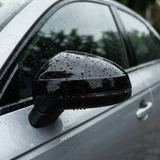
On a Polo GTI, restraint pays off. A well-proportioned hatchback spoiler, glossy black or carbon mirror caps, and extended paddle shifters are enough to sharpen the silhouette without going overboard.


From €69

From €69
View the Volkswagen GTI tuning packAll Volkswagen accessories
Other VW and Seat reliability guides
Still undecided between several models before signing? Find our other used car buying guides, written using the same method (known faults, critical mileages, maintenance budget, and real market value):
- used Volkswagen Golf 7 R reliability guide — 300 hp, 4Motion transmission, and DQ250/DQ381 DSG gearboxes.
- used Audi A3 8V, S3 and RS3 reliability guide — the entire A3 8V range, from the 1.4 TFSI to the RS3.
- used Mercedes A-Class W176 buying guide — the A45 AMG's civil base, cheaper to maintain.
- used Audi RS3 (8P/8V/8Y) reliability guide — the 2.5 TFSI 5-cylinder, the DQ500 S tronic, and carbon buildup.
- used Volkswagen Golf 6 buying guide — the civil base of the Golf 6 GTI and Scirocco R.
- used Audi A3 8P buying guide — the civil base of the 8P RS3.
- used BMW M135i and M140i buying guide — the 6-cylinder rear-wheel drive compared to four-wheel drive compacts.
- used Mercedes CLA C117 buying guide — the coupe sedan that serves as the base for the CLA45 AMG.
Verdict: should you buy a used Polo GTI in 2026 ?
Yes, provided you choose the right generation. That is the only real difficulty with this model, and it is entirely within your control: the risk is shown on the registration certificate and under the hood, not in chance.
The 6C 1.8 TSI with a manual gearbox is one of the best affordable sports car purchases on the French market. The AW 2.0 TSI is the most refined. The 9N3 is an endearing youngtimer. The 6R twincharger, however, is only justified with an impeccable mechanical history.
At the wheel, they all share the same asset: compactness and lightness that modern compacts have lost. On a winding road, a Polo GTI with the right tires remains a pleasure that is difficult to find elsewhere for this budget.
FAQ: your questions about the used Polo GTI
Is the Polo GTI reliable ?
It depends entirely on the generation. The 6C 1.8 TSI and AW 2.0 TSI versions are reliable. The 6R 1.4 TSI twincharger from 2010 to 2014, on the other hand, has both a timing chain problem and a risk of piston perforation.
What is the best generation of Polo GTI ?
The 6C from 2015 to 2017 with the 192 hp 1.8 TSI and six-speed manual gearbox. It combines a good engine, no mechatronic risk, and excellent driving pleasure.
Should you avoid the Polo GTI 6R ?
Not necessarily, but it requires a complete history. Without an invoice for the chain tensioner or a cylinder leak test, the financial risk is too high given the price of the car.
Is the Polo GTI DSG gearbox reliable ?
The DSG7 DQ200 dry 6R and 6C remains the weak point, with sensitive mechatronics. The DSG6 DQ381 wet-sump of the AW generation is significantly more robust, provided it is serviced every 60,000 km.
How much does a Polo GTI consume ?
Between 7.5 and 9.5 l/100 km in mixed use depending on the generation, about 6.5 l/100 km on the highway at legal speed, and up to 12 l/100 km in sporty driving.
What annual budget should you plan ?
Between €700 and €1,210 for 10,000 km per year, including maintenance, tires, brakes, and an unforeseen provision, excluding fuel and insurance.
What maximum mileage should you accept ?
On a 6C or an AW, 150,000 km with a good service history is not a problem. On a 6R, the question of mileage comes after that of history: a 90,000 km car without an invoice is riskier than a 140,000 km car that has been refurbished.
Is a Polo GTI suitable for a young driver ?
Yes, that is even one of its arguments. Its power remains within insurable limits, unlike a Golf R or an RS. However, check your insurance quotes before buying: rates vary enormously.
Polo GTI or Golf GTI used ?
For the same budget, the Polo GTI will be newer and have fewer kilometers, while the Golf GTI will be larger, faster, and more comfortable. If you often drive with several people or over long distances, the Golf remains more versatile.
Does the Polo GTI appreciate in value ?
The 6C with a manual gearbox and the 9N3 in very good condition have reached their floor and are stabilizing. The 6R without history continue to drop. Recent AW models still have depreciation ahead of them.
Can you remap a Polo GTI without risk ?
On a 6C or an AW in good condition, a careful remap with a suitable intercooler remains reasonable. On a 6R twincharger, it precisely stresses the already fragile components, and we advise against it.
What accessories to personalize a Polo GTI ?
The safe bets are the hatch spoiler, glossy black or carbon mirror caps, extended paddle shifters, and a quality steering wheel cover. Find the whole set in our Volkswagen performance accessories collection.
Personalize your Polo GTI
Once the right generation has been identified and the mechanical history validated, it is time for the fun part. The Polo GTI has a compact silhouette that responds very well to a few well-placed touches, without the need for a complete transformation.
Explore our dedicated selections: Volkswagen spoilers, Volkswagen mirror caps, Volkswagen paddle shifters, Volkswagen grilles, and Volkswagen steering wheels. Each reference is classified by model and generation to avoid any installation error.
Discover Volkswagen accessories
Frequent searches : used polo gti, used polo gti price, polo gti reliability, polo gti 6r problem, polo gti 1.4 tsi chain, polo gti 6c review, polo gti dsg problem, used polo gti 2.0 tsi, polo gti review, used polo gti Germany, used automatic polo gti, polo gti maintenance price, polo gti 180 hp review, best generation polo gti, polo gti or golf gti.
Recevez nos prochains guides en avant-première
Tutos pose, comparatifs aftermarket vs origine, sélection M Performance/AMG/RS, codes promos exclusifs.